
























![Kingdom Hearts Collection [I-III] Review](https://gazettely.com/wp-content/uploads/2026/10/Kingdom-Hearts-Collection-I-III-1-360x180.webp "Kingdom Hearts Collection [I-III] Review: KHII Holds Steady as Newer Entries Fluctuate 37")




The mythology of the American artist is built on a foundation of glorious, impoverished struggle followed by a sudden, explosive arrival. Terrestrial takes this myth and turns it into a horror story.
We meet Allen, a writer ostensibly living the dream in a Hollywood Hills mansion that feels less like a home and more like an architectural monument to someone else’s success. Into this sterile paradise arrive his college friends (the concerned ex-flame Maddie, her envious fiancé Ryan, and the irreverent Vic), ready to toast a book-and-movie deal that seems too good to be true.
It is. From the opening moments, Allen’s posture is one of profound discomfort. He moves through his own life like a trespasser, his forced smiles cracking under the weight of a secret. The film establishes not a whodunit, but a what-did-he-do, turning the Los Angeles landscape into a sun-drenched haunted house where the ghost is a lie waiting to be exposed.
Portrait of the Artist as a Young Fraud
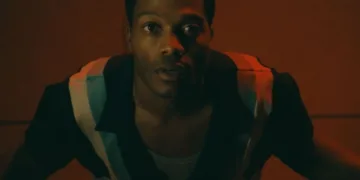
At the center of the film’s nervous breakdown is Jermaine Fowler’s performance as Allen, a man drowning in the deep end of his own fabrication. Fowler portrays Allen not as a master manipulator but as a panicked amateur whose every gesture screams impostor.

He embodies a uniquely modern condition one might call “success-panic,” a state of manic anxiety born from the constant, exhausting labor of pretending to have what you want. He rattles around the cavernous, impersonal spaces of the mansion, his attempts at playing the magnanimous host collapsing into barely-contained terror.
His friends, a well-calibrated trio of archetypes, serve as the catalysts for his unraveling. James Morosini’s Ryan is a pitch-perfect study in professional jealousy; his suspicion is not just journalistic, it is a form of validation for his own stalled life. Pauline Chalamet gives Maddie a conflicted warmth, her loyalty—a compound of history and pity—straining against the mounting evidence of a deep rot.
And Edy Modica’s Vic acts as the pragmatist, her comedic observations slowly souring as the weekend shifts from awkward to actively dangerous. Their strained interactions feel authentic to a friendship that has aged past its sell-by date.
The strangest feature of the house is a shrine to SJ Purcell, an obscure sci-fi author. With its dog-eared paperbacks and cheesy VHS tapes on a loop, this is Allen’s secular altar. It is a regression, a retreat into an adolescent ideal of success that he, as a failed adult, cannot replicate.
Genre Soup for the Post-Truth Soul
Director Steve Pink approaches the story with a kind of structural restlessness. After establishing the central mystery with commendable patience, the screenplay by Connor Diedrich and Samuel Johnson abruptly rewinds to show us exactly how the grift was constructed.

This choice is a significant gamble; it sacrifices the tension of the unknown for the dramatic irony of the inevitable. We are no longer asking if the lie will collapse, but when, and how spectacularly. By showing its hand, the film forces the audience into a position of uncomfortable complicity; we are now in on the deception, watching the earlier scenes with the grim knowledge of the rot beneath the floorboards. The film mixes dark comedy, psychological thriller, and industry satire into a concoction that is sometimes jarring.
The whiplash between a scene of quiet, simmering psychological tension and a moment of outright, almost slapstick, absurdity feels intentional, mirroring the fractured way we consume media. One minute we are diagnosing a character’s pathology, the next we are watching clips of The Neptune Cycle, Allen’s beloved low-budget sci-fi show. This fiction-within-the-fiction is the movie’s sincere, beating heart.
Its scrappy, handmade quality represents the pure artistic dream Allen has corrupted. It is the authentic artifact in a world of perfect fakes, a relic of a passion that has since curdled into a dangerous obsession.
The High Cost of Being Somebody Else
The final act descends into a frenzied, bloody spectacle, a Rube Goldberg machine of bad decisions where the farcical premise collapses into clumsy, desperate violence. This is where the movie makes its sharpest point about the modern condition.

Allen’s predicament is a grotesque exaggeration of the pressure to curate a successful life for public consumption, a phenomenon that has migrated from Hollywood to every smartphone screen. His belief that he can construct a new reality through sheer force of will is a microcosm of a larger cultural delusion.
His jealousy is not just wanting what someone else possesses, but wanting to be them—to erase their identity and claim it as his own. The film leaves the audience in a difficult, challenging position. As his lies lead to graver consequences, any pity we might have felt for him curdles into cold distaste.
Terrestrial refuses to grant Allen absolution or the comfort of a redemption arc, a bold choice in an age that often demands clear heroes. By the end, we are fully alienated from him, forced to confront the ugliness of his ambition without any emotional release. The final message is bleak and uncompromising: the fantasy is a predator, and if you invite it into your home, it will eventually consume you whole.
Full Credits
Director: Steve Pink
Writers: Connor Diedrich, Samuel Johnson
Producers: Luca Balser, AJ Bourscheid, Molly Conners, Austin Lantero, Josh Jason, Molly Gilula, Rachel Walden, Pauline Chalamet, Ramfis Myrthil
Executive Producers: Julia Frey, Kurt Frey
Cast: Jermaine Fowler, James Morosini, Pauline Chalamet, Edy Modica, Rob Yang, Brendan Hunt
Director of Photography (Cinematographer): Tom Hernquist
Editors: Neal Wynne
Composer: James McAlister
The Review
Terrestrial
A bleak and intellectually ambitious satire, Terrestrial expertly dissects the modern obsession with performative success. While its structural gambles and punishingly unlikable protagonist make for an alienating experience, the film remains a sharp, unsettling commentary on the high cost of chasing a fantasy. It is a work more easily admired for its bitter insights than enjoyed for its story.
PROS
- Jermaine Fowler’s central performance compellingly captures a man consumed by the anxiety of his own fraud.
- A sharp and intelligent satire of modern ambition, professional jealousy, and impostor syndrome.
- Strong thematic depth that connects effectively to the pressures of the social media era.
- Effective use of its single location to build a tense, claustrophobic atmosphere.
CONS
- The protagonist becomes so thoroughly unlikable that it makes an emotional connection nearly impossible.
- Jarring tonal shifts between psychological thriller, dark comedy, and satire can feel disjointed.
- The narrative’s flashback structure risks deflating the central mystery and suspense.
- Its relentlessly bleak tone makes for a punishing, often unpleasant, viewing experience.







