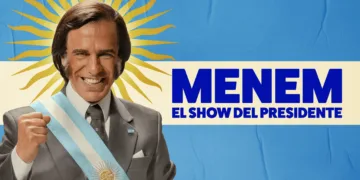

























Menem: The President Show is a fictionalized chronicle of Carlos Menem, the flamboyant and divisive figure who dominated Argentine politics. The series recounts his improbable ascent from provincial governor to the nation’s highest office during the turbulent late 1980s.
This is not a staid political history. It is a high-energy dramedy that views a nation’s fate through a pop-culture lens, approaching its subject with a cocktail of humor, absurdity, and kinetic force. The narrative drops viewers into a period of national desperation, with hyperinflation gutting the economy and the public hungry for a savior.
Menem emerges as that unconventional figure, a populist who understood that raw charisma could be a potent political tool. The show immediately frames its central subject as a master seducer, a man who courted the masses with the same flair he applied to his personal life, blurring the line between political leadership and pure spectacle.
Embodying an Era
The series builds its world on the shoulders of Leonardo Sbaraglia’s transformative performance. His Carlos Menem is a creature of pure political will, a physical creation brought to life through meticulous makeup and carefully studied mannerisms.
Sbaraglia captures the duality at the heart of Menem’s power: the irresistible public charm of a man who could connect with any voter, coexisting with a sharp, unscrupulous ambition. He is at once magnetic and arrogant, projecting a belief in his own destiny that feels both ridiculous and utterly convincing.
The performance conveys the essence of Menem’s appeal, sidestepping perfect mimicry of his regional accent to instead capture the spirit of a political seducer. He embodies the schmoozing, the dramatic entrances, and the stubborn insistence on his signature sideburns—all elements of a carefully cultivated persona.
As his wife, Zulema Yoma, Griselda Siciliani provides a formidable and necessary counterweight. Her portrayal is a masterclass in controlled fury, showing a woman who refuses to be a decorative political prop. Their on-screen relationship is a volatile storm of personal betrayal and political negotiation.
The script gives her agency beyond that of a scorned spouse; she is a shrewd political operator in her own right, demanding a role in his decision-making and offering sharp, unsolicited advice on cabinet appointments. Her ambition is a different vintage from her husband’s—quieter, perhaps more tactical, but just as potent.
Around this central couple, the supporting cast operates in a heightened reality. Key figures like the Minister of Economy, Domingo Cavallo, are presented as bold caricatures, their complexities flattened into a battle of egos. This is a deliberate choice, creating a coherent, slightly ridiculous world where politics is a stage for outsized personalities. The fictional character of Olegario Salas, the photographer, serves as the audience’s initial guide.
His journey from a cynical observer to a member of the inner circle is meant to mirror the nation’s own captivation with Menem. Yet, the introduction of his family subplot feels like a narrative misstep, a forced attempt to graft a conventional moral compass onto a story that thrives on the ambiguity of its cynical, power-hungry world.
A Ferrari Ride Through History
The identity of Menem is forged in its aesthetic. Director Ariel Winograd, drawing from a background in comedy and music videos, gives the series a distinct, breathless rhythm. The narrative moves with the speed and adrenaline of a Ferrari, a metaphor made literal by Menem’s own infamous automotive gift.

The editing is a dizzying flurry of rapid cuts, stylistic montages that compress entire political campaigns into minutes, and jarring on-screen graphics that introduce the flawed players in this political theater. At times, characters break the fourth wall, directly addressing the audience and shattering any pretense of traditional historical drama. This is a story told with a modern, almost restless, visual grammar.
This frantic energy is matched by a saturated, pop-art visual style. The photography uses dramatic light and shadow to paint a moral picture of the 1990s, creating a world of glamorous surfaces that barely conceal an underlying decay.
The production design is immaculate, recreating the era through its fashion, cars, and architecture with a precision that borders on fetishistic. The result is a portrait of the period that feels both nostalgic and deeply critical. The soundtrack is an active participant in this project, using period-specific songs to comment on the action, often with a sharp sense of irony.
The show’s aesthetic is its argument. Form is not merely a vehicle for content; it is the content. By presenting grave matters of state with the same slick, fast-paced gloss as a presidential affair, the series makes a profound statement.
This stylistic flattening mirrors the political culture it depicts, a culture that prized forward momentum and dazzling spectacle above all else, leaving little room for quiet contemplation of the consequences. The refusal to slow down is not a flaw in the storytelling; it is the central thesis.
History as Montage
The series is thematically obsessed with the power of the image. The character of Olegario Salas, the photographer, is the living embodiment of this fixation. Through his lens, the show explores the very mechanics of how a modern political persona is constructed. An old idea suggests that to destroy a pernicious image, one must destroy its physical medium.

Here, the opposite is true: the medium of television and photography is what creates the president. Salas does not merely capture Menem’s likeness; he helps invent it, famously encouraging the leader to maintain his iconic look against the advice of handlers who wanted a more polished politician.
This dynamic raises questions about control: does the power lie with the subject or with the one who crafts the image? Salas himself becomes a beneficiary of this proximity to power, his own fortunes rising alongside Menem’s, a subtle commentary on the enrichment of those who attached themselves to the government in the 1990s.
This focus on surface and image comes at a cost. The show chronicles a checklist of watershed historical moments—the controversial pardons for military leaders, the implementation of the convertibility plan, the devastating terrorist attacks—but it treats them as items in a frantic montage rather than events with deep, painful roots.
The pardons are explained away as a necessary step for governability, a political calculation devoid of its moral weight. The economic policies are discussed in terms of monetary stabilization, with their catastrophic social impact left largely off-screen. History becomes a series of spectacular moments, snapshots in a photo album rather than a connected, causal chain.
The narrative reflects the very culture it portrays, mirroring the surface-level frivolity of the era instead of exploring its darker undercurrents. Its main argument is that politics, in this time and place, transformed into a form of mass entertainment, a spectacle for a nation. The series portrays a populist who understood that power was a performance, and it uses its own spectacular form to tell that story.
“Menem: The President Show” is a political drama series that premiered on Prime Video on July 9, 2025.
Full Credits
Director: Ariel Winograd, Fernando Alcalde
Writers: Mariana Levy, Federico Levin, Luciana Porchietto, Silvina Olschansky, Guillermo Salmerón
Producers: Mariana Aceves, Rob Cubero, Adrian Grunberg, Stacy Perskie, Mario Savino, Pamela Toro Moreno, Brian Grazer, Ron Howard, Pamela Toro
Executive Producers: Mariano Kohan
Cast: Leonardo Sbaraglia, Juan Minujín, Griselda Siciliani, Jorgelina Aruzzi, Marco Antonio Caponi, Cumelén Sanz, Alberto Ajaka, Violeta Urtizberea, Campi
Editors: Dante Perini, Andrés Quaranta, Pilar Gonzalez
The Review
Menem: The President Show
A stylish and kinetic portrait, Menem: The President Show succeeds brilliantly as an aesthetic statement and a character study of populist power. Propelled by strong performances and audacious direction, it captures the dizzying spectacle of the era it depicts. Its deliberate choice to favor form over substance makes it a fascinating, if intentionally shallow, look at the politics of image, reflecting the dazzling surface of its subject while leaving the deeper historical consequences just out of frame. It is an entertaining and visually stunning ride.
PROS
- A powerful and transformative central performance from Leonardo Sbaraglia.
- Excellent supporting performance by Griselda Siciliani as a formidable Zulema Yoma.
- A distinct, high-energy directorial style that is both immersive and exciting.
- Superb production design, costumes, and use of music that effectively recreate the 1990s.
- Functions as a sharp critique of image-making and politics as spectacle.
CONS
- Major historical events are treated superficially, lacking deep analysis of their impact.
- Most supporting characters are portrayed as one-dimensional caricatures.
- The fictional subplot involving the photographer's family feels underdeveloped and emotionally thin.
- The relentless pace and focus on aesthetics may feel hollow to viewers seeking historical depth.