

















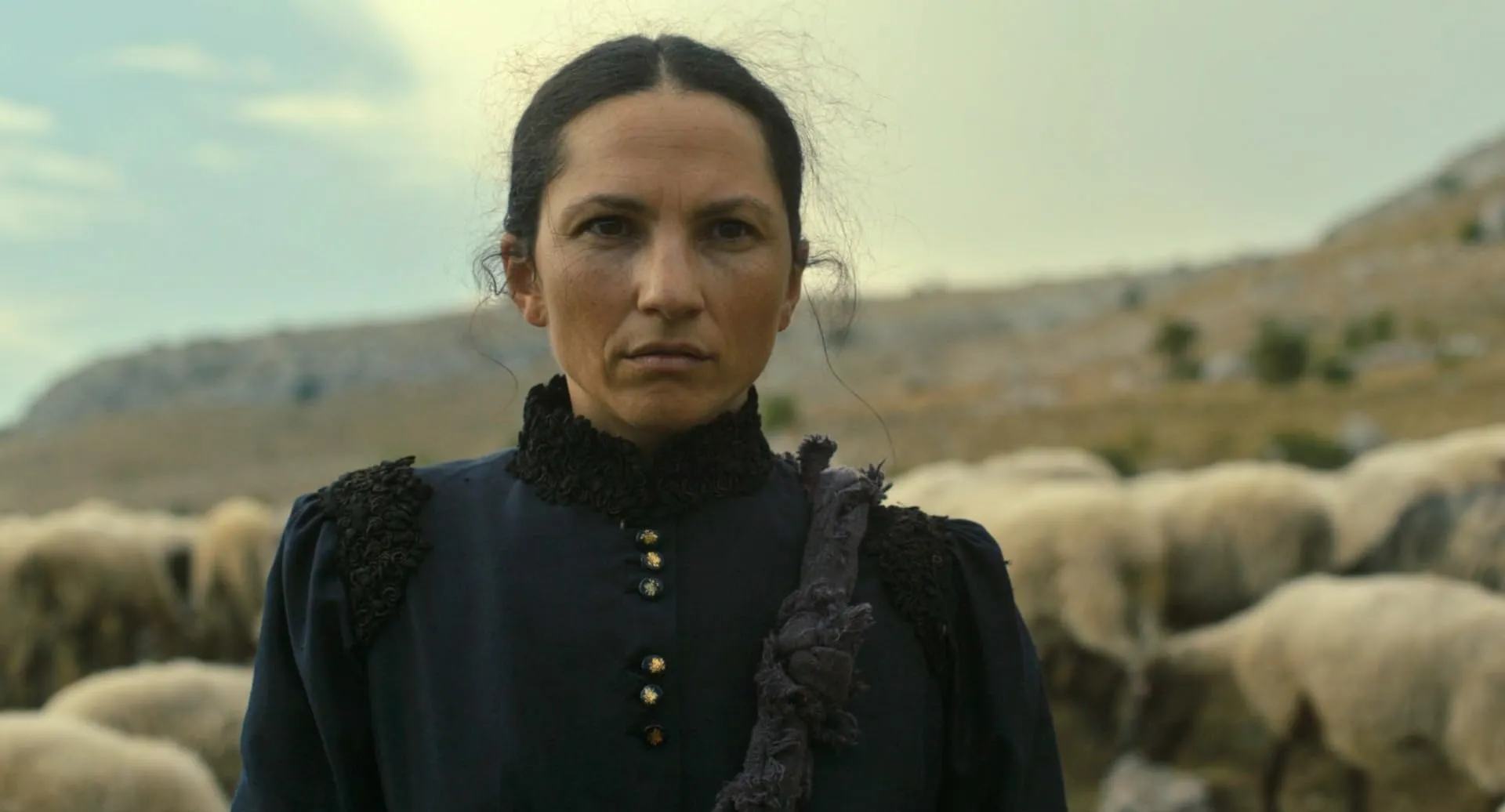

A woman appears as a dark tear in the fabric of the landscape. She is Teresa, a Chilean apparition in funereal black, walking into the raw, windswept Croatian mountains at the dawn of the 20th century. In her hands, she carries the brittle relics of a man: the bones of her husband, Marko.
She seeks his family, a remote shepherd clan living a life carved from stone and tradition. She brings a story they cannot understand, for her tongue speaks only Spanish in a land that knows only its own dialect.
The air is immediately thick with suspicion, a silence that is not empty but filled with the weight of what cannot be said. Hana Jušić’s God Will Not Help begins here, in this chasm between worlds, establishing a bleak and potent study of human isolation.
The Grammar of Bone and Gesture
The film strips its characters of language to see what remains, asking a profound question: when the edifice of vocabulary collapses, what foundation of truth is left? Communication becomes a primal, precarious act, a desperate translation of intent through the crude iconography of an illustrated prayer book or the faded portraits on a family quilt.
In this quiet, Hana Jušić examines how confession finds its most honest voice in the ear of one who cannot judge, how intimacy can be forged in the strange crucible of mutual incomprehension. Teresa herself is a void, a human Rorschach test into which the family pours its own nature.
For the marginalized sister Milena, treated like dirt by her own kin, she is a silent anchor, a fellow outcast whose presence offers an unspoken solidarity. For the grasping younger brother Nikola, she is a simple equation of flesh and land, a means to an inheritance.
For the pious patriarch Ilija, a failed priest, she is a far more complex torment. He sees in her a sister in Christ, yet her foreignness awakens a carnal desire that threatens his carefully constructed sanctity.
Manuela Martelli’s performance is a marvel of ambiguity; her Teresa is a figure of devout suffering, yet a current of manipulative wildness runs beneath her placid surface. She is a catalyst whose presence does not create conflict so much as reveal the fractures already present in this patriarchal bedrock.
Echoes in the Stone and Static
The world of this film is one of elemental truths, captured by Jana Plećaš’s stark, patient cinematography. Vast, indifferent mountains pin the human figures to their slopes, their western-like grandeur reducing personal dramas to the scale of insects. This Malickian use of landscape suggests a silent, divine witness that offers no comfort, only perspective on human fragility.

These agoraphobic vistas are then contrasted with the suffocating darkness of the family’s stone huts. Here, the camera finds a claustrophobic tension where the night is a physical presence, barely held back by the lonely flicker of a single torch. This visual language speaks of exposure and confinement, of being lost in the open and trapped within the home.
This austere beauty is unsettled by a brilliantly anachronistic synth score, a soundscape that pulses with the sweeping, electronic tones of Vangelis or Tangerine Dream. It is the sound of Teresa’s otherness, the hum of a modernity and internal chaos that has breached the walls of this ancient place.
The music functions as her unspoken interiority, the persistent, static-laced frequency of a past and a guilt that cannot be translated into the local tongue. It is the film’s own unsettling psychological heartbeat.
The Slow Sacrament of Guilt
The film’s pace is a deliberate, measured ritual, rejecting the rush of conventional narrative for something closer to a sacrament. It moves with the unhurried gait of a shepherd or the slow recitation of a prayer, demanding the viewer’s patience as an act of bearing witness.
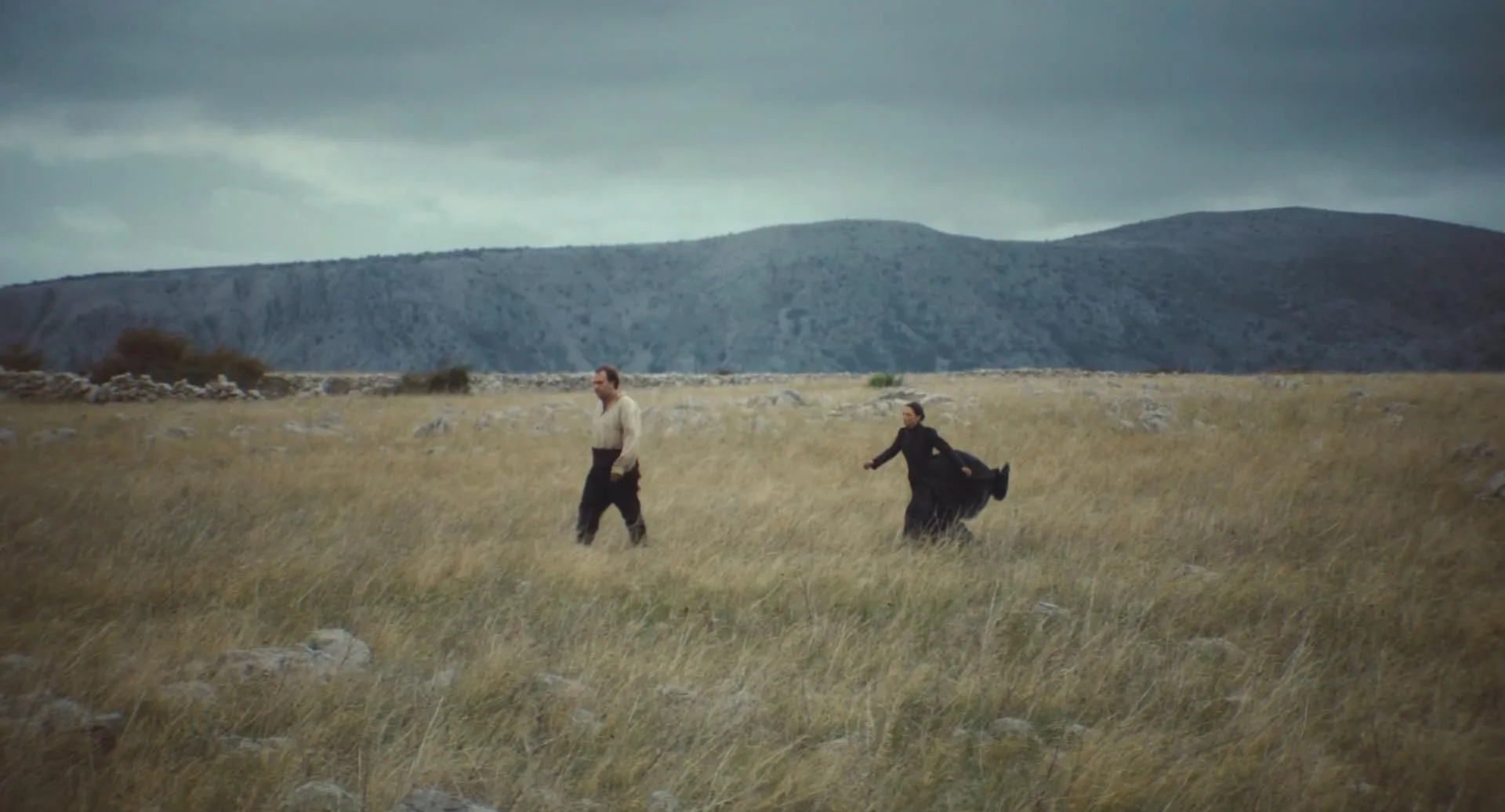
This is not a story that races toward resolution; it is a deep immersion in a state of being, an atmosphere thick with unspoken history and unresolved sin. Jušić allows the silence to stretch, forcing us to watch, to listen to what is not being said, and to feel the immense weight of the past that these characters carry like stones in their mouths.
This deliberate pacing gives the performances their devastating power. The actors must convey entire histories through their weary bodies and the guarded expressions in their eyes. Manuela Martelli, in particular, carries the film’s central mystery in her haunted gaze.
God Will Not Help is a demanding experience, a bleak meditation on faith and defiance in a world where salvation must be earned from the earth, not the heavens. It offers no easy answers, rewarding a patient viewer with a profound and unsettling resonance that smolders long after the final frame.
“God Will Not Help” is a drama film directed and written by Hana Jušić. It premiered at the 78th Locarno Film Festival on August 8, 2025. The film also competed in the Competition Programme – Feature Film at the 31st Sarajevo Film Festival. It’s a Croatian-Italian-Romanian-Greek-French-Slovenian co-production.
Full Credits
Director: Hana Jušić
Writers: Hana Jušić
Producers: Ankica Jurić Tilić
Cast: Manuela Martelli, Ana Marija Veselčić, Filip Đurić, Mauro Ercegović Gracin, Nikša Butijer
Director of Photography (Cinematographer): Jana Plećaš
Editors: Jan Klemsche
Composer: Stavros Evangelou, Iris Asimakopoulou, Vasilis Chontos
The Review
God Will Not Help
A challenging and deliberately paced descent into a world stripped of language, God Will Not Help is a masterful exercise in atmosphere. It rewards the patient viewer with a profound, unsettling meditation on faith, guilt, and the spaces between words. Supported by a haunting score and stark cinematography, the film is a potent, if demanding, piece of existential cinema that lingers like a chilling whisper. It is a work of filmmaking that trusts silence over spectacle.
PROS
- Deeply atmospheric and mysterious tone
- Stunning, painterly cinematography
- Powerful, nuanced central performance
- Unique and highly effective anachronistic score
- Rich thematic exploration of communication and faith
CONS
- Deliberately slow pacing may alienate some viewers
- A long runtime that feels repetitive at times
- Some supernatural scenes can feel heavy-handed
- Bleak tone might be too demanding for some