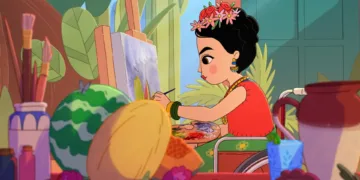



















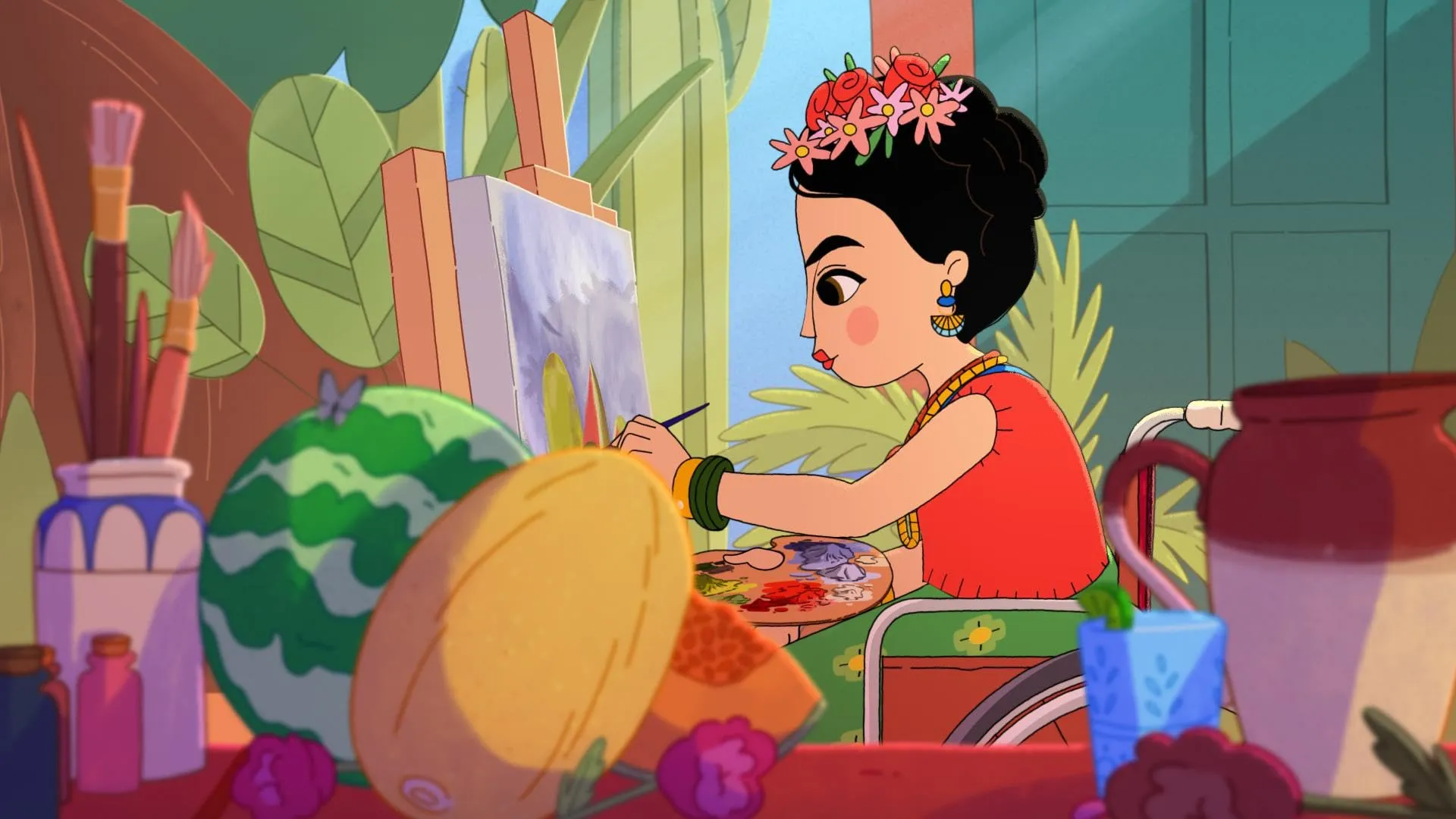

An adult woman in a wheelchair opens a notebook filled with childhood sketches. This is the entry point into Hola Frida, an animated biography that chooses not to monumentalize its famous subject but to return her to the lesser-known years of her youth.
The film, adapted from the picture book Frida, c’est moi, sidesteps the storms of Frida Kahlo’s adult life. Instead, it offers a portrait of a six-year-old girl in Coyoacán who loves to draw, dreams of becoming a doctor, and plays with her friends and family.
The central drama arises from her bout with poliomyelitis, the first great physical trial that would come to define her existence. By focusing on this formative period, the film presents an accessible, reimagined history. It is a story that prioritizes a child’s imaginative capacity for perseverance over the raw, complicated pain that fueled the artist’s later work.
Visions in Crayon
The film’s visual language operates on two distinct planes. Its primary world is rendered in a simple, two-dimensional style that directly echoes its storybook origins. Characters are defined by large, round heads and clean lines, set against brightly colored yet modestly detailed backgrounds.
In many shots, only a few elements move, a technique that could feel static if not for a camera that is always sliding and soaring through the illustrated vistas. This aesthetic is well-suited to its young target audience, creating a world that is welcoming and easy to parse.
The choice to use animation liberates the narrative from the demands of physical likeness that constrain live-action biopics, allowing it to invent and fabulate. The animation truly finds its voice, however, in the sequences depicting Frida’s subconscious.
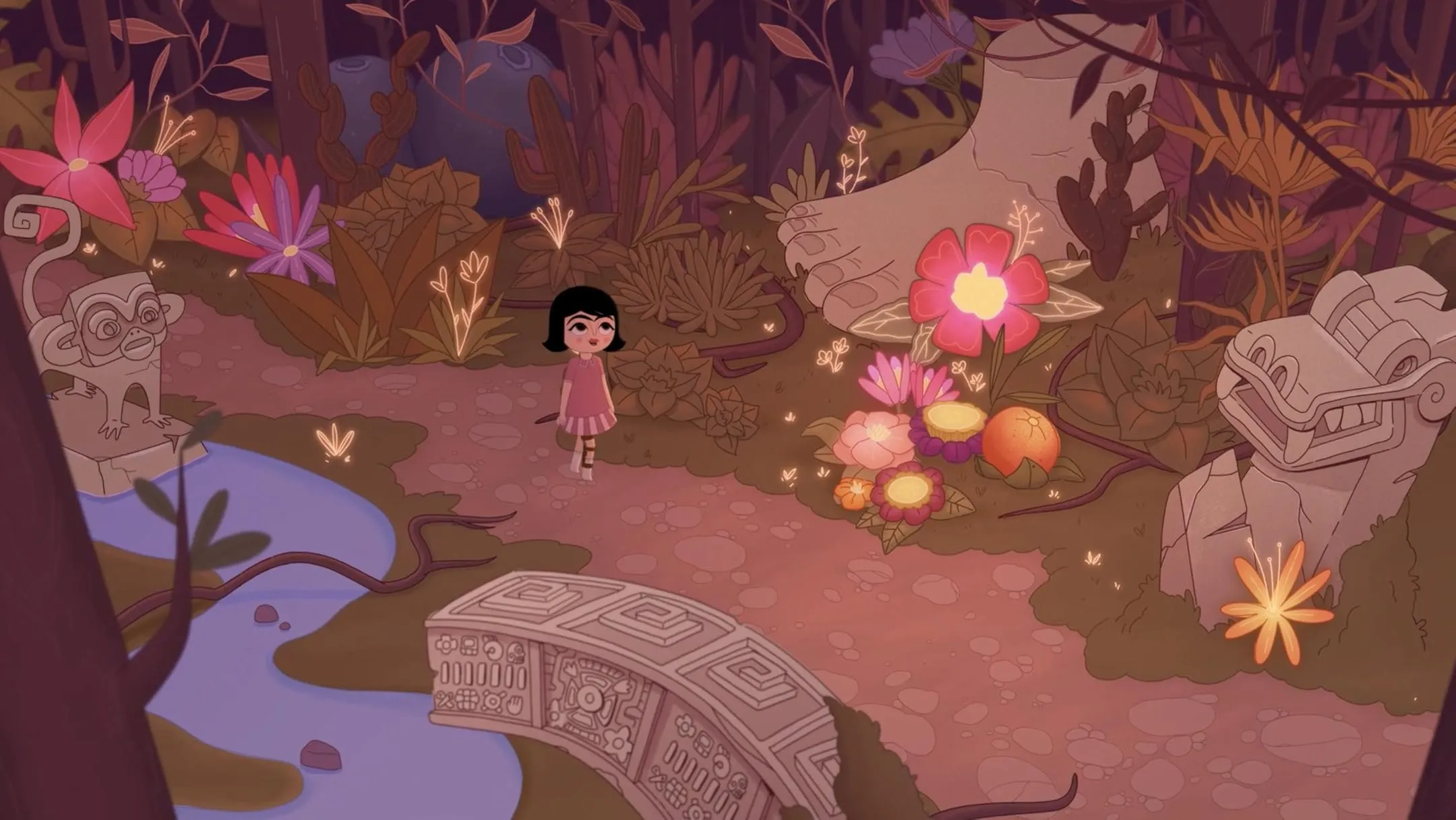
During her illness-induced dreams, the style shifts, becoming more surreal and symbolically dense. Here, the imagery borrows from Kahlo’s artistic universe without directly imitating her paintings. We see spider monkeys and xoloitzcuintles, impossible skies with both the sun and moon present, and ancient temples rising from lush foliage.
These are the early seeds of her artistic vocabulary. We see La Catrina, a strangely maternal personification of death, and an idealized “other Frida,” healthy and confident. These visions, rich with Zapotec cultural symbols, demonstrate how animation can effectively visualize the inner life of an artist whose work was a direct translation of her own vivid imagination.
A Dialogue with Mortality
The narrative confronts Frida’s polio and its aftermath, showing her weakened leg and the cruelty of a schoolyard bully. Yet the film packages this suffering within a determinedly uplifting framework, at times raising questions about its simplification of genuine hardship. Her recovery is presented through a training montage that channels her defiance into a familiar trope of athletic triumph.
Her pain becomes the impetus for a new goal: strengthening her leg to compete in a roller-skating race. This approach risks trivializing the ordeal, but the story is deepened by its forays into more mature territory. Frida’s subconscious encounters with death are the film’s most compelling feature. The personification of Death, La Catrina, is not a frightening villain but an alluring, almost maternally concerned figure who believes it is Frida’s time.
She does not merely endure her illness; she actively bargains with this entity, demanding more time among the living. This dialogue elevates the film beyond a simple message of self-belief. It introduces a sophisticated, culturally specific view of mortality.
The appearance of her healthy doppelgänger, a guide with orange irises who possesses the confidence Frida lacks, further complicates the narrative. This internal conversation establishes a sense of duality that prefigures Kahlo’s lifelong artistic exploration of her fractured self, most famously in “The Two Fridas.” The film attempts a delicate balance, presenting these weighty ideas in a form simple enough for children to grasp.
An Icon Distilled
Hola Frida weaves cultural and historical threads into its story with a light touch. Frida’s Zapotec heritage is explained by her mother in a lesson that connects her to a strong, Indigenous lineage. Faint echoes of the Mexican Revolution are heard in the streets, and she finds a real-world role model in Matilde Montoya Lafragua, Mexico’s first female doctor.
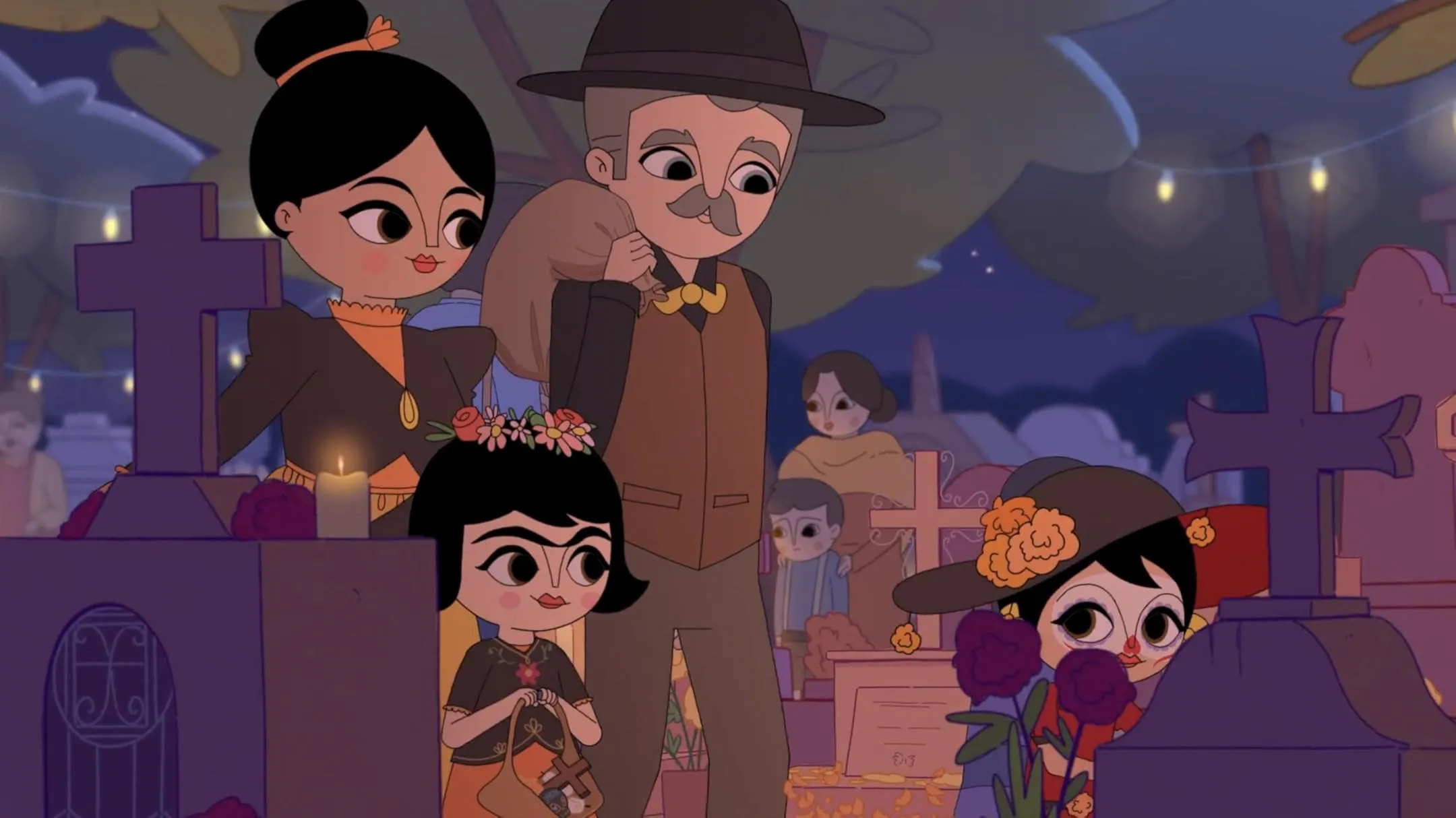
This context adds texture without becoming a heavy-handed history lesson. The English-language version’s use of “Spanglish” is a more awkward choice. Spanish words are sprinkled into English dialogue and then often repeated for the benefit of non-bilingual viewers. This pedagogical method, reminiscent of “Dora the Explorer,” compromises the film’s sense of authentic place, a clear concession to a wider market at the expense of cultural immersion.
Framed by the adult Frida’s reverie, the narrative jumps forward near its end to include her devastating tram accident, another trial she must face. Ultimately, the film succeeds as an agreeable and handsome introduction to the artist.
It offers a sanitized account of a complex life. It presents Frida as an everyday child who transforms her challenges into creative fuel, a portrayal that makes her eventual greatness feel relatable. In offering a delicate and thoughtful story against a media landscape saturated with louder productions, it positions the artist’s beginnings as a quiet act of resistance.
“Hola Frida” is a Canadian and French co-production, aimed at children and families. It was released in France in February 2025 and in Quebec and Spain in the spring of 2025. It premiered in the U.S. at the New York International Children’s Film Festival and is scheduled for a limited theatrical run in the U.S. starting August 8, 2025, courtesy of Level 33 Entertainment.
Full Credits
Directors: Karine Vézina, André Kadi
Writers: Sophie Faucher, Anne Bryan, André Kadi
Producers: Marie-Michelle Laflamme, Florence Roche, Johanne Champagne, Karine Vézina, Sarah Lalonde, Sophie Faucher
Executive Producers: Jean-François Latour, Joël Thibault
Cast: Emma Rodriguez, Layla Tuy-Sok, Olivia Ruiz, Angela Galuppo, Annie Girard, Holly Gauthier-Frankle, Léo Côté, Lucinda Davis, Marcel Jeannin, Eleanor Noble
Director of Photography (Cinematographer): Pierre-Alexandre Comtois
Editors: Elric Robichon, Catherine Bouffard
Composer: Laëtitia Pansanel-Garric
The Review
Hola Frida
A gentle and visually charming animated feature, Hola Frida offers a worthwhile introduction to the iconic artist for young viewers. Its strength lies in the imaginative dream sequences that explore complex themes of mortality and identity with surprising depth. While the film successfully captures a spirit of creative resilience, its sanitized narrative and awkward "Spanglish" dialogue present a simplified portrait of a profoundly complex life. It is an agreeable, if not essential, primer.
PROS
- Visually appealing animation, particularly in the surreal dream sequences.
- Makes difficult subjects like illness and mortality accessible to a young audience.
- Serves as a gentle and effective introduction to the life and world of Frida Kahlo.
- Successfully captures a sense of imaginative defiance and resilience.
CONS
- Presents a sanitized and oversimplified version of Kahlo's suffering.
- The "Spanglish" dialogue in the English dub feels artificial and can detract from the setting's authenticity.
- The uplifting tone sometimes minimizes the severity of the challenges Frida faced.