

























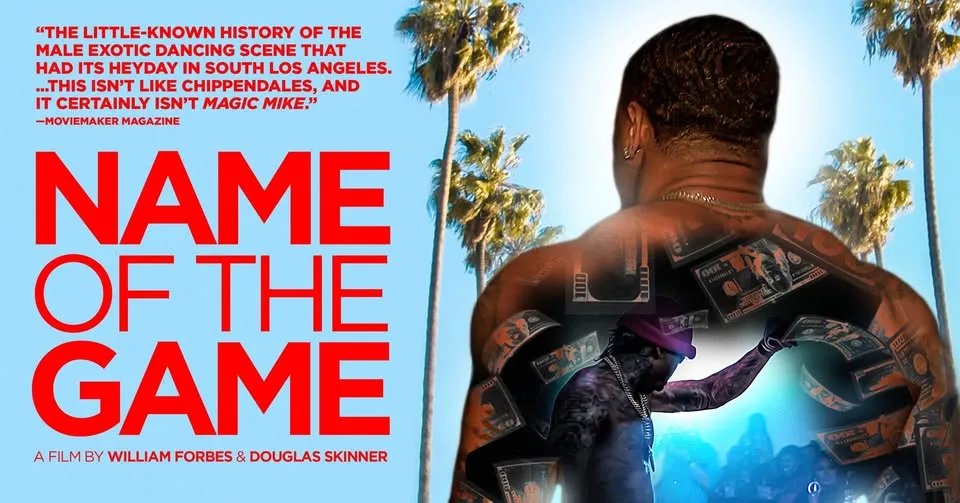

The male body as spectacle is hardly new territory. It is a polished, shrink-wrapped commodity in the cultural marketplace. The documentary Name Of The Game, however, is not interested in that product. Directors William Forbes and Douglas Skinner instead excavate a specific, unlit corner of history: the Black male exotic dance scene that pulsed through South Los Angeles from the late 1980s into the new millennium.
Their camera does not capture a sanitized performance; it functions as an archival tool, documenting a subculture born of necessity and defiance. This is a historical record of a world that operated entirely outside the mainstream gaze, and the film approaches it with the unfiltered candor of a key witness. It is less a movie, more a testimony.
A Scene Apart
The narrative architecture of this scene was built on a foundation of exclusion. The film makes it plain that the commercial stripping industry of the era, epitomized by Chippendale’s, operated with a rigid racial logic. Its aesthetic was one of clean, almost sterile, uniformity.

Black performers, if present at all, were accessories used to add a dash of perceived danger, never the main event. In this starkly lit landscape of limited opportunity, a parallel economy emerged not just from desire but from necessity. Black-owned clubs like The Right Track and The Boom Boom Room became the centers of a self-contained universe.
The documentary’s visual language emphasizes this division. It juxtaposes the slick, promotional material of the mainstream with grainy, handheld footage from within these clubs. The sound design tells a similar story; the polite applause of a theater is replaced by a cacophony of shouts and participatory energy. This was not a passive viewing experience.
It was a visceral, interactive environment. In a noir sense, this was about territory. The creation of these spaces was an act of claiming cultural and economic ground. The film presents this development not as a political statement but as a pragmatic response to a market failure.
These venues provided a stage where the desires of a specific audience, primarily Black women, were the sole focus. The performance itself was transformed, shedding choreographed routine for something more immediate and authentic.
The Perilous Contract
The film’s existential core lies in the lives of the dancers themselves, men who fit the mold of the classic noir protagonist. Their choices were rarely made in a vacuum, often framed by the institutional walls of a prison or the invisible ones of poverty. With such pathways leading directly to the stage, the notion of free will becomes a murky philosophical question.
The profession offered a precarious salvation, a way to earn thousands in a night while navigating a world of profound moral ambiguity. This influx of cash, a powerful destabilizing force for men conditioned by a scarcity mindset, often became its own kind of trap. The directors wisely avoid moralizing, presenting the ethical contradictions with a documentarian’s detachment.
The audience is made a voyeur to these complex lives. The film probes the psychological toll of the work. Is the on-stage persona a disposable mask or a second self that slowly consumes the original? The documentary confronts the scene’s darkest facet: the internalized misogyny that could erupt into violence against the very women whose desire fueled their careers.
This brutal reality exists alongside the ethos of a performer like Hena C, who viewed success as an act of genuine connection and appreciation. The camera holds steady during interviews discussing these contradictions, forcing the viewer to search the men’s faces for answers the film refuses to provide. One man’s art was another’s transaction. One man’s liberation was another’s cage. The film offers no simple answer.
Form Follows Function
The documentary concludes its examination by following the dancers into their present lives, where the stage lights have long since faded. The film’s editing structure here is crucial, cutting between the vibrant, chaotic past and the quiet, reflective present.
This juxtaposition creates a powerful sense of temporal dislocation. The trajectory of Featherstone Brewer, once known as XTC, from stripper to preacher is presented without irony. It is a character arc that resists simple interpretation.
Is it a story of redemption or a lateral move from one form of public ministry to another? A wry question the film leaves hanging in the air. Brewer himself expresses no regret, viewing his past profession as the means that allowed him to put his daughter through college. The choice was practical, its morality judged by its outcome.
This pragmatic perspective is mirrored in the film’s own construction. The production is intentionally raw, devoid of polished cinematography or slick editing. The lighting seems sourced from the locations themselves, the camerawork is often handheld, and the interviews feel more like conversations than formal cinematic events.
Any other aesthetic would feel like a betrayal, an attempt to impose a clean narrative arc onto messy, unresolved lives. A more polished film would have offered judgment or resolution. This documentary’s power lies in its refusal to do so. The unvarnished style is the only one that could honestly capture the grit and authenticity of this underground history.
Name of the Game (2023) was released in the United States on May 27, 2023.
Full Credits
Director: William Forbes, Douglas Skinner
Writers: William Forbes, Douglas Skinner
Producers and Executive Producers: EBE Productions, Glass Slipper Pictures
Cast: Russell Anthony, Kenny Blyth
The Review
Name Of The Game
Name Of The Game operates as a vital piece of cultural archeology. It is an unflinching and necessary document, capturing a forgotten chapter of social history with the candor it deserves. The film’s power is in its refusal to moralize or polish its subjects, instead presenting their complicated lives through a raw aesthetic that perfectly matches the material. It is less a piece of entertainment and more an essential testimony, valuable for its historical insight and its sober examination of the intersection between race, economics, and desire.
PROS
- Functions as a vital historical record, uncovering a largely forgotten subculture.
- Offers an honest and direct look at complex themes of moral ambiguity and socioeconomic pressure.
- The raw, unpolished filmmaking style effectively serves the authenticity of the subject matter.
- Provides deep insight into the lives and motivations of its subjects without passing judgment.
CONS
- The unvarnished, low-fidelity production quality may not appeal to all viewers.
- Its narrative structure avoids clear resolutions, which could be frustrating for some.
- The specific and gritty subject matter might limit its accessibility to a broader audience.