

























![Kingdom Hearts Collection [I-III] Review](https://gazettely.com/wp-content/uploads/2026/10/Kingdom-Hearts-Collection-I-III-1-360x180.webp "Kingdom Hearts Collection [I-III] Review: KHII Holds Steady as Newer Entries Fluctuate 37")



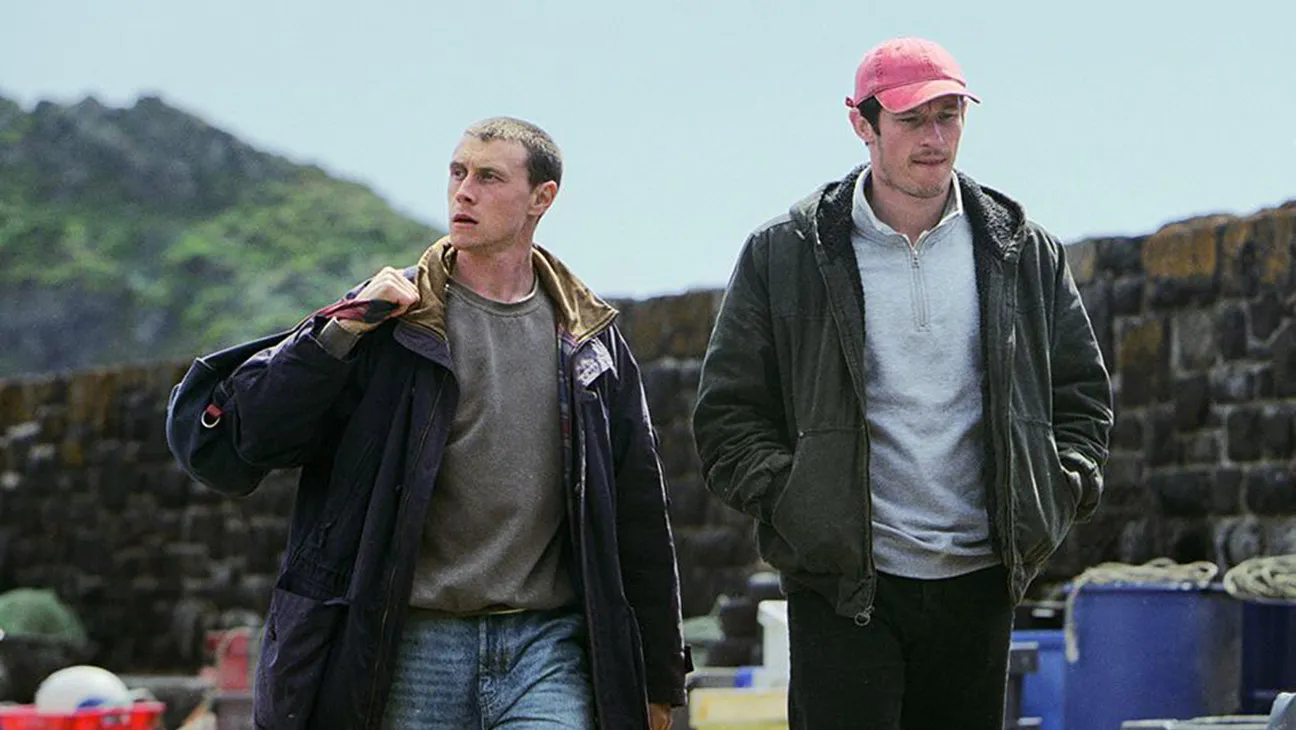

A boat named the Rose of Nevada bobs innocuously in the harbour, its sudden appearance a quiet tear in the fabric of a depressed Cornish fishing town. Rust stains the landscape, and a sense of decay hangs in the salt air. This vessel, lost to the sea with all its crew thirty years ago, has returned without explanation.
Its reappearance offers a sliver of possibility in a place that has forgotten what hope looks like. Two young men are drawn to its mystique. Nick, played by George MacKay, is a local father whose struggle to provide for his family is etched onto his face.
He collects groceries from a food bank while his home crumbles around him. Into this world drifts Liam, a restless outsider portrayed by Callum Turner, possessing a casual confidence that feels alien here. Against all logic, a plan is hatched to put the ghost ship back to work, a desperate gamble that the tide of fortune might turn with it.
The Texture of a Dream
To watch a Mark Jenkin film is to submit to a complete sensory takeover. Rose of Nevada is captured on grainy 16mm film, its images scratched and worn as if the celluloid itself were a relic salvaged from the seabed. These imperfections are not flaws but intentional textures, giving the film a physical history and the authority of a found object.
The claustrophobic, boxy frame traps the characters in their world, while the colors bleed with a vivid, super-saturated intensity that recalls aged home movies. The visual language suggests a faded document from a half-forgotten era. This effect is amplified by the soundscape, a masterclass in disorientation.
All dialogue and ambient noise are layered onto the film in post-production, creating a subtle but persistent disconnect between action and sound that feels profoundly uncanny. Voices seem detached from their speakers, floating in the air.
The sounds of the boat itself are a physical presence; the groan of winches, the hydraulic sigh of machinery, and the shriek of gulls are turned up to an almost uncomfortable pitch. This makes the vessel a screaming, living entity, its mechanical noises feeling more vital than the hushed conversations of its crew. The film is assembled from a mosaic of brisk, fragmented vignettes.
The viewer is forced to piece together the narrative from intense close-ups on working hands, weathered faces, and decaying nets, a visual fragmentation that mirrors the characters’ own fractured psychology.
An Unwanted Homecoming
When the Rose of Nevada returns to port after its first successful catch, the shore is different. The town is bustling, the pub is full, and the year is 1993. Nick and Liam find themselves mistaken for two men who vanished with the original boat, their identities suddenly erased and rewritten by a town’s collective memory. Their reactions to this temporal displacement define the film’s central conflict.
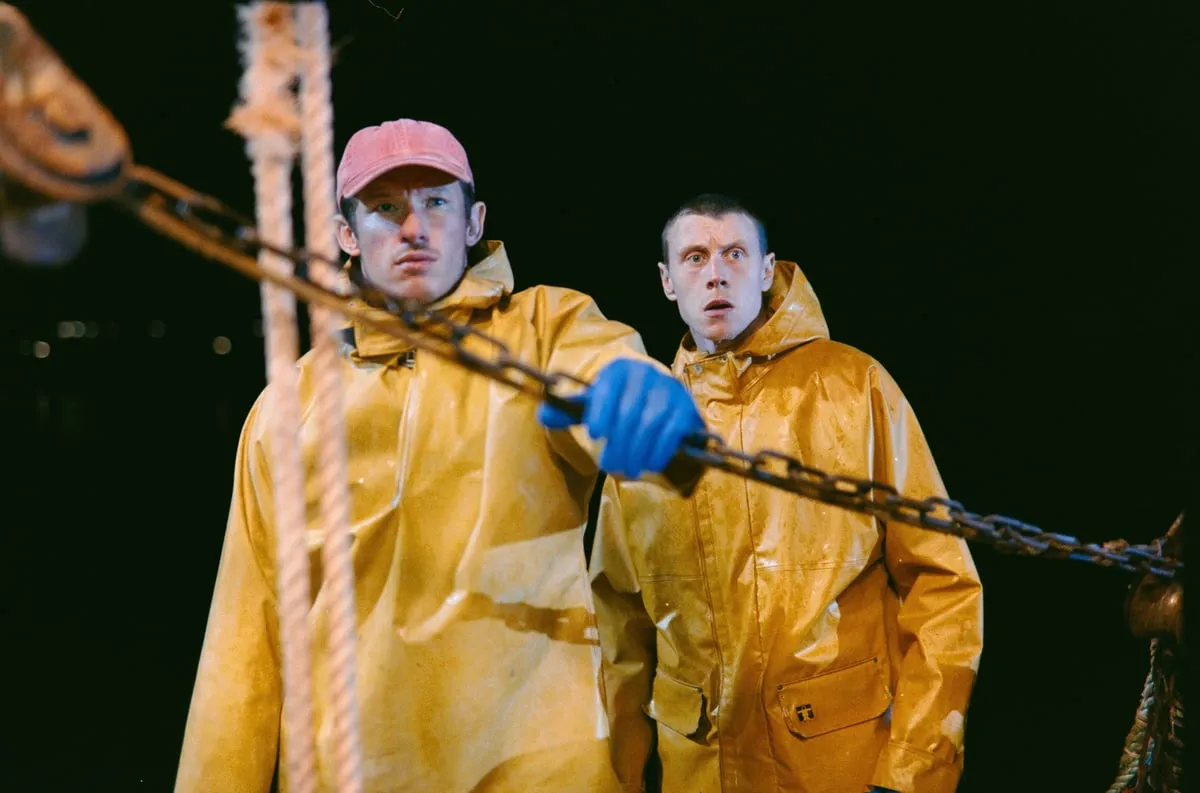
George MacKay gives Nick a raw, desperate energy. His performance is physical, coiled with tension and disbelief. His horror is palpable; he is a man trapped in an existential nightmare, his every action driven by the frantic need to return to the wife and child he left behind in the future. They are his physical anchor to a reality that is slipping away.
In stark opposition, Callum Turner’s Liam is a study in rootless adaptability. He accepts the new reality with a placid opportunism, slipping into another man’s life and family with an unsettling ease. For him, this past is an improvement on his aimless former existence.
His moral compass is fluid, and his assimilation into the past highlights a modern detachment from history and place. This divergence is watched over by spectral figures from the community, like the grieving mother played by Mary Woodvine, who exists in the present as a Cassandra figure whose dementia gives her a unique clarity across time.
The Weight of Water
Rose of Nevada operates as a working-class drama that curdles into psychological horror, where economic anxiety manifests as a supernatural event. The film is an exploration of a “ghost town” in both a literal and a figurative sense. The community is haunted by the memory of a more prosperous past, a specter that the time-slip narrative makes terrifyingly real.
The ghost ship is the ghost of a dead industry. History here is a suffocating burden, a cyclical tide that traps the younger generation into reliving the unresolved tragedies of their forebears. The film poses deep questions about identity and memory but refuses to offer simple answers. It operates on a potent dream logic, creating a world where it is unclear if the men are experiencing a premonition from thirty years ago or have become ghosts in their own future.
Is identity an internal truth, or is it a role conferred upon us by a community? Nick fights to preserve his sense of self, while Liam sheds his like a coat. The story’s power is in this deliberate ambiguity, transforming it into an experience to be absorbed instead of a puzzle to be solved. It examines what happens when a community’s future evaporates, leaving only the past to be endlessly, dangerously, rewritten.
Rose of Nevada is a 2025 British science fiction drama film with a runtime of 114 minutes. The film had its world premiere in the Orizzonti section of the 82nd Venice International Film Festival on August 30, 2025. It is primarily in the English language and was produced by companies including Bosena, Film4, and the BFI.
Full Credits
Director: Mark Jenkin
Writers: Mark Jenkin
Producers and Executive Producers: Denzil Monk, Ama Ampadu, Farhana Bhula, Ben Bond, Ben Coren, Johnny Fewings, Neil Fox, Phil Hunt, Ollie Madden, Kingsley Marshall, Compton Ross
Cast: George MacKay, Callum Turner, Francis Magee, Edward Rowe, Rosalind Eleazar, Mary Woodvine, Adrian Rawlins, Yana Penrose
Director of Photography (Cinematographer): Mark Jenkin
Editors: Mark Jenkin
Composer: Mark Jenkin
The Review
Rose Of Nevada
Mark Jenkin’s Rose of Nevada is a disorienting and hypnotic piece of filmmaking. It pulls the viewer into its world through a powerful combination of grainy 16mm visuals and an unnerving, immersive soundscape. While its ambiguous, dreamlike narrative may frustrate those seeking clear answers, the film succeeds as a haunting exploration of history’s weight and the ghosts of economic decline. Anchored by a desperate performance from George MacKay, it is a challenging, meticulously crafted work that lingers long after the screen goes dark. A potent sensory experience for the adventurous viewer.
PROS
- Mark Jenkin's unique, immersive filmmaking style creates a palpable sense of place and dread.
- The post-synced audio and heightened mechanical sounds build a powerful and uncanny mood.
- George MacKay provides a compelling and physically desperate emotional anchor.
- A rich exploration of community, history, and economic anxiety.
- The grainy 16mm cinematography gives the film a timeless, artifact-like quality.
CONS
- The narrative can feel impenetrable and may frustrate viewers seeking a conventional story.
- The unconventional techniques, such as the dislocated sound, could be off-putting for some audiences.
- Its focus on mood over plot progression might feel slow or meandering.







