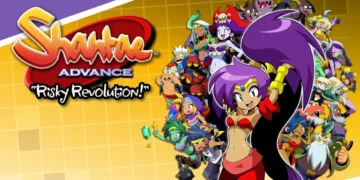




















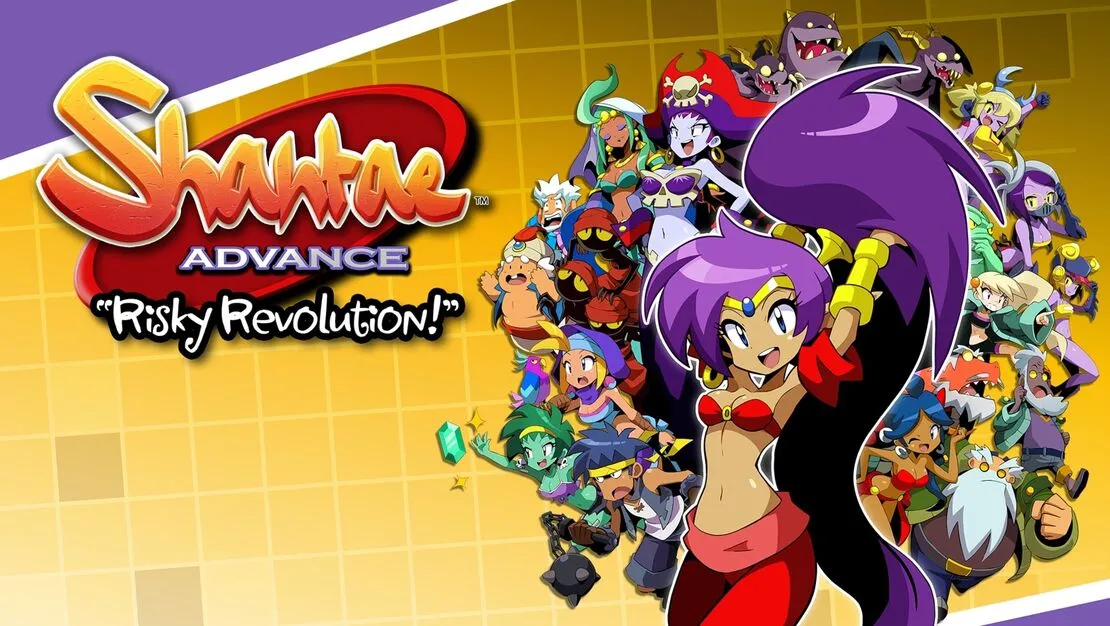

Video game history has its share of lost projects, but few get a second chance two decades later. Shantae Advance: Risky Revolution is one such project, a title developed for the Game Boy Advance in 2004 that was shelved before completion. Now finished and released, it fills a narrative gap, acting as a direct sequel to the Game Boy Color original and a prequel to Risky’s Revenge.
The story begins with the series’ recurring antagonist, the pirate captain Risky Boots, unleashing her latest invention: the Tremor Engine. This powerful device allows her to physically rearrange the geography of Sequin Land, shifting entire towns to create new coastlines for her to plunder.
In response, the half-genie hero Shantae sets off to find the three Relic Hunters, geology experts who are her only hope of countering Risky’s continental chaos. This premise sets the stage for a lighthearted adventure defined by its creative central idea.
Shifting Landscapes
The central mechanical conceit of Risky Revolution is the Tremor Engine, and its effects are felt in every aspect of level design. While its invention is the catalyst for the plot, its leftover machinery becomes the game’s primary puzzle-solving tool. In most areas, Shantae will discover large button mechanisms that, when struck, physically alter the level.
The most common effect is a plane shift, where the distant background moves forward to become the new playable area, while the former foreground recedes into a non-interactive backdrop. This system is a more dynamic and player-controlled evolution of the background-hopping seen in Risky’s Revenge.
Its implementation is clever; a treasure chest visible on a far-off cliff is not just set dressing but an objective. The player must search the current plane for the corresponding mechanism to bring that distant cliff within reach. This transforms exploration from simple lateral movement into a spatial puzzle, demanding a constant awareness of both visible planes.
This design is supported by a world structure that prioritizes convenience over cohesion. Unlike the sprawling, interconnected maps of games like Super Metroid, Sequin Land is presented as a collection of standalone stages accessible from a world map. Shantae’s friend Sky, atop her giant bird Hatchet, acts as a transport service, flying the player to any unlocked location instantly.
This model, which closely mirrors the structure of Shantae and the Pirate’s Curse, is exceptionally user-friendly. It eliminates the tedious backtracking across multiple zones that can bog down other action-adventure titles. When a new ability is acquired, returning to a previous area to unlock its secrets is a matter of a few button presses.
This convenience, however, means the world feels less like a single, organic place and more like a series of discrete levels. The initial swapping of Scuttle Town with the arid Mining Town demonstrates the chaos of the Tremor Engine, but the subsequent island-hopping nature of gameplay removes some of that initial feeling of a world thrown into disarray.
Even with streamlined travel, navigating the individual levels can sometimes be confusing. The plane-shifting mechanic, for all its ingenuity, can occasionally obscure the path forward. Some areas feature looping screen transitions, meaning exiting a cave to the right might place you back at that same cave’s entrance.
When this is combined with a plane shift, a player can lose their bearings and struggle to map the area mentally. The game is also occasionally obtuse about what is required for progress. A player might find themselves stuck, only to realize that a seemingly decorative part of the environment was meant to be interacted with using a newly acquired transformation.
To its credit, the game packs these areas with content. Most regions contain a main story dungeon and a secondary, optional dungeon, often filled with undead enemies and a recurring zombie mini-boss. These extra areas reward thorough exploration and add significant playtime to what is otherwise a compact adventure.
Power Through Piracy
Shantae’s moveset is a familiar but refined collection of her signature abilities. Her primary method of attack remains her magical ponytail, which she can whip at enemies. The attack is fast, responsive, and serves a dual purpose, acting as the key to hitting switches and triggering environmental mechanisms. Her other core skill is dancing, a series staple activated with a press of a shoulder button.

The dance itself has a utility function, creating a magical field that draws in nearby gems and items. Its main purpose, however, is to activate Shantae’s transformations. These animal forms are the backbone of the game’s progression, gating access to new areas until the correct form is found. Each transformation provides a distinct set of skills, forcing the player to think about which animal is right for the job.
The transformations range from series mainstays to more unusual additions. The Monkey form grants the ability to climb walls, opening up vertical pathways and providing access to high ledges. The Elephant is a powerhouse, using its bulk to smash through breakable blocks and perform a ground-pounding stomp. These two forms cover the classic “agility versus power” archetypes common to the genre. The other transformations offer more specialized utility.
The Crab allows Shantae to explore underwater areas, which are otherwise inaccessible, and can also drop explosives to destroy certain obstacles. The Spider provides a different kind of vertical movement, letting Shantae scale specific webbed surfaces that the Monkey cannot grip. Each of these forms also has a hidden secondary ability, such as the Monkey’s power to see through walls, which encourages players to revisit old areas and rewards the most dedicated explorers.
This toolset can be enhanced through a robust but easily exploitable upgrade system. Defeated enemies drop gems in large quantities, and these are used as currency at the shop run by the zombie Rottytops. Here, players can purchase consumable items, sub-weapons like the orbiting Pike Balls, and permanent upgrades. These upgrades, sold as different types of shampoo, can dramatically increase the power of Shantae’s ponytail attack. Other items can cut her magic consumption in half.
Because enemies respawn frequently and drop currency so freely, it is possible to pause one’s progress and grind for a short time to afford the most powerful upgrades very early on. This design choice places the difficulty curve squarely in the player’s hands. One can choose to engage with the system minimally for a more challenging experience, or one can become an overwhelmingly powerful force before the halfway point.
This can lead to bosses feeling trivial, their patterns and attacks rendered ineffective against a fully-upgraded Shantae. Paradoxically, the most consistent threat can become the standard enemies, whose ability to deal small amounts of damage repeatedly can wear down an overconfident player.
Pixels with Personality
As a completed Game Boy Advance project, Risky Revolution authentically captures the look and feel of that console’s golden age. The 32-bit pixel art is excellent, with fluid sprite animations, vibrant color palettes, and imaginative enemy designs, from the lowly Tinkerbats to the demonic Muck Lord bosses. The game offers two distinct presentation modes to the player.

Classic Mode is the pure GBA experience, rendering the game exactly as it would have appeared in 2004. The modern mode provides a more contemporary wrapper, adding a clean, high-definition user interface and gorgeous, fully-drawn character portraits during dialogue.
These portraits add a tremendous amount of personality, conveying emotion and nuance that the small in-game sprites cannot. It is important to note that the core gameplay graphics remain pixelated in both modes. This is a restoration, not a ground-up remake in the vein of Half-Genie Hero, a choice that honors the game’s unique history.
Where the game truly excels is in its writing and characterization. The script is sharp, witty, and consistently funny, turning what could be simple fetch quests into amusing scenarios. A joke near the beginning involving a large fan, an exclamation of being “here for the fan service,” and the appearance of Rottytops perfectly encapsulates the game’s self-aware and playful tone.
The cast is filled with memorable personalities. Shantae herself is an endearing hero, and the game allows her to show a cantankerous side that makes her more relatable. Her friends all play important roles: Sky is the ever-reliable pilot, Rottytops is a snarky but helpful shopkeeper, and Bolo is the well-meaning handyman who helps repair Risky’s machines.
The new characters, like the trio of quirky Relic Hunters and oddballs like the Shareware Wolf, fit seamlessly into the established world. This charming cast elevates the entire experience, making the simple plot feel much more engaging.
This presentation is tied together with an excellent soundtrack. The music is energetic and catchy, with upbeat chiptune-inspired tracks that drive the action forward. The score is perfectly matched to the gameplay, providing a sense of high adventure during exploration and ramping up the intensity during boss battles. Even in moments of potential frustration, such as when one is lost in a looping section of a level, the cheerful music keeps the mood light.
The sound design is equally strong, with satisfying effects for attacks, collecting items, and interacting with the world. In the modern presentation mode, occasional voice clips from Shantae during combat add another layer of polish, though they can be a bit jarring at first within the otherwise retro soundscape.
Side Stages and Extras
In addition to the main story campaign, Risky Revolution includes a few pieces of extra content that reflect its origins as a GBA title. The most notable is the multiplayer Battle Mode, a local-only affair for two to four players. The mode takes place on a single-screen arena where participants fight to be the last one standing, usually by knocking opponents into spikes that appear when the stage shifts.

While a functional inclusion, it feels more like a historical curiosity than a fully-featured mode. Its limitations are immediately apparent. There are no AI opponents, making it inaccessible to solo players. Furthermore, character selection is locked; Player 1 is always Shantae, Player 2 is Risky Boots, and so on. There is no option to choose a stage, as the arenas simply cycle in a predetermined order. It is a simple diversion, best enjoyed for a few minutes with friends before returning to the main game.
The package is rounded out by content offered in the game’s Deluxe Edition, which provides players with a set of alternate costumes for Shantae to wear during the adventure. For the most part, these are purely cosmetic, allowing players to change Shantae’s appearance to their liking. One of the costumes, however, does provide a minor gameplay benefit by increasing the strength of certain sub-weapons.
This further contributes to the game’s malleable difficulty, giving players who purchase this version another small advantage. This extra content does little to extend the game’s lifespan, which is relatively short. A single playthrough can be completed in under ten hours, even for those who seek out every collectible Secret Squid. The primary incentive for a second playthrough is to experience the story again or to play in the alternate visual mode. The game’s value is found not in its length or its bonus modes, but in the quality and charm of its core adventure.
The Review
Shantae Advance: Risky Revolution
Shantae Advance: Risky Revolution is a masterful revival of a lost title. Its clever world-shifting mechanic, exceptionally charming writing, and solid platforming create a delightful adventure. While its GBA origins are apparent in some looping level design and an easily circumvented difficulty curve, the game is a wonderfully preserved piece of handheld history that stands tall within the series.
PROS
- Inventive plane-shifting gameplay mechanic.
- Extremely charming characters and witty dialogue.
- Excellent pixel art and an energetic soundtrack.
- Convenient world structure simplifies backtracking.
CONS
- Level design can be confusing and disorienting at times.
- Difficulty is easily trivialized through grinding.
- Multiplayer mode is a barebones, limited extra.
- Relatively short playtime.