



















Ben Wheatley retreats from the glossy emptiness of the studio machine to offer us Bulk, a piece of celluloid shrapnel lodged in the mind. It is a film made not from money but from impulse, a frantic return to the elemental chaos of creation. The premise serves as a faint, flickering signal: a journalist, Cory Harlan, is pulled into a slipstream reality to retrieve a ghost, a tech mogul lost within his own multiverse-shattering invention.
This is a movie that operates as a conspiracy thriller, a science fiction thought experiment, and a parody of both. It does not tell a story so much as it presents the debris of one. The experience is one of disorientation, a deliberate abandonment of narrative gravity, asking the viewer to float in its strange, playful void.
An Architecture of Echoes
The film dismantles the very idea of a plot, treating story as a cage from which it must escape. What remains is a skeletal framework, an excuse for the movie’s true purpose: the exploration of a consciousness shattered into infinite pieces. The “brain collider” accident is less a plot device and more a creation myth for a new, incoherent reality where the self is no longer a stable entity.
Identity becomes a liquid concept, pouring across dimensions. Cory Harlan encounters multiple versions of his captors and himself, each one a slight variation, an echo of a person who may have never existed in the first place. The film questions if a core identity is possible when every choice spawns a new universe, a new self.
The suburban house where much of the action is confined becomes a physical manifestation of this psychic prison, a space where doorways lead not to other rooms but to other planes of existence. It is a labyrinth of the mind, its walls constantly shifting.
The film’s metatextual humor feels less like a series of jokes and more like moments of profound lucidity. When Aclima warns, “Don’t question the story out loud,” she speaks as the film’s oracle, admitting the futility of seeking logic in a universe governed by paradox. Clarity is not the goal; the film immerses us in the terror and strange beauty of its absence.
Ghosts in the Machine
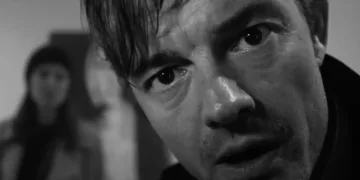
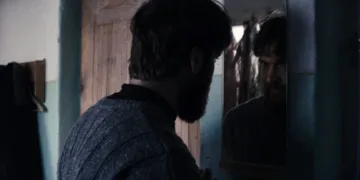
The visual world of Bulk is an artifact, a conscious relic assembled from the dreams of cinema’s past. Its aesthetic is a philosophical statement. The stark, monochrome cinematography strips the world down to shadow and light, form and void, turning mundane settings into expressionistic landscapes of dread.
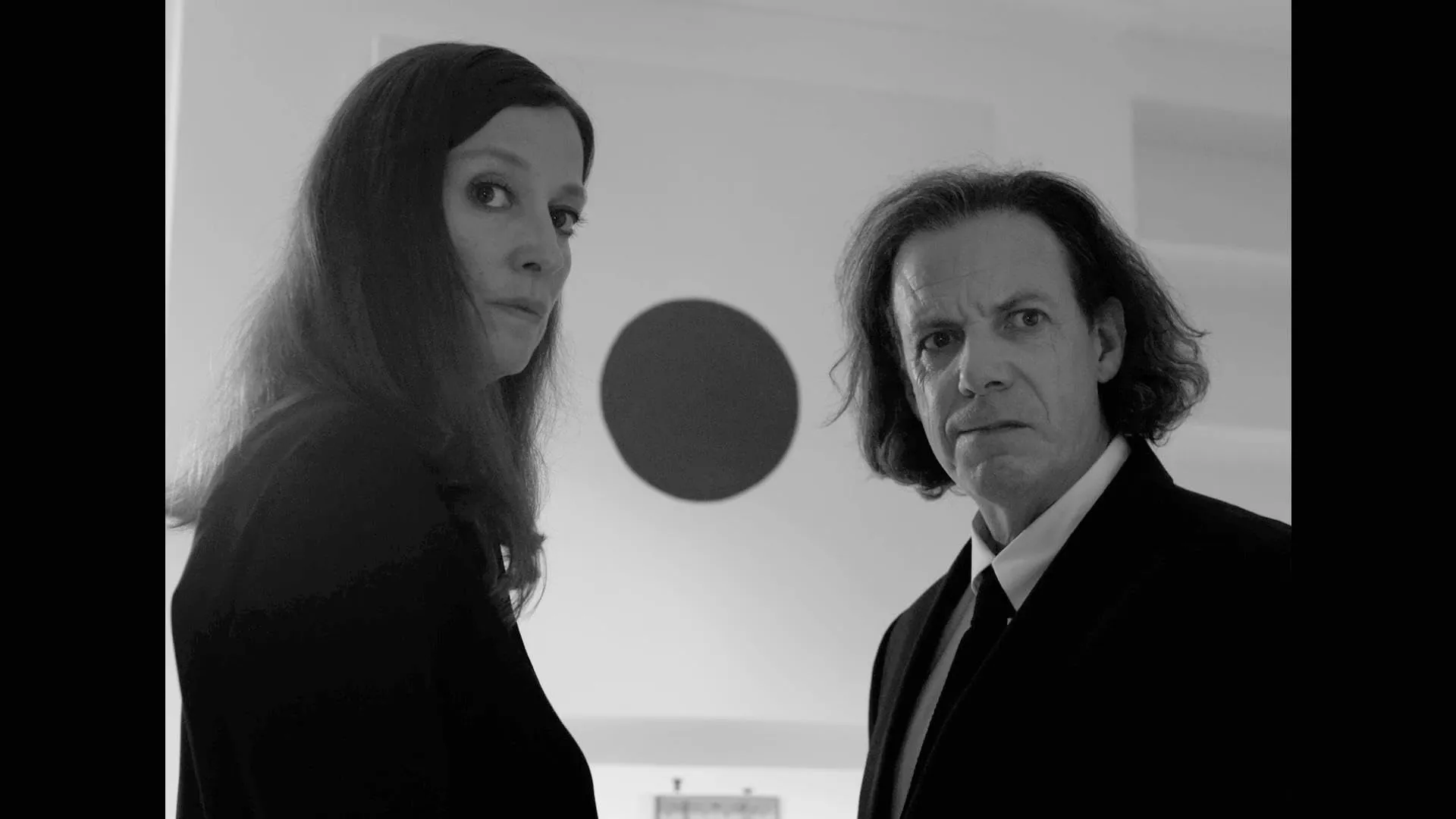
This is a world of harsh silhouettes and deep, consuming blacks, where a person can be swallowed by the darkness in their own living room. The effects are proudly, defiantly handmade. We see the charming stutter of a stop-motion rock creature and the visible seams on a model Land Rover traversing a miniature wasteland.
This is not a failure of budget but a successful expression of theme; the film shows us its own construction to remind us that all realities are, in some sense, artificial. The very texture of the image is unstable, shifting from the crispness of noir to the murky, ghost-haunted quality of old magnetic tape. The sound design completes this dislocation.
Dialogue, deliberately recorded and synced in post-production, floats unnervingly detached from the lips that speak it. This turns every conversation into a transmission from an unknown place, creating a profound sense of alienation between the characters and their own words. The simple synthesizer score hums beneath, a lonely, pulsing signal from a forgotten video game, the perfect soundtrack to this elegant collapse.
Figures in a Fever Dream
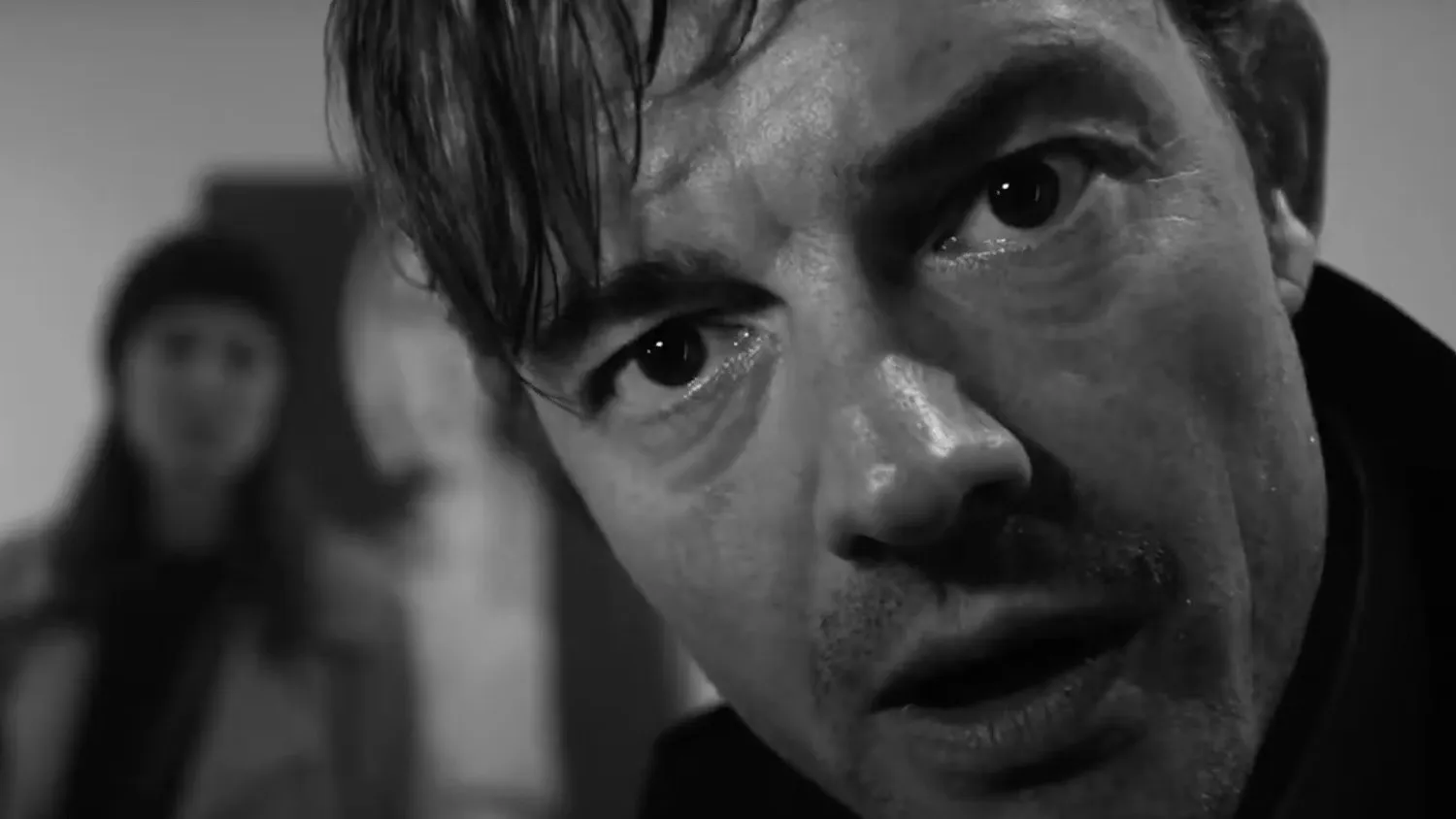
Within this disintegrating world, the performances are less about character and more about embodying a state of being. Sam Riley offers a masterful portrait of existential vertigo. His Cory Harlan is more than a classic “wrong man”; he is a symbol of modern consciousness, desperately trying to find a foothold in a frictionless reality where cause and effect have been severed.
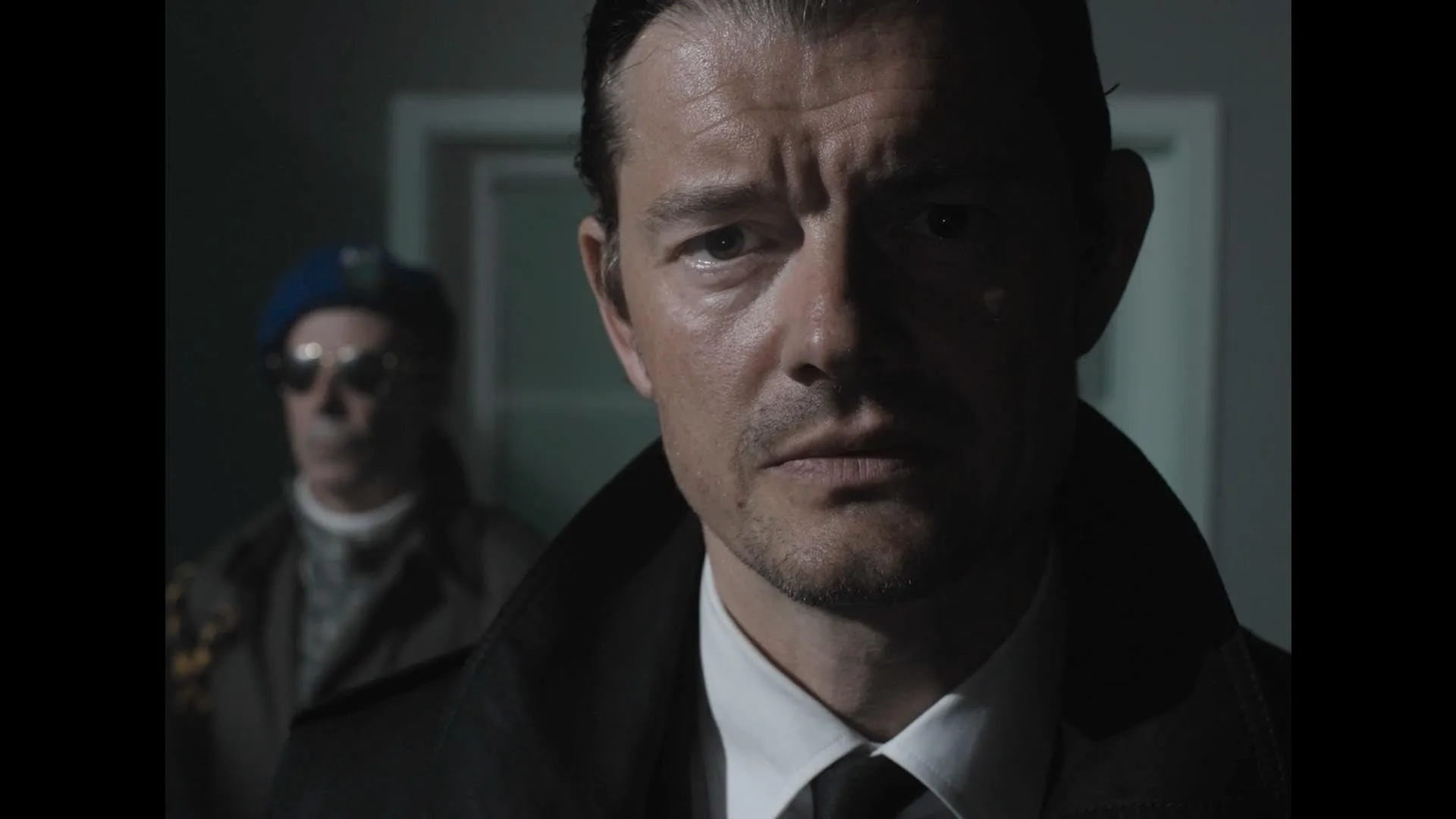
His sweat-slicked brow and perpetually baffled expression are the physical symptoms of a mind confronting its own redundancy. He is the audience’s anchor, yet he himself is adrift. Opposite him, Alexandra Maria Lara’s Aclima is a figure of terrifying calm. Her deadpan serenity in the face of cosmic unraveling makes her an ambiguous warden. Is she a guide through the chaos, or is she an agent of it? Her stillness is a mirror to the film’s central void.
The cast fully commits to the premise’s absurdity, playing their multiple roles with a liberated energy. They seem to understand that they are not portraying people but rather facets of a single, fractured dream. Bulk is an unapologetically personal work, a cinematic dare. It is a film for those who find comfort not in answers, but in the elegance of a well-posed question. Its enjoyment depends on a willingness to surrender to its peculiar logic and embrace the beautiful absurdity of the abyss.
Bulk is a science fiction thriller that premiered in the Midnight Madness section of the Edinburgh International Film Festival on August 14, 2025. The film was directed, written and edited by Ben Wheatley and was kept under wraps during its production. It is a black and white film and features Bill Nighy as the narrator. The movie is a production of Rook Films and Film4. The film has been described as Wheatley’s return to basics. Its international sales have not yet begun, but the film is expected to be released in the United States in September 2025.
Full Credits
Director: Ben Wheatley
Writers: Ben Wheatley
Producers: Ben Wheatley, Andy Starke
Executive Producers: Ollie Madden, David Kimbangi
Cast: Alexandra Maria Lara, Sam Riley, Noah Taylor, Mark Monero, Bill Nighy
Director of Photography (Cinematographer): Nick Gillespie
Editors: Ben Wheatley
Composer: Dave Welder
The Review
Bulk
Bulk is a defiant rejection of conventional storytelling, offering a disorienting journey through a fractured reality. Ben Wheatley crafts a philosophically dense puzzle box, prioritizing atmosphere and metatextual games over a coherent plot. Its handmade charm and committed performances are admirable, but its intentional obscurity makes it a difficult, alienating experience. This is a bold, personal experiment built for a very specific audience prepared to embrace its beautiful, maddening chaos.
PROS
- A bold and original artistic vision.
- Intellectually stimulating with rich philosophical questions.
- Unique, handmade visual aesthetic that serves the story.
- Strong, committed performances from the entire cast.
CONS
- The narrative is intentionally fragmented and confusing.
- Its experimental nature will likely alienate a broad audience.
- Can feel self-indulgent and weird for the sake of it.
- Pacing is deliberately uneven and challenging.