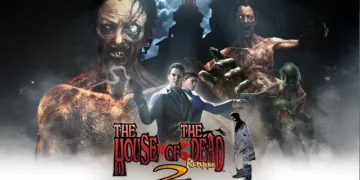




















There is a distinct energy to 1990s arcade rail shooters, a frantic rhythm of pumping quarters, plastic guns, and B-movie horror. The House of the Dead 2 was a titan of that era, a game defined by its speed, camp, and satisfying zombie dismemberment. Its return as a full remake on the Nintendo Switch seeks to capture that lightning in a bottle for a new generation.
The premise is as simple and effective as ever: agents James Taylor and Gary Stewart shoot their way through a European city overrun by undead horrors, all orchestrated by the magnate Goldman. The game is a dedicated effort to preserve the original’s blueprint, from its level design to its absurd plot. This dedication, however, is challenged by a clumsy transition to modern hardware.
Fighting Your Own Gun
A rail shooter’s success is measured by the purity of the connection between player intent and on-screen action. It must be seamless, intuitive, and immediate. The original arcade cabinet achieved this with its satisfyingly chunky light guns. This remake, however, builds a wall of technical frustration between you and the game, forcing you to fight your own weapon more than the zombie horde. The central issue lies in its translation to the Nintendo Switch hardware.
The primary control method, motion-based gyro aiming, should theoretically be the perfect modern analog for a light gun. In practice, it is fundamentally unreliable. The aiming reticle, your only connection to the world, has a mind of its own. It will drift languidly toward the edge of the screen without any input, and then snap erratically when you try to make a precise adjustment.
Imagine a scenario core to the game’s design: a civilian is being accosted by two zombies, and you have a split second to land two perfect headshots. You line up the first shot, but the act of pressing the fire button sends your reticle flying several inches to the left. You miss, the civilian is lost, and your path through the level is altered for the worse. Or consider a boss fight against the winged creature Zeal, who guards the towering Judgment.
The fight requires you to keep your aim trained on a small, fast-moving target. The gyro’s constant drift and unpredictable jitters make this a maddening exercise in luck rather than a test of skill. You are constantly forced to recalibrate by pushing the reticle off-screen and letting it re-center, a clumsy workaround that shatters the pace of the action. This problem is not new; it stems from the Switch’s lack of an external sensor bar, which the Nintendo Wii used to provide a stable and accurate point of reference. Without it, the system struggles to track the Joy-Con’s position in 3D space, resulting in this flawed experience.
The alternative, aiming with the analog stick, trades one problem for another. It offers stability, eliminating the drift and jitters. Yet it is painfully slow. The game moves at a blistering, predetermined pace, with enemies leaping into view instantly. The sluggishness of the analog cursor means you are always one step behind the action.
You will see a threat, begin to move your reticle, and take damage before your aim ever reaches its target. This creates a feeling of helplessness, where the challenge comes from the interface, not the game design. The entire promise of the power fantasy, of being a hyper-competent agent, is undone.
This leads to a bizarre meta-game that takes place entirely within the settings menu. Before each run, and often after each death, you will likely pause the game, navigate to the options, and nudge the sensitivity sliders back and forth. You are searching for a “sweet spot,” a perfect balance that simply does not exist. This constant tweaking is the antithesis of the arcade spirit.
It breaks immersion and kills momentum. The most confusing part of this entire situation is the baffling omission of touchscreen controls for gameplay. The feature was present in the remake of the first game and is used for menu navigation here. It would have provided a precise and intuitive solution for handheld play, yet it is inexplicably absent. The result is a game that fails its very first and most important test: to make pointing and shooting feel good.
The Unchanged Heart of the Action
For players with enough patience to find a semi-functional control scheme, the game hiding beneath these frustrations is a brilliant and loving preservation of an arcade masterpiece. When you are not fighting the controls, the core gameplay loop is as compelling today as it was in 1998. There is a deeply satisfying, almost tangible feedback to the action.

The sound design of a successful headshot is a chunky, rewarding thud. Enemy models react dynamically to your shots, with limbs and chunks of flesh flying off, visually communicating your accuracy. This is not just gratuitous gore; it is a critical feedback system that makes every shot feel meaningful. The game’s pacing is a masterclass in arcade design, built to sustain a constant state of heightened tension. It moves you from one chaotic set piece to another with relentless forward momentum, ensuring your adrenaline never has a chance to dip.
The developers’ reverence for the source material is evident in every frame. This is not a re-imagining; it is a faithful reconstruction. The branching paths, a revolutionary feature for its time, are fully intact. In the very first stage, you are presented with a choice: do you save a civilian about to be thrown from a bridge? Your success or failure dictates your route through the rest of the level, leading to different enemy encounters, locations, and strategic challenges.
This mechanic gives each playthrough a unique narrative flow, rewarding mastery and encouraging repeated attempts to see every path. The iconic boss battles are recreated with similar care, from the chainsaw-wielding zombie Zealot to the massive, multi-headed hydra, Strength. These encounters are pure spectacle, demanding pattern recognition and precise shooting under pressure.
The remake enriches this classic formula with a wealth of content. The main campaign can be played in “Arcade Mode,” a pure, unfiltered version of the original experience focused on high scores and credit management. Alternatively, “Original Mode” adds a modern progression layer. By shooting hidden crates and barrels, you unlock points to spend on permanent upgrades, such as increased firepower, a larger clip size, or extra lives.
This shifts the game’s focus slightly, rewarding exploration and giving players a way to overcome difficult sections through persistence instead of pure skill. Adding to this are a dedicated “Boss Mode” for practicing against the game’s major encounters and a “Training Mode” filled with micro-challenges. These are not mere distractions; they are focused drills that hone specific skills, like target prioritization or ammo conservation.
Crucially, the game retains its two-player local co-op. Playing with a friend transforms the experience entirely. It becomes a loud, chaotic, and collaborative affair, with players shouting warnings, dividing the screen to cover threats, and competing for the highest score. This social element was the lifeblood of the arcade, and its preservation here is essential to capturing the game’s spirit. With multiple endings tied to your final score and the number of civilians saved, the game is designed to be played over and over again, a true testament to its arcade heritage.
An Awkward, Lovable Performance
The aesthetic presentation of the remake is a fascinating case study in the challenges of modernizing a cult classic. On a technical level, the visuals are a massive leap forward. Every character model, from the player agents to the most grotesque zombie, has been rebuilt from the ground up with high-resolution textures and detailed geometry.
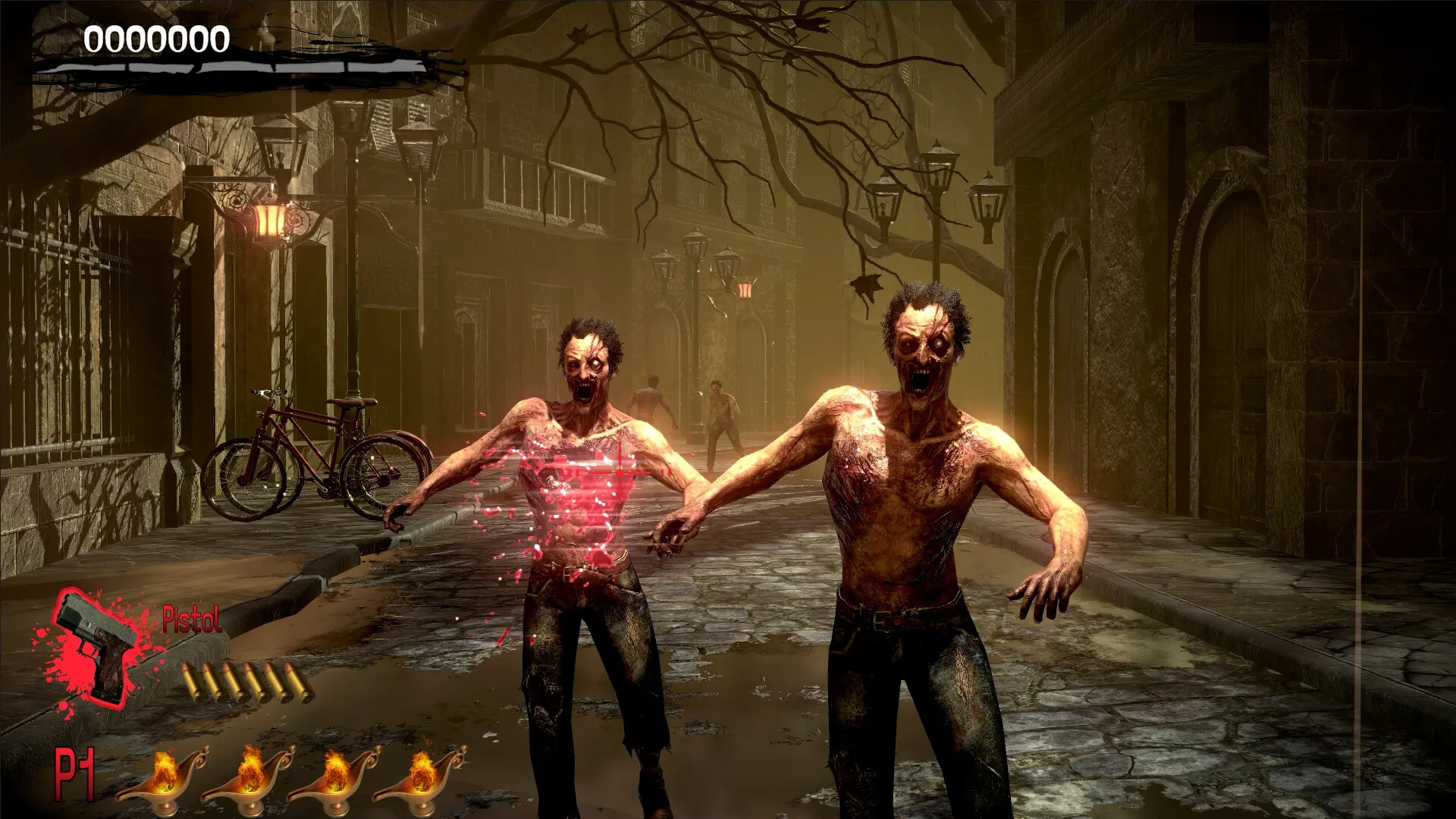
The environments are more complex, filled with new assets that flesh out the Venetian-inspired city. The developers clearly put in a significant amount of work. Yet, the artistic direction often feels at odds with the source material’s tone. The new lighting engine, while capable, often illuminates scenes too brightly, stripping them of the deep, oppressive shadows that created a sense of horror in the original.
Many surfaces have a generic, plastic-like sheen that makes the world feel sterile and artificial, robbing the monsters of their grotesque, organic quality. This is most apparent in the new blood effects, which are rendered as bright, cartoonish puffs of red, a choice that feels more aligned with a Saturday morning cartoon than a creature feature.
This dissonance is most profoundly felt in the audio department, specifically the voice acting. The 1998 original is legendary for having some of the most unintentionally hilarious dialogue in video game history. Lines like “Suffer like G did?” or “Don’t come! Don’t come!” were delivered with a baffling sincerity that turned them into accidental art. The remake faced an impossible task: how do you replicate accidental genius?
The solution was to re-record all dialogue with actors consciously performing badness. The result is a strange and hollow echo of the original. You can hear the actors trying to sound stilted, their delivery wooden by choice. It is a winking, self-aware imitation that lacks the genuine, earnest charm of its predecessor. It feels like a cover band playing the hits instead of the original artist. Goldman’s new, inexplicable Texan accent is a prime example of the remake’s bizarre and distracting directorial choices.
The rest of the sound design is a competent but unremarkable update. The gunshot effects have a satisfying weight, and the squelching sounds of zombie impacts provide good feedback. The music re-orchestrates the original’s synth-heavy tracks, but loses some of the 90s charm in the process. Then there is the infamous “Reload!” shout, an auditory cue that screams at the player incessantly every time their clip runs dry.
It is an actively annoying piece of sound design, and while the developers wisely included an option to disable it, its inclusion as the default highlights a lack of thoughtful user experience design. This lack of polish extends to the interface, where the pre-mission upgrade screen is laid out in a confusing and unintuitive manner. The game’s presentation is caught between a desire to be faithful and a need to be modern, and in trying to be both, it often fails to be truly effective at either.
The Review
The House Of The Dead 2: Remake
The House Of The Dead 2: Remake is a faithful recreation of an arcade classic, preserving the frantic action and campy charm that made the original beloved. Underneath, the core game is a blast, packed with content and replay value. This reverence is tragically undermined by fundamentally flawed controls that make the simple act of pointing and shooting a constant struggle. It is a frustrating experience where a fantastic game is trapped inside a clumsy, poorly implemented package, making it difficult to recommend without serious reservations.
PROS
- A remarkably faithful recreation of the 1998 arcade game.
- Satisfying, fast-paced shooting action and visceral feedback.
- Plenty of content, including multiple modes and branching paths.
- Excellent two-player local co-op experience.
CONS
- Gyro and analog controls are frustratingly unreliable and unintuitive.
- Requires constant, tedious tweaking in the settings menu.
- Questionable artistic choices and a self-conscious vocal performance.
- Puzzling omission of touchscreen controls for handheld play.