


























![Kingdom Hearts Collection [I-III] Review](https://gazettely.com/wp-content/uploads/2026/10/Kingdom-Hearts-Collection-I-III-1-360x180.webp "Kingdom Hearts Collection [I-III] Review: KHII Holds Steady as Newer Entries Fluctuate 40")


The most difficult task for any storyteller confronting a historical atrocity is choosing the right lens. When the truth itself is an abyss of human suffering, what kind of narrative can possibly grant it meaning without diminishing its scale? In the Japanese Imperial Army’s Unit 731, human subjects were referred to as “logs,” a word that surgically removes all traces of personhood.
They became objects, quantities of flesh to be used in experiments and then discarded. Linshan Zhao’s film 731 attempts to find a story within this void. It sets its sights on an escape plot, a narrative of human agency fighting back against a system of absolute control. The premise pits the ingenuity of a few prisoners against the industrial cruelty of their captors, proposing a classic conflict of the human spirit against the machine.
A Familiar Blueprint for an Unspeakable Place
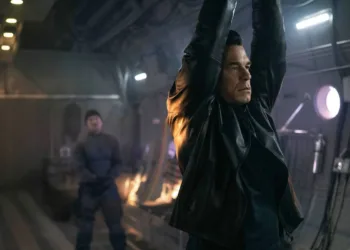
The film anchors its plot to a conventional prison-break structure, a choice that feels both safe and profoundly misguided. Its narrative engine is Wang (Wu Jiang), a man of shifting identities who is part con artist and part folk hero. His arrival in the camp provides the necessary spark, but the plan itself comes from another inmate, the methodical Cunshan (Zhiwen Wang).
The film spends considerable time detailing their collaboration and the cleverness of their methods. We see intricate plans for passing messages, the co-opting of a mouse as a courier, and the careful mapping of the facility. These sequences are constructed as procedural puzzles, designed to create suspense and offer the intellectual satisfaction of watching a complex machine being built. The problem is that this narrative machine operates in a place that defies logic and order.
The film asks us to invest in the mechanics of the escape, but all around the protagonists is a reality of pointless, chaotic suffering that the plot largely ignores. By defaulting to the tropes of a thriller, the story frames the horror of Unit 731 as a problem to be solved, an obstacle to be overcome by a mysterious hero and his determined allies. This reduces the incomprehensible evil of the situation to a mere backdrop for a familiar genre exercise, making the setting feel less like a historical reality and more like a high-concept prison.
A Carnival of Cruelty
The film’s structural issues are compounded by a severe tonal imbalance. Director Linshan Zhao seems uncertain whether to make a serious historical drama, a visceral horror film, or a sentimental melodrama, so he attempts all three at once. The result is a disjointed and often bewildering experience. The camera adopts a ghastly intimacy during scenes of experimentation.
It does not simply observe the horror of a man’s frozen arms being shattered by a hammer or the gruesome effects of a pressure chamber; it seems fascinated by the spectacle. The fluid, almost eager movement of the camera turns the audience into voyeurs, pushing the depiction beyond harrowing realism into the realm of exploitative “torture porn.” This graphic intensity is then immediately undercut by the film’s bafflingly simplistic portrayal of its characters.
The Japanese officials are not the terrifying bureaucrats of evil seen in more thoughtful examinations of atrocity; they are sneering, one-dimensional villains from a lesser war movie. In the prisoners’ barracks, we find ready-made archetypes designed for easy pathos: a noble pregnant woman, a plucky young boy who performs magic. These characters feel less like people and more like narrative props, deployed to elicit a specific emotional response that the core story fails to earn. This jarring mix of graphic cruelty and cheap sentimentality creates an atmosphere where nothing feels authentic.
The Weight of a Subject
Any film about Unit 731 enters a cinematic landscape defined by T. F. Mou’s infamous 1988 film, Men Behind the Sun. That work set a precedent for unblinking, exploitative gore, becoming a benchmark for shock cinema rather than a serious historical document. While 731 is less extreme, it falls into a similar trap of believing that showing the atrocity is the same as understanding it.
The film’s greatest failure is its lack of a coherent cinematic language to process the horror. Compare its approach to a film like Son of Saul, which uses a restrictive, subjective point-of-view to convey the claustrophobic and disorienting reality of the Holocaust without reveling in spectacle. 731 has no such vision. It simply presents its horrors as a series of shocking tableaus, interspersed with a generic thriller plot. The reliance on genre conventions and superficial gore comes at the expense of exploring the victims’ humanity.
The film is a disservice to the memory of those who perished, using their suffering as the setting for a story that has nothing profound to say about it. The final verdict is best delivered by a line from the film itself, when a character tells the protagonist, “You tell your story very badly.” In its attempt to give voice to the silenced, the film only creates more noise.
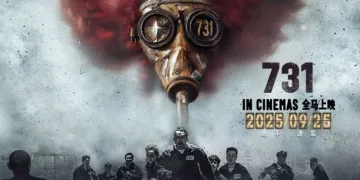
“Evil Unbound (731)” is a Chinese historical drama directed by Zhao Linshan. The movie premiered in Harbin on September 17, 2025, with a wide release in China and globally on September 18, 2025. The film tells the story of the atrocities committed by the Imperial Japanese Army’s Unit 731 during World War II. It shows the tragic experiences of ordinary civilians who were subjected to inhumane live experiments, depicting their suffering and resistance in the face of war.
Full Credits
Director: Linshan Zhao
Writers: Linshan Zhao, Liu Heng
Producers and Executive Producers: Zhuang Yan, Zhang Wang
Cast: Wenjuan Feng, Wu Jiang, Naiwen Li, Ziye Lin, Qian Sun, Irene Wan, Zhiwen Wang
The Review
731
731 approaches a subject of immense historical weight with a stunning lack of vision. By forcing the incomprehensible horrors of the facility into the familiar shape of a prison-break thriller, the film trivializes the very history it claims to honor. Its jarring tonal shifts between exploitative gore and simplistic melodrama, coupled with a superficial treatment of its characters, result in a narrative that is not only ineffective but deeply irresponsible. It is a cinematic failure that mistakes graphic depiction for profound insight, ultimately doing a great disservice to the memory of the victims.
PROS
- Attempts to bring a lesser-known historical atrocity to the attention of a wider audience.
- The mechanics of the escape plot are constructed with some procedural ingenuity, creating moments of conventional tension.
CONS
- The reliance on a standard thriller narrative undermines the gravity of the historical setting.
- Suffers from severe and confusing tonal inconsistencies, mixing graphic horror with cartoonish villains and cheap sentimentality.
- Its depiction of violence feels gratuitous and exploitative rather than serving a meaningful purpose.
- Fails to develop the humanity of its victims, reducing them to narrative props.
- The overall execution is a clumsy and irresponsible handling of its subject matter.