


























Stories about the decline of a great, flawed man are a familiar narrative territory. We know the type: the brilliant academic whose life is a monument to intellectual achievement and personal chaos, his charm a weapon wielded to keep intimacy at bay. Death of a Ladies’ Man begins by inhabiting this archetype so completely that it feels like a well-worn book.
Its protagonist, Samuel O’Shea, is a poetry professor in Montreal, a man whose lectures are fueled by alcohol and whose personal life is a string of romantic wreckage. The film’s narrative engine is ignited not by one event, but by two that strike in quick succession. First comes the domestic humiliation of discovering his young wife’s affair, a sharp blow to his ego. It is immediately followed by a cerebral gut punch: an inoperable brain tumor.
This diagnosis becomes the story’s primary creative license. It is the mechanism that dissolves the barrier between the real and the imagined, plunging Samuel, and the audience, into a surreal landscape of his own making. This internal chaos finds its perfect external voice in the music of Leonard Cohen, whose songs are woven into the film’s fabric as both commentary and confession.
Anchoring the Absurd
The success of a film built around a narcissistic, frequently drunk protagonist rests almost entirely on its lead performer. The role of Samuel O’Shea is a tightrope walk, and Gabriel Byrne navigates it with breathtaking precision. The character could easily have been a caricature of the boozy intellectual, but Byrne locates a profound and compelling humanity beneath the layers of self-absorption.
He portrays Samuel’s charisma not as an inherent trait but as a practiced defense mechanism, one that is beginning to fail him. We see it in his interactions with a generation of students who are immune to his performative charm and in his failed flirtations that now seem more desperate than roguish.
Byrne’s performance is a study in quiet erosion. He conveys Samuel’s inner turmoil not through grand emotional displays but through the weary weight in his eyes and the slight tremor in his hands. He makes the character’s deep-seated selfishness feel like a product of fear, a lifelong effort to outrun a vulnerability he cannot admit to.
This grounding is essential because it gives the film’s more outlandish moments an emotional anchor. When Samuel is at his most difficult, Byrne reveals a flicker of the man he might have been, or the man he is terrified of becoming. It is this nuanced portrayal that keeps the audience invested in a character who has spent a lifetime pushing people away. The performance provides the necessary gravity, ensuring the film’s fantastical flights remain tethered to a recognizable human experience.
Scored by a Patron Saint
The film’s most distinctive structural choice is its full-throated embrace of the surreal. Samuel’s brain tumor is not just a plot point; it is a narrative prism through which the entire story is refracted. His hallucinations are elaborate and thematic, functioning as cinematic manifestations of his psyche.

He doesn’t just remember his father; he engages in long, argumentative conversations with his ghost, who appears as a chain-smoking man younger than Samuel himself, a literal representation of a past he can never reclaim. In a moment of despair, he finds a drinking companion in Frankenstein’s monster, a perfect symbol of a man stitched together from disparate, ill-fitting parts.
These visions are intrinsically linked to the film’s use of Leonard Cohen’s music. The songs are not simply laid over a scene for emotional effect. Instead, the narrative reality bends to accommodate them. An otherwise grim Alcoholics Anonymous meeting suddenly transforms into a full-blown musical number, with attendees singing “Did I Ever Love You” before breaking into a jig.
In the film’s most poignant and whimsical sequence, the violent grace of a hockey game morphs into a delicate ice dance scored to “Bird on the Wire.” This technique is a daring one, as it constantly risks shattering the dramatic tension. Yet, it largely succeeds by externalizing Samuel’s mental state, creating a tone that mirrors the experience of a man whose mind is cross-wiring memories, regrets, and poetic fantasies in its final months. It is a world governed by a dream logic both absurd and deeply sad.
A Reckoning in Two Acts
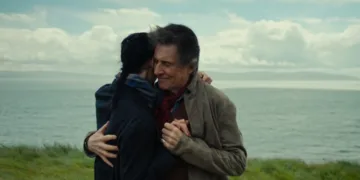
Structurally, the film is a tale of two distinct movements. After establishing his life in Montreal, the narrative follows Samuel on a pilgrimage back to the wild coast of Ireland, the landscape of his birth. This geographical shift signals a deeper thematic one, from confronting the consequences of his life to excavating its origins.
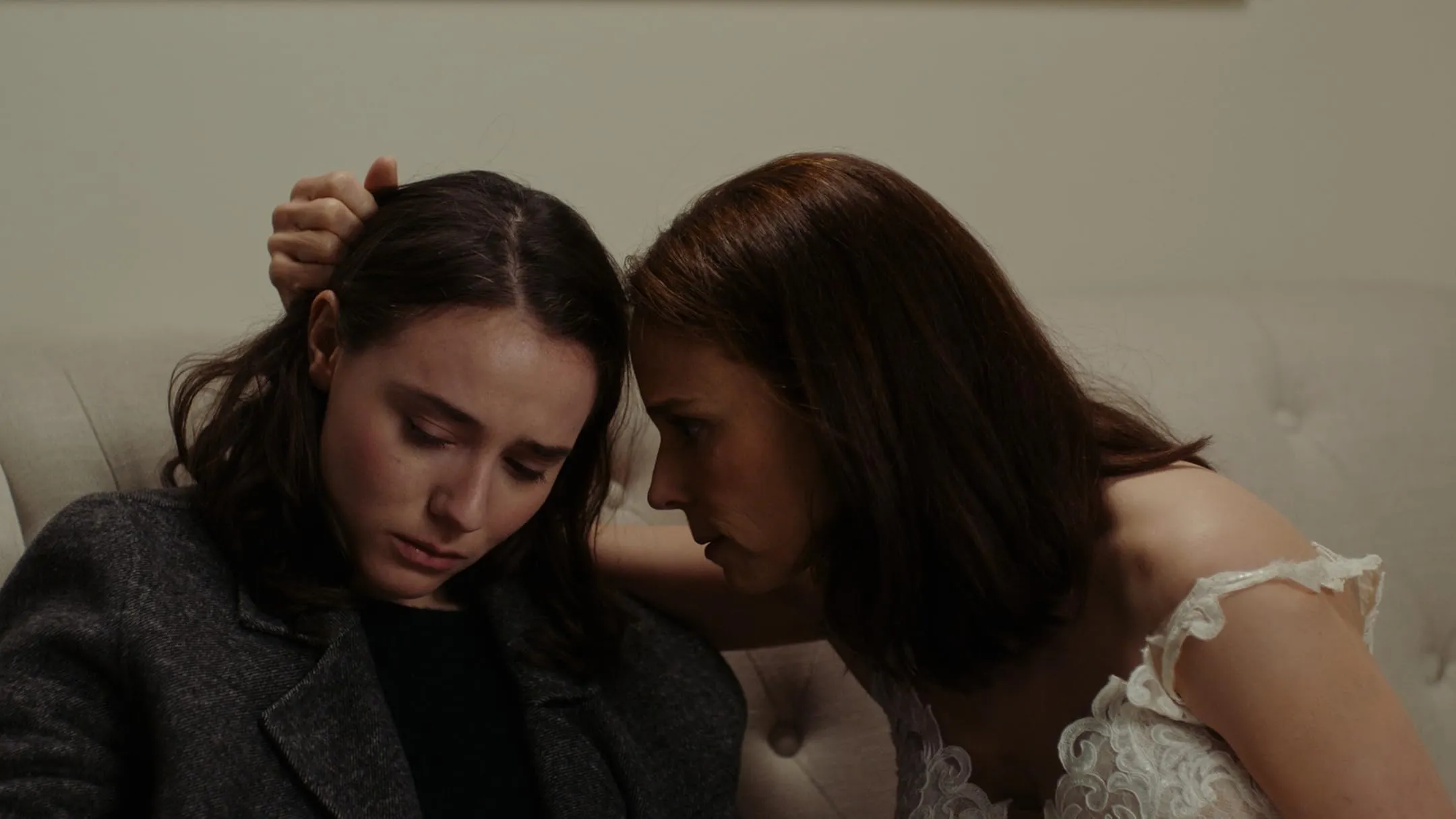
By leaving his family behind, the film risks losing some of its emotional momentum, but the choice focuses the story squarely on Samuel’s internal reckoning. The supporting characters he interacts with across both locations function as mirrors. His adult children are living testaments to his parental failures, their struggles a direct reflection of his neglect. The alluring younger woman he meets in Ireland represents a final, flickering fantasy of the ladies’ man he once was.
The film smartly avoids a simplistic path to redemption. There are no grand apologies or tearful reconciliations that neatly resolve a lifetime of damage. Samuel’s journey is messier and more honest. It is about the process of seeing himself, and his legacy, with a clarity that has long eluded him.
His redemption, if it can be called that, comes in the form of acceptance. He learns to live with the ghosts that populate his mind, eventually treating them as familiar companions on his terminal path. The film’s final impression is of mortality as a strange, lyrical, and darkly humorous unraveling, a final poem composed of a life’s beautiful and regrettable verses.
Death of a Ladies’ Man is a 2020 Canadian-Irish comedy-drama film, directed by Matthew Bissonnette and heavily influenced by the music and spirit of Leonard Cohen. The film premiered on September 24, 2020, at the Calgary International Film Festival (CIFF) and had a limited Canadian release on March 12, 2021, distributed by Mongrel Media. The movie is set to the music of Leonard Cohen and is available to stream on various platforms, including Apple TV and Prime Video, depending on your region.
Full Credits
Director: Matt Bissonnette
Writers: Matt Bissonnette, Bobby Theodore
Producers and Executive Producers: Corey Marr, Don Carmody, Martina Niland, Marie-Claude Poulin, Aleksandr Kushaev, Mark Gingras, Hengameh Panahi, Charlotte Mickie, Hussain Amarshi
Cast: Gabriel Byrne, Jessica Paré, Brian Gleeson, Antoine Olivier Pilon, Karelle Tremblay, Suzanne Clément, Pascale Bussières, Carolina Bartczak, Joel Bissonnette, Raphael Grosz-Harvey, Alex Ivanovici, Tyrone Benskin, Richard Jutras, Pat Kiely, Nora Guerch, Massimo Cannistraro, Mike Paterson
Director of Photography (Cinematographer): Jonathon Cliff
Editors: Matt Lyon
Composer: Stephen Rennicks
The Review
Death of a Ladies' Man
Death of a Ladies’ Man is a daring and often beautiful film, anchored by a career-best performance from Gabriel Byrne. While its ambitious blend of surreal musical numbers and grounded drama can feel uneven, its commitment to a unique, poetic vision is undeniable. The narrative succeeds as a messy, lyrical, and darkly funny character study that uses the music of Leonard Cohen to explore one man's final, chaotic reckoning with himself. It is a flawed but deeply felt cinematic elegy.
PROS
- A masterful and deeply nuanced lead performance from Gabriel Byrne.
- The creative, ambitious integration of Leonard Cohen's music into the narrative fabric.
- A successful blend of wry humor and genuine poignancy.
- Bold and memorable surrealistic sequences that visualize the protagonist's inner state.
CONS
- The frequent and abrupt tonal shifts between drama and musical fantasy can be jarring.
- Supporting characters feel underdeveloped, often serving only as reflections of the protagonist.
- The narrative’s structural split between two countries can feel disjointed.