





























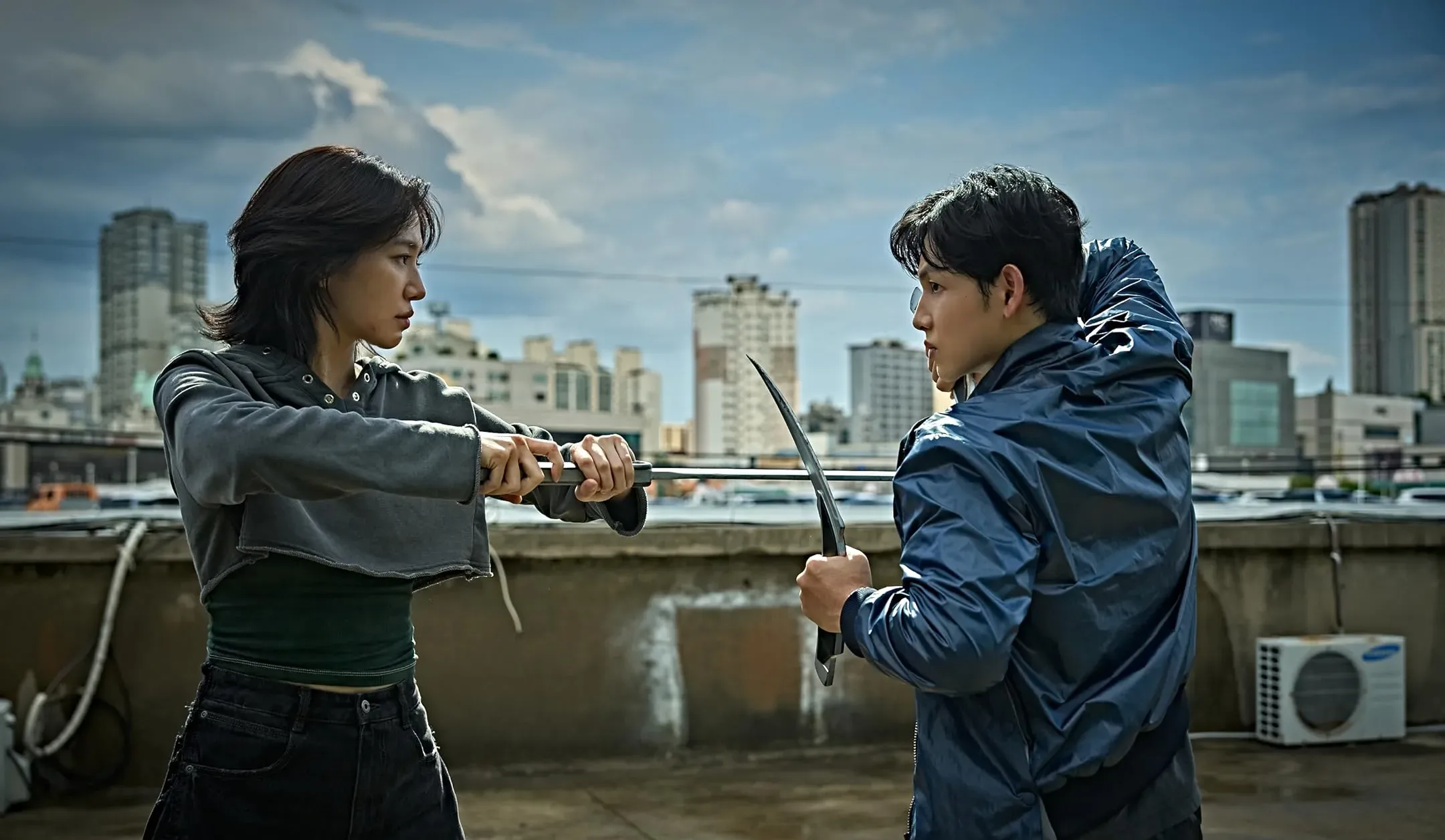

A system without its architect is merely a collection of decaying habits. This idea is the foundation of Mantis, a film that explores the violent vacuum left behind when rules and rulers are erased. It operates within the same universe as Kill Boksoon but tells a distinct story about the messy process of succession. The story opens on an underworld of professional assassins in freefall after the death of their industry’s titan.
This chaotic environment, where alliances are temporary and survival depends on ruthlessness, mirrors the power struggles seen in many global crime stories. At this precarious moment, the supremely skilled killer Han-ul, known as Mantis, returns to Seoul. He sees the anarchy not as a threat but as a business opportunity, a chance to build his own dynasty from the rubble of the old one.
The Heart of the Matter: A Bond Turned Brittle
The film finds its emotional weight in the disintegrating bond between two friends, placing this relationship above the spectacle of its assassinations. This dynamic recalls the potent “dosti-dushmani” (friendship-enmity) narratives prevalent in Indian cinema, where loyalty is tested by ambition.
Yim Si-wan portrays Han-ul with a charismatic swagger that masks a deep naivety; his arrogance prevents him from seeing the industry’s shift or his friend’s growing resentment. He is an artist of violence but a novice in leadership. His foil is Jae-yi, played with a phenomenal, simmering intensity by Park Gyu-young. She is the story’s anchor, a warrior whose skill may now exceed Han-ul’s. Park’s performance is a study in restraint, communicating years of frustration through subtle glances and a rigid posture before it erupts.
The on-screen chemistry between the leads is palpable, making their partnership feel genuine. As professional pressures mount, their relationship frays, transforming from mutual support to a rivalry poisoned by jealousy. Watching over them is the stoic mentor Dok-go, a figure from the old guard whose quiet presence serves as a constant reminder of the world that was lost and the discipline it once demanded.
A Spectacle of Blades and Wit
Mantis distinguishes itself through its action and a notable shift in tone. The fight choreography is fluid and hard-hitting, a kinetic dance where weapons are extensions of character. This approach, where an instrument of death defines the user, echoes the hero-centric action design of many South Indian blockbusters.

Han-ul’s curved blades are used in swift, circular motions, making him seem like a whirlwind of steel. Jae-yi’s swordplay is more direct and powerful, each strike filled with purpose. The camera work in these sequences favors clarity over chaos, allowing the audience to appreciate the skill involved. Director Lee Tae-sung opts for a lighter, more humorous mood compared to the grim atmosphere of the film’s predecessor, a choice that aligns with the global “masala” trend of blending genres.
Moments of comedy are used to break the tension, making the violence feel more like spectacle. While the direction is proficient and captures the energy of each confrontation, it sometimes lacks the distinct visual signature that made the previous film’s set pieces so memorable. The action serves the plot well, building toward a satisfying final clash where fighting styles and emotional conflicts merge completely.
Commerce, Chaos, and Creative Flaws
Beneath its slick surface, Mantis explores themes of modern economic anxiety. The assassin’s world becomes a metaphor for the precarious freelance economy, where individuals fight for scraps in an unregulated market. The film depicts this through scenes of desperate killers underbidding each other and the constant hustle for the next contract.

This critique of capitalism will be familiar to international audiences, mirroring stories from new-wave Indian cinema about urban disillusionment. The narrative is not without its weaknesses, however. Several story threads, such as the plight of other young assassins, feel underdeveloped. The character of Benjamin, a smug tech investor, is an especially weak point. He consumes valuable screen time with a subplot that feels disconnected from the main drama and resolves with little impact.
A noticeable lull in the middle act also hampers the movie’s momentum. It is filled with conversations that circle back on themselves instead of pushing the story forward. Despite these stumbles, the film succeeds because its core relationship is so well-realized, and its action sequences are executed with flair.
Mantis is a 2025 South Korean action thriller film that serves as a spin-off to the 2023 movie Kill Boksoon. The movie is directed by Lee Tae-sung and is distributed worldwide by Netflix. The plot follows Han-ul, an ace assassin nicknamed “Mantis” who returns from vacation to find the hired killer industry in complete chaos. He, along with his former rival Jae-yi and a retired legendary killer named Dok-go, finds himself competing for the top spot in the violent underworld. The film premiered exclusively on Netflix on September 26, 2025.
Full Credits
The Review
Mantis
While its story is hampered by a slow middle act and underdeveloped subplots, Mantis is an entertaining action film anchored by the electric chemistry of its leads. The stylish combat and exploration of a chaotic freelance underworld are effective, but the powerful dynamic between its two central rivals is what makes this a worthy expansion of its world.
PROS
- A strong, emotionally complex relationship between the two main characters.
- Excellent lead performances, particularly from Park Gyu-young.
- Fluid and well-choreographed action sequences with distinct fighting styles.
- An interesting thematic parallel between the assassin underworld and the modern gig economy.
CONS
- Noticeable pacing issues, with a significant lull in the middle of the film.
- Several side plots and characters feel underdeveloped or unnecessary.
- A lighter tone that may disappoint viewers seeking the predecessor's dramatic weight.
- The visual style is less distinctive than the film that came before it.