










Ali Asgari’s Divine Comedy operates as a sharp, self-aware diagnosis of a specific cultural sickness: the bureaucratic strangulation of art. The film centers on Bahram, an arthouse director in Tehran played with a perfect neurotic weariness by the actual filmmaker Bahram Ark. His particular affliction is a commitment to his principles. He makes uncompromising films in the Turkish-Azeri language, and for this, the state censors have consistently denied him a screening permit.
His latest work is no exception. Joined by his spirited and defiant producer, Sadaf (a magnetic Sadaf Asgari), he decides to spend a single day navigating the city’s labyrinthine social and political landscape to stage an illegal screening. What follows is a witty, quietly furious examination of artistic expression in a place that fears it, framing the simple act of showing a movie as a Sisyphean struggle. The tone is less a roar of anger and more a deeply sarcastic sigh.
An Absurdist’s Guide to Distribution
The quest for a screen sends Bahram and Sadaf on a modern odyssey through the circles of Tehran’s film industry, a landscape populated by hypocrites, sycophants, and the occasional true believer. Their journey is a series of frustrating, often hilarious, vignettes that map the topography of artistic compromise.
They first approach a cinema owner who extols the virtues of their early, collaborative work but now exclusively programs state-sanctioned populist comedies with titles like Women Are Amazing. The exchange lays bare the cynical mechanism of state-sponsored entertainment: a diet of frivolous content designed to keep the populace placid.
This philosophy finds its avatar in Bahram’s own twin brother, Bahman, a successful director who has traded artistic ambition for comfort. In his lavish apartment, a poster of Godard hangs like a relic of a forgotten faith, a ghost of the cinephilia he and Bahram once shared. He has sold out, and the system rewards him for it.
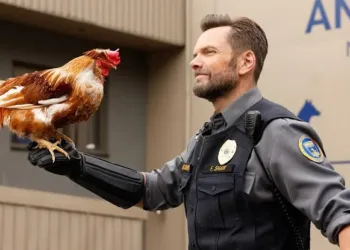
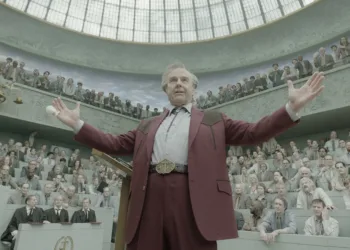
The duo’s encounters grow stranger. They must tiptoe around the fragile ego of Rouzbeh, a coke-fueled actor whose grandiose monologues reveal a talent curdled by a lack of meaningful work. He is a casualty of the very system that Bahman thrives in. Later, in a moment of pure surrealism, a man on the street proclaims himself a prophet, offering to guide Bahram from purgatory before deftly stealing his doughnut. It is perhaps the film’s most succinct metaphor. Even salvation is a petty scam.
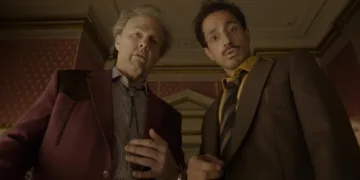
The day’s journey through this urban purgatory culminates in a meeting with Haranov, a government official whose expensive suit and reptilian smile barely conceal the threat beneath his offers of “help.” He is the polite face of the invisible, monolithic power that dictates every choice, turning the creative process into a paranoid game of chess.
The Camera as Cage, The Vespa as Escape
Asgari’s cinematic language is a direct reflection of his themes, a carefully constructed dialectic between confinement and liberty. For much of the film, his camera remains static, employing long, unflinching takes. Characters are frequently framed by doorways, windows, or corridors, creating a diorama of impotence. These shots are not merely stylistic; they are visual prisons, mirroring the institutional and social paralysis that traps Bahram.
The rigid composition transforms the screen into a cage, making the audience complicit in the act of observation without intervention. The breezy jazz score that plays over these scenes creates a dissonant, almost cruel, sense of casualness in the face of this suffocation.
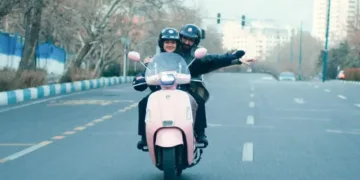
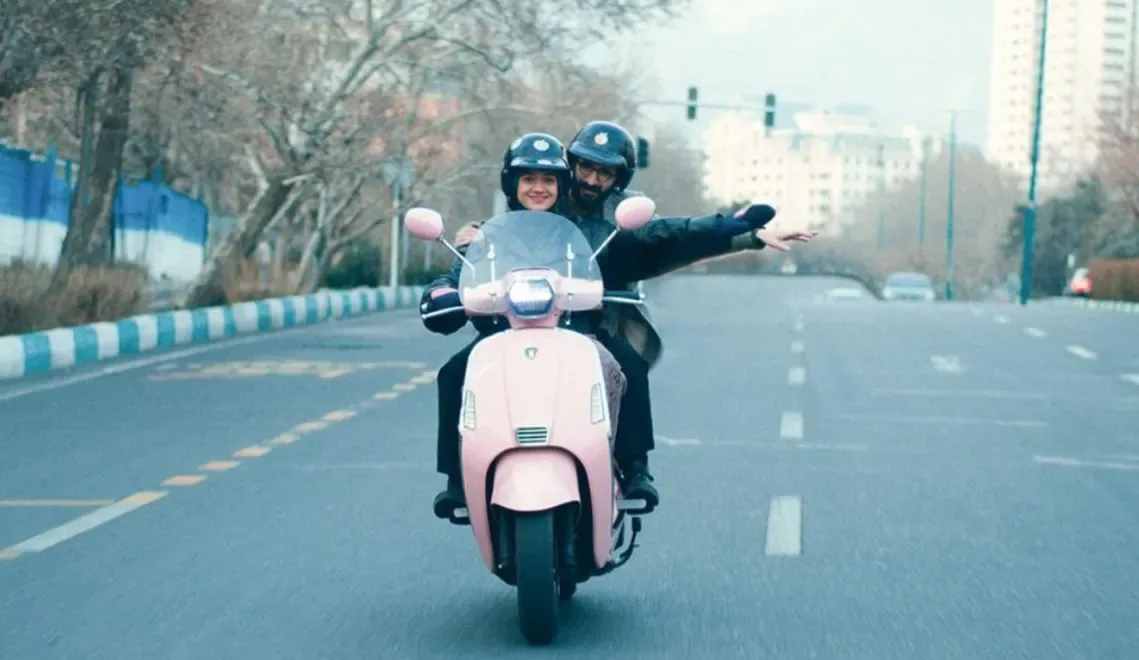
Then, the film breathes. In sequences showing Bahram and Sadaf zipping through Tehran on her sorbet-pink Vespa, the camera becomes fluid and free. These moments, clear nods to Nanni Moretti’s Dear Diary, are exhilarating gasps of air, suggesting that freedom, however fleeting, is found in motion and personal defiance. The city blurs into a backdrop for their small rebellion.
This stylistic contrast is the film’s central visual argument. The meta-fictional architecture is just as crucial. Bahram Ark and Sadaf Asgari are not just playing characters; they are performing a version of their own reality. Sadaf was banned from acting in Iran after appearing at Cannes, making her presence here an act of civil disobedience.
This collapses the distance between performer and role, creating a “performative truth” where the fiction is haunted by reality. The script’s cinematic references, especially a recurring discussion of The Matrix, function as a shared language. Bahram’s quiet confession that he still sometimes tries to bend the spoon is a heartbreaking admission of his own struggle against an immovable system—a private act of faith in the impossible.
Laughter in the Face of the Void
Divine Comedy uses its cynical humor as a potent political weapon, a tool for dissecting a repressive system without succumbing to didacticism. It belongs to a courageous tradition of Iranian cinema where the filmmaking process itself becomes a commentary on state control. It shares a philosophical lineage with the work of Jafar Panahi, who turns a taxi into a mobile film studio in Taxi, and Mohammad Rasoulof, whose films like There Is No Evil confront the moral corrosion demanded by the state.
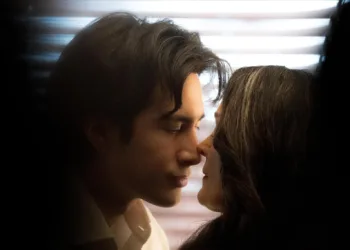
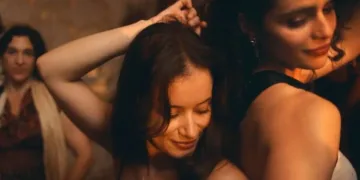
Asgari’s film is a lighter, more satirical entry, but its bite is no less sharp. The simple, sustained presence of Sadaf, with her vibrant blue hair and refusal to wear a hijab, is a quiet but powerful symbol. Her appearance is not just a character choice; it is her argument, a flag planted on the contested territory of her own body.
The film’s final act sees the duo achieve their goal: a clandestine screening in a private home. They have, for a moment, bent the spoon. This small victory is immediately punctured by a news alert announcing the fall of Syrian dictator Bashar al-Assad. Reality crashes the party. The film screen, a space of crafted rebellion, is instantly dwarfed by the brute force of history.
It is a stunning, ambiguous ending. Does it render their artistic struggle trivial, or does it reinforce its urgency by showing the fragility of all authoritarian structures? The film leaves the question open. The title’s meaning deepens here. The “divine comedy” is not just a literary reference; it is the cosmic joke of trying to create something true in a world built on lies, and the defiant laughter required to endure it.
Divine Comedy is a 2025 satirical film directed by Ali Asgari. The movie follows an Iranian filmmaker who decides to screen his banned work without official permission, navigating the absurd bureaucracy and censorship in his country. The film premiered at the Venice International Film Festival in 2025. It is a fictional story with real-life connections, as the director and some of the cast have faced similar issues with Iranian authorities. The film is a co-production between Iran, Italy, France, Germany, and Turkey.
Full Credits
Director: Ali Asgari
Writers: Alireza Khatami, Bahram Ark, Bahman Ark, Ali Asgari
Producers and Executive Producers: Milad Khosravi, Ali Asgari, Hasan Köroğlu, Lorenzo Cioffi, Giorgio Giampà, Avantika Singh Desbouvries, Solmaz Azizi, Lasse Scharpen
Cast: Bahram Ark, Sadaf Asgari, Hossein Soleimani, Mohammad Soori, Amirreza Ranjbaran, Faezeh Rad, Milad Ashkali, Amirreza Ranjbaran, Shahoo Rostami
Director of Photography (Cinematographer): Amin Jafari
Editors: Ehsan Vaseghi
Composer: Hossein Mirzagholi
The Review
Divine Comedy
Divine Comedy is a brilliantly sharp and self-aware satire that finds potent humor in the face of absurdity. Propelled by a clever script and authentic performances from actors living the very reality they depict, the film is a masterclass in cinematic defiance. Ali Asgari uses a distinctive visual style and a meta-fictional framework to dissect the Kafkaesque nature of artistic censorship. It is an intelligent, funny, and deeply relevant work that cements its place within the courageous tradition of modern Iranian filmmaking, arguing that sometimes the most powerful response to oppression is a perfectly timed, sarcastic laugh.
PROS
- An intelligent and witty script filled with dry humor.
- A powerful meta-fictional premise that blurs the line between reality and art.
- Thoughtful cinematography that visually represents the film's central themes.
- Strong, naturalistic performances from the lead actors.
- A timely and sharp critique of state censorship and artistic freedom.
CONS
- The specific cultural and cinematic references may feel dense for some viewers.
- Its cynical tone and dry humor might not connect with all audiences.
- The narrative's episodic, vignette-style structure could feel disjointed to some.