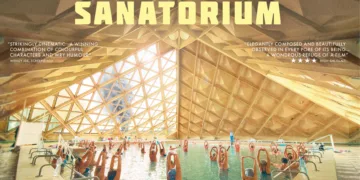


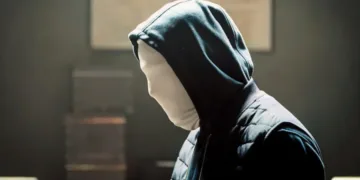










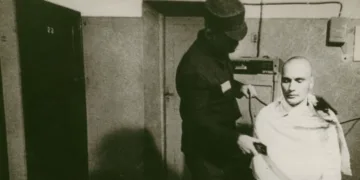


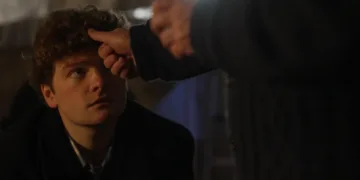
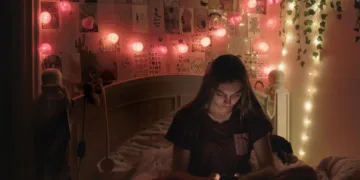











The Kuyalnik Sanatorium stands like a monument to a future that never arrived. Gar O’Rourke’s camera finds it beached near Odesa, a brutalist concrete behemoth slowly surrendering to time. The visual language is established immediately through static, precisely composed shots that frame vast, empty corridors and water-stained ceilings with a kind of reverent stillness.
Denys Melnyk’s cinematography finds a strange beauty in the decay; the pale, institutional light catches on peeling paint, rendering the textures of neglect with painterly care. This is a place hermetically sealed from the present. Yet, the seal is imperfect.
Beyond its walls, a war unfolds, and the sanatorium’s atmosphere is thick with this knowledge. The quiet routine of mud wraps and electro-massage is a fragile performance of normalcy, a collective agreement to ignore the rumbles from the outside world. The film is an observational study of this agreement, watching a small society attempt to heal itself while a nation is wounded.
A Catalogue of Minor Cures
The sanatorium’s dwindling population is a collection of souls seeking repair. O’Rourke observes them with a detached intimacy, allowing their stories to surface without narrative intrusion. The manager, Dmitriy, is a Falstaffian figure, a great wardrobe of a man whose bellowing commands are the primary acoustic events in the otherwise quiet halls.
He moves through his decaying kingdom with a proprietary air, part warden and part worried father, his anxiety over low booking numbers a darkly comic counterpoint to the existential dread of his country. His presence is theatrical, a force of personality attempting to hold entropy at bay.
Among his guests is Natalia, a mother whose singular mission is finding a wife for her 40-year-old son, Andriy. Her quest, followed by the camera with wry amusement, is a desperate grasp for a future, for continuity, in a nation whose own future is perpetually in question.
Their slow dance to George Michael’s “Careless Whisper” at the sparsely attended disco is a masterpiece of tragicomedy. The camera holds a wide shot, capturing the cavernous, empty room, the lonely flashing lights, and this small island of human tenderness, all set to a pop artifact from another world.
Their story is placed alongside that of a young soldier whose body is a map of the frontline, his rehabilitation exercises a quiet testament to the war’s physical cost. A widow attributes her stress-induced psoriasis to the loss of her husband in the conflict. These figures prevent the film from drifting into pure absurdism; their physical and emotional scars are the story’s anchor to a brutal reality.
A Hiss on the Horizon
The war in Sanatorium is never shown. It exists as a disturbance in the sensory field, a masterful exercise in building suspense from absence. The film’s tension comes from this deliberate withholding, from the constant threat that lies just beyond the frame.

O’Rourke cultivates a specific kind of dread through long, static takes that force the viewer into a state of waiting, of anticipation for a disruption that may or may not come. This technique manipulates audience perception in a way that recalls classic psychological thrillers, where the most terrifying threat is the one you cannot see.
The sound design is the primary vehicle for this off-screen horror. The sanatorium’s mundane diegetic sounds—the clinking of cutlery, the low hum of arcane medical machines, the murmur of quiet conversation—create a fragile sonic bubble. This bubble is violently punctured by the shriek of an air raid siren, a sound that rips through the placid facade and sends residents shuffling to basement shelters.
Visually, the threat is more insidious. A lazy plume of smoke on the distant horizon, observed with the same calm framing as a seaside vista, becomes a recurring motif of corrupted tranquility. Inside, the blue light from a smartphone screen illuminates a face checking for missile alerts.
These small screens become portals to the external chaos, creating a palpable internal tension within the otherwise serene compositions. By focusing on these sensory cues, the film translates a geopolitical crisis into a personal, psychological experience of perpetual, managed fear.
Symmetry in Decay
The film’s aesthetic is its argument. Melnyk’s cinematography employs a rigorous formalism, with locked-off shots and slow, deliberate zooms that create a dioramic effect, as if observing specimens in a carefully constructed habitat. The compositions are often strikingly symmetrical, turning the sanatorium’s brutalist architecture into a series of expressionistic frames that contain, and perhaps imprison, the human subjects within.

This rigid visual control, reminiscent of Wes Anderson’s framing but drained of his whimsy, creates a powerful friction against the emotional messiness of the characters’ lives. The color palette—a symphony of washed-out institutional mints, pale beiges, and livid pinks from therapeutic lamps—reinforces the sense of a world faded, a time capsule from a defunct empire.
The soundtrack amplifies this feeling of dislocation. Jaunty vintage Ukrainian pop plays over scenes of arcane medical treatments, an echo from a more stable past that feels both comforting and deeply ironic. The use of “Careless Whisper,” a global hit from the Cold War’s final act, feels like an alien broadcast, a message from a world of simple heartbreaks penetrating one of complex survival.
The film’s ultimate statement lies in this friction, in the human impulse to create small pockets of order and ritual inside a larger chaos. The sight of guests singing the national anthem, tears visible on their faces in a rare moment of direct emotional expression, is the instant the film’s carefully constructed containment finally breaks. It reveals the collective grief that underpins every individual quest for a minor cure.
Sanatorium is a 2025 documentary comedy film directed by Gar O’Rourke. It had its world premiere at CPH:DOX in March 2025 and was released in Irish theaters on September 5, 2025. The film follows the staff and guests of a sanatorium in Odesa, Ukraine, as they seek healing and happiness while the Russo-Ukrainian War takes place nearby. It was selected as Ireland’s official entry for the Best International Feature Film at the 98th Academy Awards.
Full Credits
Director: Gar O’Rourke
Producers: Andrew Freedman, Ken Wardrop, Samantha Corr
Executive Producer: Greg Martin
Director of Photography: Denys Melnyk
Editor: John Murphy
Composer: Denis Kilty
The Review
Sanatorium
A masterclass in atmospheric storytelling, Sanatorium documents a war by studiously ignoring it. O’Rourke’s formal precision and Melnyk’s stark cinematography capture a nation’s psychological state with deep insight. It exchanges the bombast of conflict for the quiet hum of endurance, finding in the mundane rituals of a decaying health resort a deeply affecting picture of resilience. The film is a quiet, haunting, and essential piece of cinema, examining the space between personal healing and collective trauma. A formally rigorous and profoundly human work.
PROS
- Stunning, formalist cinematography that turns the setting into a character.
- Masterful creation of psychological tension and atmospheric dread.
- Gentle, observant portrayals of its subjects offer a unique window into Ukrainian resilience.
- Intelligent, indirect approach to depicting the pervasive effects of war.
CONS
- The slow, observational pacing may feel inert to some viewers.
- Its highly controlled, formalist style can create a sense of emotional distance.
- The film's singular focus might leave some wanting a wider perspective on the conflict.