









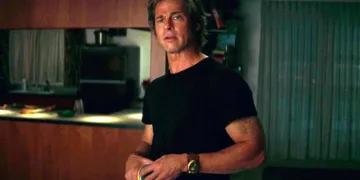


















Ablikim Rahman is asked to perform happiness, anger, and sadness for a camera that appears to know what each emotion should look like. Happiness produces effort. Anger becomes posture. Sadness arrives with unsettling ease, as though the request has touched something the experiment was never equipped to measure.
This opening screen test contains the wound inside Synthetic Sincerity. Marc Isaacs’ hybrid documentary enters an artificial intelligence laboratory where human expressions are scanned, studied, and converted into training material. The researchers want data that can imitate inner life. Isaacs keeps filming the moments when inner life refuses to become legible.
The institution is called the Synthetic Sincerity Lab, housed inside the fictional University of Southern England. Its slogan promises a place “where data learns to be human.” The phrase sounds optimistic until the film begins revealing the bargain beneath it.
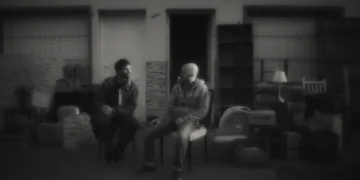
Isaacs licenses footage from his earlier documentaries so that researchers can study the faces, pauses, lies, and confessions of people he once filmed. Lives become an archive. The archive becomes material. The camera once preserved a person’s presence. Here, preservation starts to resemble extraction.
The Image Talks Back
Isaacs’ guide through the laboratory is an artificial assistant modelled on Romanian actor Ilinca Manolache. Her smooth face appears on a screen and speaks with the confidence of a supervisor who has already decided that the human filmmaker is the least efficient component in the room. She instructs him to capture “emotional content,” then warns him against violating the researchers’ privacy.
The comedy is quiet and cruel. Isaacs has spent his career approaching strangers, waiting for some unrepeatable gesture to surface. The assistant reduces that method to a task description. Find emotion. Record it. Deliver the file.
The film withholds the process that turned Manolache’s face into this digital presence. We see the finished mask, but little of its manufacture. This absence weakens the investigation of AI as a technology, since the machinery remains mostly out of sight. It also gives the avatar a spectral quality. She is a face separated from labour, history, consent, and bodily risk. Her expression is precise because nothing appears to threaten her.
Isaacs responds by turning the film toward the workers around him. Dawn shows him a house full of pinball machines, including cabinets whose lights, metal tracks, and physical impacts offer sensations no screen can reproduce. She prefers the games because she can feel their movement. The ball collides with the machine. The machine answers. No such answer comes from the avatar. It speaks, but nothing touches it.
Lives Converted Into Material
The lab studies Kelly, the shoplifter Isaacs filmed in Outside the Court. A researcher asks what made her interesting. Isaacs speaks about people who have left their pasts behind, then confronts the uncomfortable resemblance between Kelly taking goods and his own taking of her image.
The comparison does not absolve him. It exposes the unequal exchange at the base of documentary filmmaking. Kelly surrendered her face, voice, and contradictions to a film that would travel beyond her control. Years later, those same fragments are being offered to a machine. Her silence can be classified. Her evasions can be labelled. Her pain can become useful.
The researchers are drawn to people who conceal emotion, since concealment produces small facial tensions that software can analyze. Yet those tensions carry histories the system cannot see. Professor Yi-Zhe Song recalls leaving China after an abrupt academic transfer. Lynn El Safah speaks to her grandmother in Beirut during Israeli bombing, then faces institutional pressure connected to her work with a Uyghur subject and the university’s dependence on Chinese money.
These scenes drag politics into rooms designed to appear neutral. A laboratory can call a face “Subject 22,” but the number cannot erase exile. A disciplinary hearing can present itself as procedure, but money and fear sit at the table.
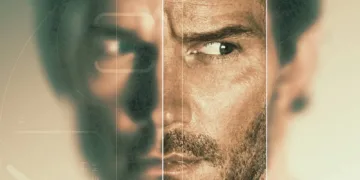
The proposed creation of an artificial Ablikim carries the film’s most troubling idea. The researchers suggest that a synthetic version might express feelings the real man cannot. The premise treats restraint as a defect waiting for technical correction. Ablikim’s guardedness may be the honest form of his experience. His refusal to speak freely contains its own truth. A machine can make him confess. That does not mean the confession belongs to him.
The Documentary Machine
Isaacs fills the film with staged exchanges, green-screen reveals, uncertain performances, scripted authority, and sudden tears in the surface of reality. The laboratory may be fictional. Some workers may be performing versions of themselves. The disciplinary conflict may belong to fact, invention, or the uneasy territory where one begins borrowing the clothes of the other.
This instability suits a film concerned with sincerity. Documentary has never been innocent. The filmmaker chooses the frame, asks the question, keeps the pause, removes the answer, then presents the arrangement as an encounter with truth. Isaacs does not place cinema outside the problem. He treats editing as an older machine for manufacturing meaning.
The loose structure can grow frustrating. The film moves between archival footage, Ablikim’s scan, Dawn’s pinball collection, Lynn’s family crisis, academic censorship, and Isaacs’ arguments with his digital handler. Several threads stop before their pressure has fully accumulated. The AI experiment remains hazier than the people surrounding it, which leaves the technological inquiry thinner than its emotional material.
Still, the wandering has purpose. Human character rarely reveals itself through the requested answer. It appears beside the question, inside a hesitation, through a joke that arrives at the wrong time. The lab searches faces for readable signals. Isaacs records everything that escapes the reading.
Near the edge of the frame, a person pauses before performing sadness. The pause belongs to no category. It waits there, small and resistant, carrying a life the machine has already mistaken for data.
This thought-provoking documentary explores the rise of generative artificial intelligence, examining whether genuine emotional authenticity can be taught to machines. The film investigates how modern technology challenges our perceptions of reality, identity, and existence.
Full Credits
Title: Synthetic Sincerity
Distributor: Independent
Release date: 2025
Director: Marc Isaacs
Writers: Marc Isaacs
Producers and Executive Producers: Marc Isaacs
Cast: Marc Isaacs
The Review
Synthetic Sincerity
Synthetic Sincerity finds humanity where its machines fail to look: in hesitation, political memory, embarrassment, and the silence before a face obeys an instruction. Marc Isaacs turns documentary ethics into a hall of mirrors, with Ablikim’s performed sorrow and Dawn’s physical attachment to pinball offering its clearest images. The loose structure leaves its AI experiment frustratingly underexamined, yet the film understands something colder and sadder: imitation may reproduce expression, while experience remains elsewhere, unreachable.
PROS
- Ablikim’s unsettling screen test
- Sharp documentary self-critique
- Rich human digressions
- Playful formal deception
- Thoughtful resistance to AI panic
CONS
- Underdeveloped AI process
- Loose, wandering structure
- Unclear fictional boundaries
- Patronising central experiment