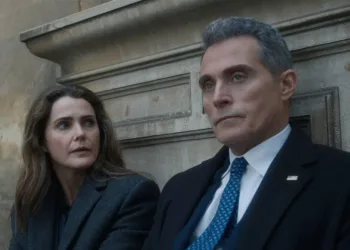




























The romantic vision of Paris is gone, replaced by a city of surveillance and strict social control. In the near future of Dog 51, the French capital is partitioned into three distinct zones, a physical manifestation of its class hierarchy. The elite live insulated in Zone 1, while the disenfranchised are confined to the decaying streets of Zone 3.
Policing is no longer a human endeavor; it’s the domain of ALMA, a predictive artificial intelligence that calculates guilt and turns officers into monitors of its cold logic. The system appears flawless until its own creator is murdered, a crime that directly challenges the machine’s authority.
To solve it, two officers from opposing worlds must collaborate: Salia, a disciplined agent from the protected Zone 2, and Zem, a jaded cop from the forgotten outer rim. They are thrown together into a high-speed thriller that questions the price of absolute technological dependence.
A Familiar Future, A Divided Paris
Director Cédric Jimenez creates a tangible world, layering iconic Parisian landmarks with the harsh aesthetics of a police state. The visual storytelling is potent; the audience feels the oppressive atmosphere through the cold, blue-tinted lighting of the official zones and the omnipresent hum of surveillance drones.
Military checkpoints are not just background elements but hostile stages where citizens are scanned and sorted, their worth determined by an algorithm. This world-building directly serves the film’s commentary on class struggle. The physical separation is absolute, reinforced by a system that offers the barest illusion of social mobility through a televised game show. This detail makes the societal decay feel more insidious. The environment becomes an active antagonist, shaping the characters’ choices and limitations.
Still, the film’s blueprint feels heavily borrowed from decades of science fiction. The rain-slicked streets, towering advertisements, and a morally compromised AI will immediately call to mind genre cornerstones. This familiarity is a double-edged sword. On one hand, it provides a useful shorthand, allowing the story to get to its central conflict quickly.
On the other, it prevents the film from asking truly new questions. Where other dystopian narratives use their settings to explore profound philosophical ideas, Dog 51 uses its world primarily as a high-stakes backdrop for its neo-noir plot. The “future” presented here has a distinctly retro feel, as if imagined from the late 90s, preventing it from offering a genuinely visionary or unsettling glimpse of what might come next.
The Human Element in a Digital Age
The film finds its soul, and its strongest argument against a world run by code, in the relationship between its two leads. Salia, played with a tightly wound intensity by Adèle Exarchopoulos, is a product of the system she serves. Her belief in its order is a shield against the chaos she witnesses. She is a stark contrast to Gilles Lellouche’s Zem, a man worn down by the futility of his work in Zone 3.

He operates on instinct and a weary empathy that the AI cannot compute. Their on-screen chemistry provides the movie’s emotional anchor and its central thematic tension. The progression from mutual disdain to a raw, unspoken partnership is built through shared glances, the rhythm of their arguments, and the gradual erosion of their professional facades.
This dynamic gives the story a human warmth that its cold, digital world desperately needs. One standout sequence in a grimy karaoke bar is a masterful piece of character work. By choosing to sing, they engage in an act of messy, imperfect, and deeply human expression. It is a deliberate pause in the narrative’s propulsive pacing, a moment that reveals their shared vulnerability and makes their eventual connection feel earned.
In contrast, the supporting cast, which includes Louis Garrel as a resistance leader, feels more functional. They represent ideas rather than fully realized people, a missed opportunity to build out the ideological landscape of this fractured Paris. The story remains tightly focused on its central pair, making their journey the heart of the experience.
Thrills, Pacing, and an Unsettling Message
As an action-thriller, Dog 51 is a lean, propulsive machine. The pacing is relentless, constructed from a series of taut, efficient sequences that flow together seamlessly. Jimenez favors kinetic, grounded action over large-scale spectacle. The shootouts are messy and claustrophobic, and the foot chases feel desperate.

The editing is sharp, cutting away any narrative fat to maintain a constant sense of forward momentum and high stakes. The central conspiracy, while engaging, may not offer many surprises to viewers familiar with the genre’s tropes. The film’s tension is not derived from guessing the outcome, but from watching the characters confront a truth that threatens to shatter their reality. The emotional weight is carried by their reactions, not by the revelation itself.
The film’s warning against unchecked surveillance and our dependence on artificial intelligence is timely. It avoids delivering a heavy-handed speech, instead allowing the message to emerge from the plot’s mechanics. ALMA is not a mustache-twirling villain; it is the logical endpoint of a society that has chosen efficiency over empathy, and security over freedom.
The story poses relevant questions about what is lost when we outsource our judgment to automated systems. Dog 51 is a stylish and effective genre piece that excels as a character-driven thriller. Its greatest assets are its powerful lead performances and its expertly managed pacing. While it may not introduce new arguments into the science fiction discourse, it repackages familiar anxieties into an energetic and deeply human cinematic ride.
Full Credits
Director: Cédric Jimenez
Writers: Cédric Jimenez, Olivier Demangel
Producers: Hugo Sélignac
Cast: Gilles Lellouche, Adèle Exarchopoulos, Louis Garrel, Romain Duris, Valeria Bruni Tedeschi, Artus, Lala &ce, Stéphane Bak, Thomas Bangalter, Daphné Patakia, Jeanne Herry, Féodor Atkine, Cyril Lecomte, Hugo Bardin, Sadou Bah, Mehmet Arikan
Director of Photography (Cinematographer): Laurent Tangy
Editors: Laure Gardette, Stan Collet
Composer: Guillaume Roussel
The Review
Dog 51
Dog 51 is a stylish and propulsive thriller that succeeds on the strength of its lead performances and relentless pacing. While its dystopian ideas feel borrowed from genre classics, the film presents them with an energy and emotional core that make the experience thoroughly engaging. The powerful chemistry between its central duo provides a necessary human anchor in a world dominated by cold technology, making this a ride worth taking, even if the destination feels familiar.
PROS
- Excellent chemistry and performances from the two lead actors.
- Tense, propulsive pacing and well-directed action.
- Strong world-building and atmospheric visuals.
- The central human relationship provides a powerful emotional core.
CONS
- Heavily relies on familiar science fiction tropes and concepts.
- The plot and its twists can be predictable for genre fans.
- Supporting characters are underdeveloped.
- Lacks a truly original or visionary take on its themes.