


















What if a map could lead you not to a destination, but to a memory? Eternal Return builds its world on this delicate premise. The story introduces Cassiopeia “Cass” Pfeffer, a young woman whose life is frozen by the grief of losing her great love, Julian. Once able to see flashes of the future, her world has shrunk to the cold logic of statistics, her heart shielded from further pain.
On her 29th birthday, a miserable milestone, she stumbles into an old map shop run by the quiet Virgil. He is a cartographer of the impossible, crafting maps from “remembrance points” that allow people to step back into the moments that shaped them. Cass sees a chance to revisit a life where she was happy, a path back to a past she believes is better than any future she could have.
A Fairytale That Forgets Its Own Rules
The film opens with a potent dose of charm that promises a consistently magical experience. A third-person, storybook narrator chronicles Cass’s life with precise timestamps, a device that immediately establishes a sense of fate and whimsy. This is paired with playful camerawork and a fanciful production design that feels carefully constructed.
The initial aesthetic is highly reminiscent of Bryan Fuller’s work on Pushing Daisies, a series where the stylized reality was an ironclad rule of its universe, informing every aspect of its storytelling. Eternal Return borrows this sensibility but treats it like an accessory rather than a foundation. The core problem is the film’s inability to commit to its own style.
The narration, so crucial in the opening act, fades away without explanation, only to reappear at odd intervals. This inconsistency breaks the immersive spell, making the cinematic world feel less like a cohesive reality and more like a collection of disconnected ideas.
The sparkly musical score is another element that overplays its hand. Instead of subtly supporting the emotional undercurrents of a scene, it often dictates the mood, insisting on a lighthearted feeling even when the characters’ expressions suggest something more complex and painful. A strong identity is established early, but the film cannot sustain it, resulting in a tonally uneven experience that feels less magical and more unfocused as it progresses.
Actors Adrift in a Sea of Whimsy
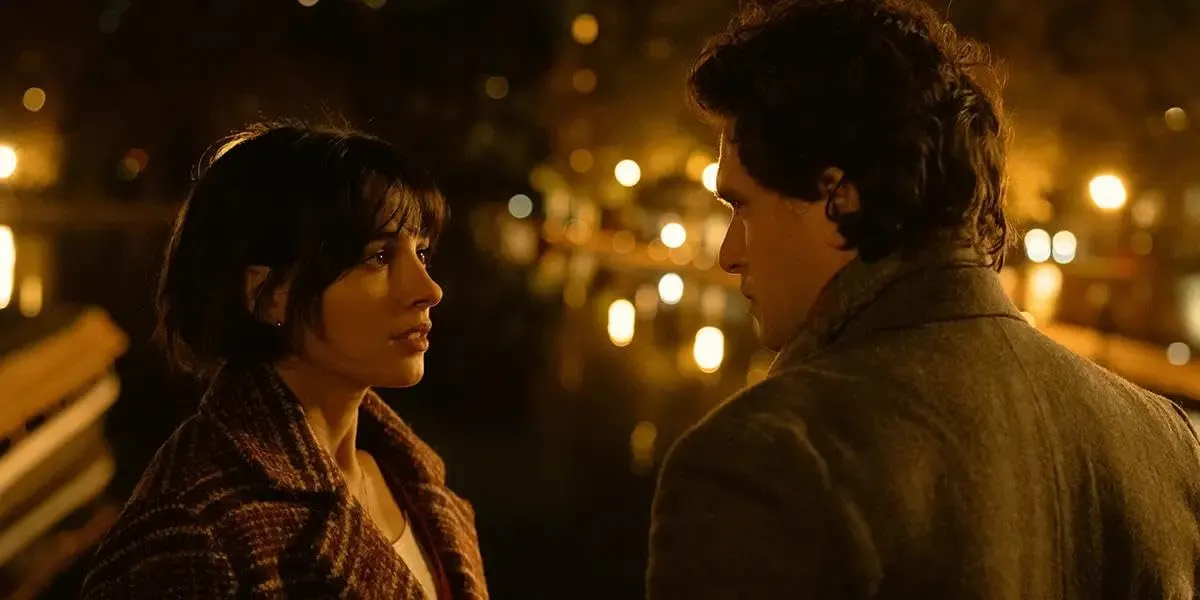
Amid the film’s wavering style, Naomi Scott delivers a performance that provides a much-needed emotional anchor. She portrays Cass’s deep sorrow not with grand theatricality, but with a lived-in exhaustion. It is visible in her downcast eyes and the weary slump of her shoulders. As she slowly allows wonder back into her life, Scott makes the shift feel earned and authentic, her expressions capturing a fragile hope that is constantly at risk of being extinguished.
She grounds the fantastical elements in a recognizable human experience, keeping the audience invested even when the script falters. Kit Harington attempts to craft a softer, more reserved character in Virgil, but the screenplay offers him very little to work with. Virgil is written as an enigma, a figure who exists almost entirely to serve Cass’s story. We learn next to nothing about his own past, his personal losses, or what drives his peculiar and magical occupation.
This lack of an inner life makes his developing romance with Cass feel hollow, a connection we are told exists but never truly feel because one half of the pairing is a blank slate. He functions like a quest-giver in a game whose own backstory is never revealed.
Simon Callow offers some energetic warmth as Virgil’s mentor, Malcolm, bringing a boisterous and lively spirit to his scenes. His performance, however, frequently tips into caricature, creating a tonal clash with the film’s more sincere emotional moments. His loud pronouncements and theatrical gestures feel like they belong in a different, more broadly comedic film.
A Story Told, Not Experienced
Eternal Return sets out to explore the familiar theme of choosing to live in the present instead of being lost in the past. Its unique premise offers a genuinely original way to approach this idea, yet the execution fails to give it the necessary weight. The central romance between Cass and Virgil is built on narrative shortcuts rather than earned intimacy.
Their time together is shown mostly through montages of walking through London and searching for remembrance points. These scenes advance the plot but do little to build a believable emotional bond. The relationship is asserted by the screenplay instead of being demonstrated through meaningful interaction. This weakness is especially apparent when compared to the vibrant, lived-in feel of Cass’s flashbacks with Julian.
Those scenes are filled with an authentic energy and specific details that make their love feel real. The present-day connection with Virgil feels flat and underdeveloped by contrast. The film becomes so preoccupied with manufacturing a whimsical atmosphere that it forgets to build a substantive emotional core.
Because the rules of its magic feel flimsy and inconsistent, the central choice Cass must make loses much of its power. Eternal Return is a frustrating film because its imaginative concept and Scott’s strong performance are stranded by a script that cannot commit to its own ideas. It offers a faint glimpse of a beautiful, moving story but is ultimately an incomplete and unsatisfying sketch.
Eternal Return is an upcoming romantic fantasy drama that premiered at the Toronto International Film Festival on September 8, 2025. It tells the story of Cass, a woman who has become emotionally invulnerable, and her encounter with an enigmatic mapmaker and his partner. They chart a course back in time to help her rekindle her passion for love.
Full Credits
The Review
Eternal Return
Eternal Return is built on a wonderfully imaginative idea, supported by a heartfelt and grounding performance from Naomi Scott. The film's initial whimsical style promises a magical journey, but its inconsistent execution and an underdeveloped central romance leave the story feeling emotionally weightless. It sketches a beautiful map but never quite reaches its destination, resulting in a frustrating film that is more a collection of charming notions than a fully realized story. It has moments of beauty, but they are lost in an unfocused and tonally uneven narrative.
PROS
- An original and imaginative central premise.
- A strong, emotionally resonant lead performance from Naomi Scott.
- Charming initial visual and narrative style.
CONS
- Inconsistent tone and filmmaking style that fades over time.
- Underdeveloped central romance that lacks believability.
- Key characters, particularly Virgil, are thinly written.
- Relies on narrative shortcuts instead of earned emotional development.