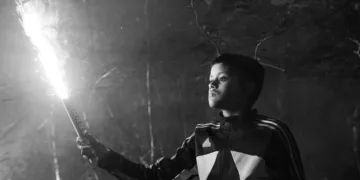











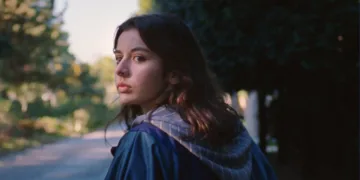















A sky, bleached of color, is perpetually torn by the passage of machines. In Imran Perretta’s Ish, the suburbs of Luton exist under this constant metallic roar, a sound that promises departure but offers none. This is the world of Ishmael, a boy of twelve whose interior landscape is as quiet and gray as the film’s photography. Still navigating the void left by his mother’s death, he finds a fragile locus for his being in his friendship with Maram, an older Palestinian boy who carries a different, sharper kind of grievance.
Their bond is forged in the town’s liminal spaces: a den of branches built in the woods, a shared secret held against the encroaching concrete. Here, in these fleeting pastorals, they perform the rituals of boyhood, picking blackberries whose sweetness is already tinged with the foreknowledge of decay. Their shared summer is a temporary state of grace, a pocket of existence before the world outside decides what they are to become.
The Treason of the Self
The language between Ish and Maram is its own sovereign territory, a fluid dialect of roadman slang and boyish whispers that insulates them from the adult world. Their code-switching is not mere affectation; it is the creation of a third space, a private reality built from shared experience that belongs to neither their families nor the hostile streets.
Their friendship is an intricate dance of loyalties, with Maram’s guarded world-weariness providing a dissonant counterpoint to Ish’s softer curiosity. He is older not just in years but in his inheritance of a conflict that Ish cannot yet comprehend. The small frictions between them—a moment of dismissal in front of older boys, a flicker of jealousy—are the faint tremors before the quake. The rupture arrives not with a shout but with the silent, predatory glide of an unmarked police van.
It is an intrusion of an external absolute, an ontological shock that shatters their private reality. In the face of this stark power, Ish runs. It is an instinctual act, a body’s desperate declaration of its own will to exist, a choice made in a space where thought is impossible.
This flight is not a simple betrayal of Maram. It is a deeper treason against the self, an admission that their shared world was an illusion, easily dissolved by the cold touch of authority. Maram emerges from the van a changed entity, coated in the shame of being seen and the fury of being forsaken. Ish is left with the silent, indelible stain of his own survival, now a new and heavier self.
The Architecture of Suspicion
The boys’ lives are not their own; they are lived within structures of prejudice as real and unyielding as the buildings around them. The stop-and-search incident is merely the moment this invisible architecture becomes brutally manifest.

The state’s suspicion is an atmospheric pressure in Luton, a constant, low-frequency hum that deforms identity and charts destinies before a boy can choose his own. Their bodies are politicized without their consent, turned into sites of potential threat. Within Ish’s home, a different pressure exists, one defined by absence.
Grief has hollowed out the space, leaving a withdrawn father lost in his own sorrow, a sister prematurely aged by responsibility, and a grandmother whose quiet wisdom is a small anchor in the silence. This intimate sorrow is set against the disembodied sound of global conflict. News reports from Gaza bleed into their lives, giving historical weight to Maram’s anger and transforming his local struggle against authority into a microcosm of a larger, inherited war.
He sees the police as the IDF, collapsing geography and time into a single, continuous experience of persecution. His trauma is ancient and collective, while Ish’s is new and painfully personal. The world forces a choice upon them, and their paths diverge down roads already paved by forces they cannot see, one toward a hardened shell of defiance, the other into a labyrinth of guilt.
Form as Witness
Perretta’s filmmaking is an act of bearing witness, and his aesthetic choices are inseparable from the film’s existential inquiry. The decision to render this world in monochrome is a profound one. It is a subtraction of life’s incidental color to reveal the stark, elemental truths beneath. Jermaine Canute Edwards’s cinematography turns Luton’s suburban sprawl into a psychological landscape, where deep shadows hold unseen threats and the pale light offers no comfort.

The low-angle shots make the surrounding architecture loom like indifferent monoliths, monuments to a world that will not bend for them. The digital image, softened and distressed, gives the present the feeling of a tragic memory being uneasily recalled. The sound design functions with a similar power, a carefully organized texture of anxiety. Perretta composes a form of musique concrète where the roar of jet engines, the rustle of leaves, and the sudden voids of silence articulate the characters’ inner states.
The sound of a plane is a violation, an indifferent power passing overhead. In this carefully constructed sensorium, the performances of Farhan Hasnat and Yahya Kitana feel less like acting and more like being. Their unvarnished presence on screen captures a truth that dialogue alone could never reach, a portrait of two young souls confronting the abyss that has opened between them. Their fumbled words and hesitant glances are the authentic language of boyhood, captured just before it hardens into the necessary performance of manhood.
“Ish” is a British coming-of-age drama that premiered at the Venice Film Festival in 2025 and is slated for its UK premiere at the 69th BFI London Film Festival. The film, shot in black and white, follows the story of two 12-year-old best friends, Ish and Maram, as they navigate their friendship in the aftermath of a traumatic police stop and search. As of now, details about a wider theatrical or streaming release for the general public have not been announced.
Full Credits
The Review
Ish
A stark, poetic meditation on the violent severance of boyhood innocence. Ish offers no easy resolutions, instead immersing the viewer in a world of atmospheric dread and quiet sorrow. Through its masterful cinematography and authentic performances, the film achieves a profound, unsettling power. A formidable directorial debut that lingers long after the screen goes dark.
PROS
- Stunning monochrome cinematography that creates a potent, psychological atmosphere.
- Deeply authentic performances from its young leads.
- A sensitive, philosophically rich exploration of identity and systemic pressure.
- Evocative and immersive sound design.
CONS
- Deliberately measured pacing may feel inaccessible to some viewers.
- Its bleakness is unrelenting, offering little in the way of catharsis.
- The narrative feels somewhat compressed, leaving some characterizations skeletal.