









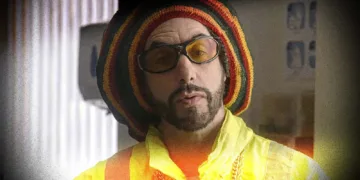

















A Hong Kong Airbnb becomes the setting for a reunion fifteen years in the making. Jon (Kenny Kwan), a filmmaker enjoying the first taste of professional success, meets his old friend Wing (Adam Pak), a man whose life has stalled in a haze of part-time jobs and minor drug dealing. Their conversation, initially filled with the easy banter of shared history, takes a sharp turn.
Wing deliberately steers the topic to Amy (Selena Lee), a woman from their past who connects them both. The mood shifts, and the small apartment transforms from a neutral space into a pressure cooker. This is no simple reunion; Wing has a clear agenda, and the room is a stage for a long-delayed confrontation. The film unfolds in real-time, trapping its characters, and the audience, in a single location to ask a difficult question: how reliable is memory when the past is a crime scene?
The Battle for the Narrative
Wing’s agenda soon becomes clear; hidden cameras are positioned to capture and broadcast a confession. He wants Jon to admit to a sexual assault against Amy on their graduation night, and the film’s first half is a taut psychological duel built on this premise. Wing’s method is a volatile mix of faux camaraderie and pointed aggression. He offers beer and drugs to lower Jon’s defenses, weaponizing their old friendship before cornering him with accusations.
It’s a calculated performance of male bonding twisted into a hostile interrogation. Adam Pak gives Wing a raw, unpredictable energy, physically occupying the space with a restless intensity. He portrays a man whose quest for justice is inextricably tangled with his own failures and personal resentment toward Jon’s success.
Opposite him, Kenny Kwan skillfully shows Jon’s polished facade cracking under the relentless pressure. Jon’s initial defense is to downplay the event, to reframe a traumatic memory as a youthful mistake, a common tactic of deflection. His success as a filmmaker has taught him how to shape narratives, and he desperately tries to control this one, but his composure erodes with each new detail Wing recalls.
Kwan’s performance captures this disintegration through subtle shifts, from confident smiles to the panicked darting of his eyes. The single room is not a passive backdrop; it functions as a crucible, a space that amplifies every word and magnifies every silence until their verbal sparring becomes a primal fight for control over history itself.
Reclaiming the Story
The film’s dynamic is completely reconfigured when Amy arrives. Portrayed with a commanding stillness by Selena Lee, who also contributed to the script, Amy is no mere object of their dispute. As an accomplished public prosecutor, she brings a calm, analytical authority that immediately dismantles the men’s self-serving narratives.

She refuses to validate either Jon’s panicked revisionism or Wing’s aggressive crusade, declining to be the damsel or the victim he needs her to be. Her presence shifts the film’s focus from a simple question of guilt to a deeper one of female agency and the reclamation of one’s own story. She confronts the two men not with hysteria, but with sharp questions that expose the selfishness at the root of their conflict.
The Hong Kong setting is vital here. By transplanting the American play, the film examines the societal pressures that compound such a trauma. The cultural concept of “face”, or saving one’s reputation, hangs heavy in the air, explaining Jon’s desperate need to protect his public image and the immense weight on Amy to remain silent.
Where the original film explored a more abstract philosophical skepticism about truth, this version engages directly with the post-#MeToo era from a specific cultural vantage point. It highlights the acute difficulty of speaking out when silence is prized. This localization gives the conflict a sharp, grounded relevance, turning the story into a potent critique of the cultural mechanisms that too often protect perpetrators at the expense of victims.
Two Tapes, One Reckoning
Director Bizhan Tong employs a direct, controlled visual style that serves the material well. His filmmaking is less overtly experimental than its predecessor, but it effectively uses the camera to heighten the drama. Tight framing and claustrophobic close-ups force the audience into an uncomfortable intimacy with the characters, making their emotional distress palpable.

The lighting also shifts subtly throughout the evening, moving from warm and inviting to harsh and clinical as the truth is exposed. The film’s most significant structural change is the addition of camcorder flashbacks that bookend the story. These sequences create a powerful “two tapes” motif: the grainy footage of 2009’s youthful promise is set against the harsh digital recording of 2024’s bitter confrontation.
This choice slightly reduces the stark ambiguity of the original work, but it offers something meaningful in its place. The flashbacks successfully re-center the narrative on Amy’s experience, providing a glimpse of the vibrant young woman whose future was altered by the events of that night.
This footage acts as an objective record, a piece of evidence that stands in stark contrast to the warped, self-serving memories of the two men. This reframing makes the film less about an intellectual puzzle and more about the tangible human cost of a single night. It becomes a potent statement on accountability, suggesting that while memory is malleable, the past can be recorded, and the consequences of one’s actions are absolute.
Tape (2024) is a Hong Kong adaptation of the 2001 film by Richard Linklater. The story follows three former high school friends whose reunion brings up old wounds and secrets. The film is scheduled for release in UK cinemas on September 19, 2025. Information regarding streaming platforms is not available at this time.
Full Credits
Director: Bizhan Tong
Writers: Bizhan Tong, Stephen Belber
Producers/Executive Producers: Phoenix Waters Productions
Cast: Selena Lee, Kenny Kwan, Adam Pak, Angus Yeung, Mason Fung, Summer Chan
The Review
Tape
Bizhan Tong's Tape is a searing and intelligent remake that successfully transplants a tense stage play into a specific Hong Kong cultural context. Powered by three potent performances, this claustrophobic chamber drama becomes a sharp examination of memory, accountability, and the fight for narrative control. While a key structural change lessens the original's ambiguity, it powerfully recenters the story on the victim's perspective, making this a relevant and deeply effective psychological thriller that stands firmly on its own.
PROS
- Exceptional performances from the three leads, particularly Selena Lee's commanding presence.
- The Hong Kong setting adds a rich, specific cultural layer concerning reputation and societal pressure.
- Taut direction creates a sustained and suspenseful claustrophobic atmosphere.
- Effectively reframes the narrative to prioritize female agency and the consequences of trauma.
CONS
- The addition of flashbacks, while purposeful, reduces the philosophical ambiguity of the source material.
- A more conventional visual style compared to the gritty, experimental aesthetic of the 2001 film.