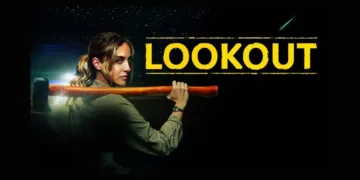




























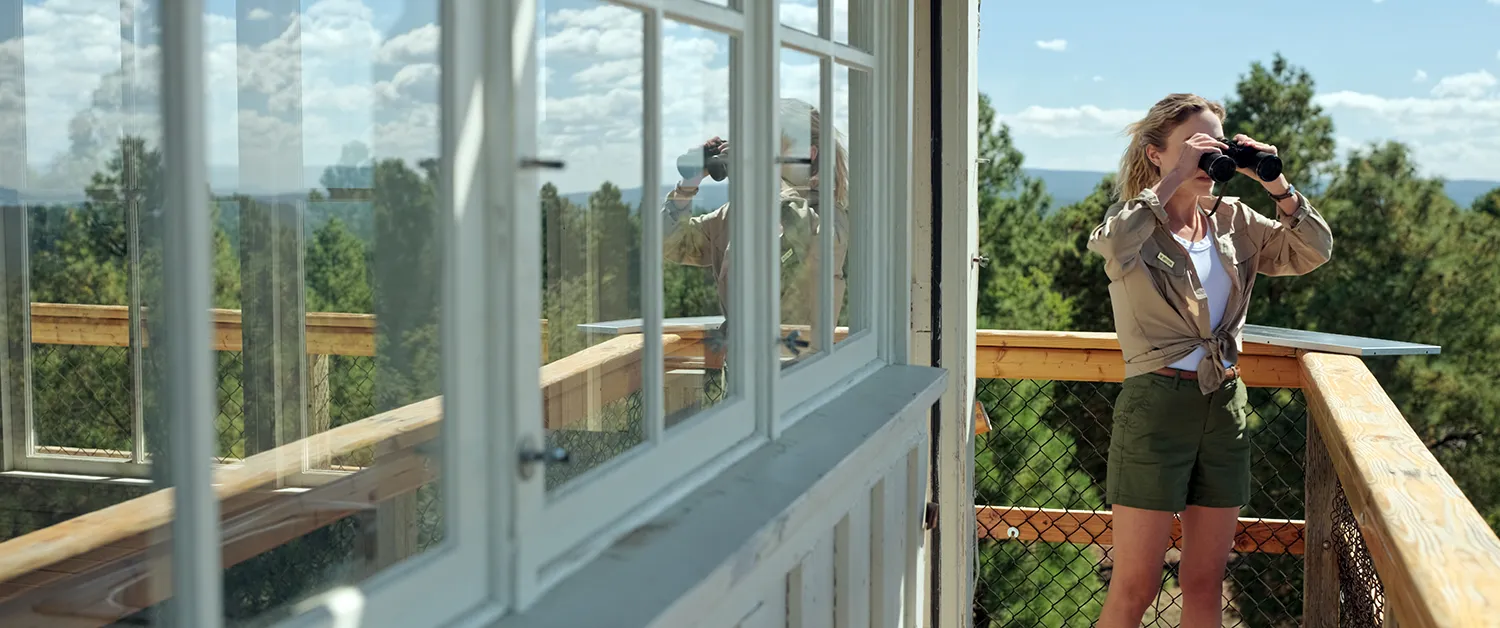
The crackle of a radio transmission is the only sound that breaks the stillness. It is a voice from another world, a place of people and problems that Melissa has deliberately left behind. Her new home is a glass box on stilts, a fire lookout tower where her sole duty is to watch the horizon. This job is not a career choice; it is a self-imposed exile, an attempt to find clarity by subtracting every complication from her life, including human contact.
For a time, the film sits with her in this chosen isolation, observing the quiet rhythm of a life reduced to its essentials. The initial promise of this setup is its minimalism, the idea of a personal drama playing out against a vast, indifferent landscape. But the silence she sought is soon filled with a new kind of noise. Unexplained lights streak across the night sky, and strange objects appear in the woods below.
Her sanctuary becomes a stage for an inexplicable phenomenon, and the film shifts its focus from a story of internal healing to one of external threat. The quiet she travelled so far to find is replaced by a chilling new question: what happens when you are finally, truly alone, and you discover you are not?
A Character Without an Interior
A story of isolation lives or dies on the interiority of its protagonist. When the external world is stripped away, the drama must come from within. Yet, Melissa remains a cipher from beginning to end. She is presented with an extraordinary situation that should force a change, but no evolution occurs. The script substitutes the arrival of mysterious alien artifacts for the necessary work of psychological development, leaving her character arc a flat, unbroken line.
She is a passive figure in her own story, a person to whom things happen instead of a person who makes things happen. The supporting cast fails to provide the friction needed to spark any growth. Her supervisor is a caricature of a cranky boss, a functional plot device who disappears once his purpose is served, offering neither meaningful conflict nor guidance.
A romantic subplot ignites and vanishes with bewildering speed, a transparent attempt to manufacture emotional stakes that the film never properly earns. Meghan Carrasquillo works to give Melissa a relatable presence, but she is fighting an inert script. There is a persistent disconnect between the uniformed ranger she is supposed to be and the bewildered camper she acts as, a gap in credibility that makes her inaction feel less like a character trait and more like a failure of the screenplay itself.
A Narrative Adrift
Pacing is a matter of controlled tension, a tightening of the narrative knot. Lookout opts for a slack rope. The film dedicates its first hour to a slow, meandering setup that generates little suspense and even less audience investment. It mistakes a lack of incident for atmosphere, creating a story that feels inert long before the central conflict appears.
The primary antagonist, a critical component for any thriller, is withheld until the final twenty minutes. He arrives on screen as a blank slate, a figure without a discernible past, a clear motivation, or any understandable connection to the supernatural events unfolding. He is not a character; he is a sudden complication required to move the plot toward its end. The science fiction elements are presented with similar vagueness. The audience is shown powerful mineral rocks and a strange gooey substance but is given no rules or context for how they work.
They are empty signifiers of the otherworldly, mystery boxes with nothing inside. The film’s greatest missed opportunity is its failure to use the setting. The isolation of the tower is a perfect crucible for psychological dread, yet no real tension is built. The story ends as it proceeds: without resolution, leaving every significant question unanswered and providing a hollow, predictable finish.
An Unsteady Hand
For an independent feature, the film achieves a certain surface polish. The cinematography makes excellent use of its beautiful forest locations, capturing the grandeur of the wilderness with a competent eye. In certain moments, the lighting effectively conveys the warmth of Melissa’s sanctuary against the vast, dark unknown that surrounds her.
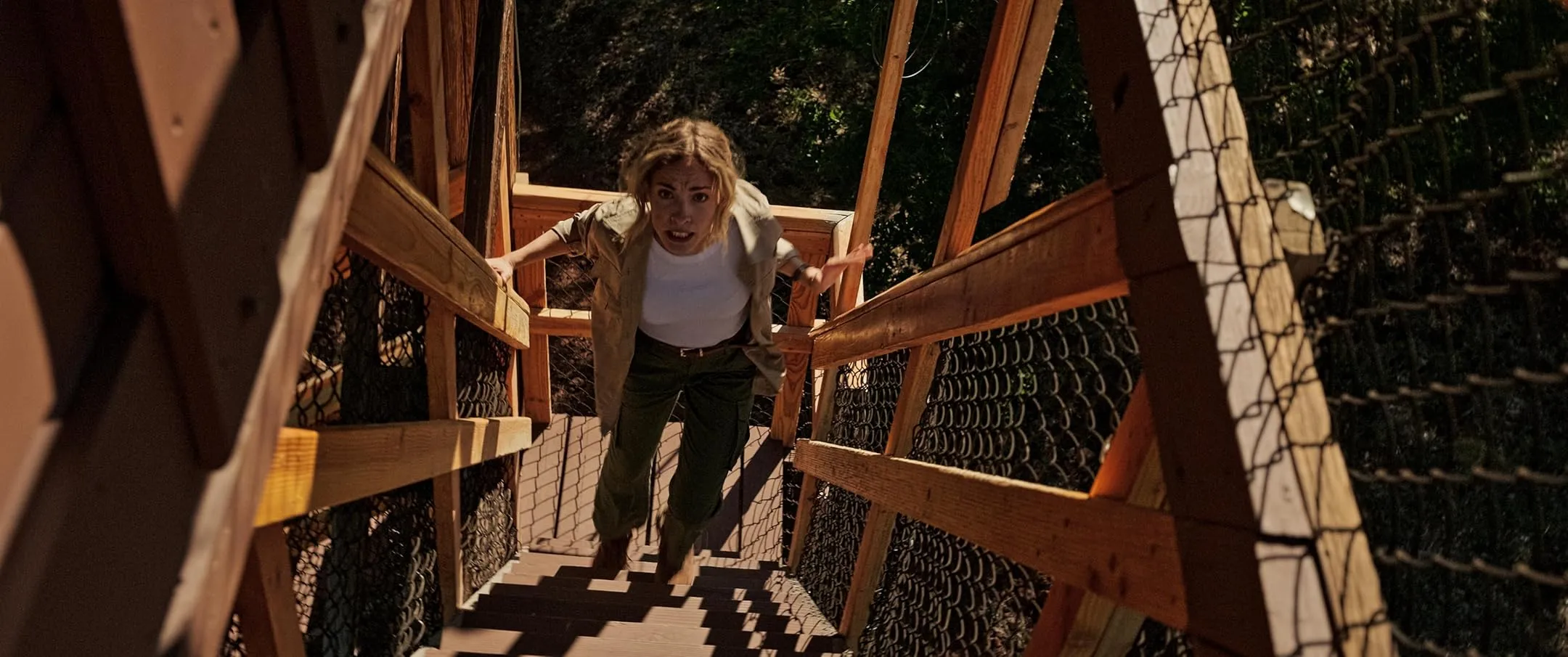
This veneer of professionalism, however, cracks under the slightest pressure. The action sequences are notably clumsy, staged with unconvincing choreography that feels hesitant and slow. The editing in these scenes fails to conceal the artifice, often holding a shot for a beat too long and revealing that a punch never landed. This carelessness extends to the film’s basic continuity. A character suffers a foot injury so severe she cannot walk, only to be seen running at a steady pace through the woods moments later.
This is not a minor oversight; it is a signal to the audience that the physical stakes are meaningless. The visual style can be erratic, with certain scenes drenched in an unnatural yellow hue that feels arbitrary and distracting. This tonal dissonance is amplified by the musical score, which frequently employs cues that would be more at home in a lighthearted comedy, actively sabotaging any attempt to build an atmosphere of peril or wonder.
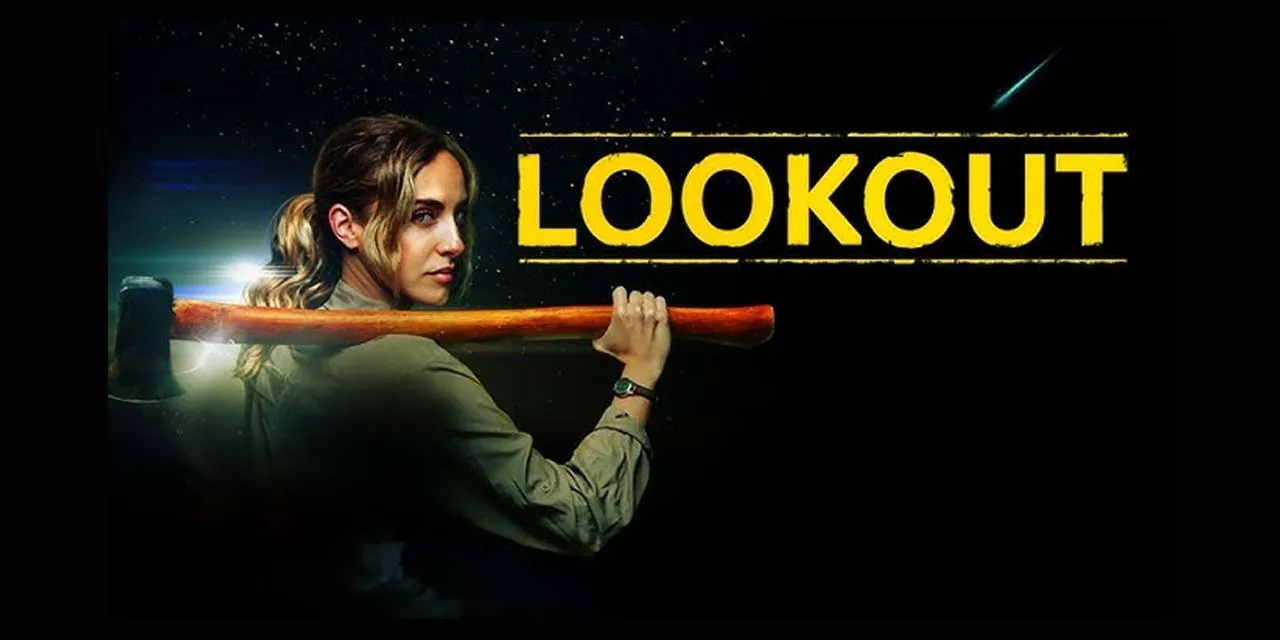
Lookout is a 2025 sci-fi thriller directed by Stefan Colson and written by Brandon Cahela. The film follows a young woman who takes a job as a fire lookout at a remote tower in the Coconino National Forest seeking peace from her troubled life, but she soon begins to experience strange, otherworldly phenomena and must confront the chilling secrets of her isolated location. The film was distributed by Jackrabbit Media and was released on September 2, 2025, and is available to watch on digital platforms including Amazon Prime Video, Apple TV, Google Play, and Vudu, as well as on Blu-ray and DVD.
Full Credits
Director: Stefan Colson
Writers: Brandon Cahela
Producers and Executive Producers: Jack Campbell, Rebecca Campbell, Mark Padilla, Corey Brown
Cast: Meghan Carrasquillo, Trent Culkin, John Marrs, Mitch Tellez, Robert Clark, Jim Round, Braden Mccawley, Cara Leoni
The Review
Lookout
Lookout begins with a potent concept and an appealing scenic backdrop. This initial promise is soon squandered by a script that goes nowhere, a protagonist who experiences no growth, and a plot that introduces mysteries without offering any answers. Despite some competent cinematography, the film is an exercise in unfulfilled potential; a slow burn that ends not with a bang, but with a fizzle.
PROS
- An effective and relatable initial premise.
- Beautiful natural scenery and a strong sense of location.
- Serviceable cinematography and lighting that provide a professional sheen.
CONS
- A completely static protagonist who undergoes no development.
- Excessively slow pacing that fails to build suspense or tension.
- Underdeveloped plot with unexplained sci-fi elements and an unsatisfying ending.
- Poorly choreographed action sequences and noticeable continuity errors.
- An unfitting musical score that often detracts from the intended tone.