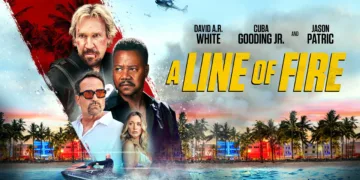



























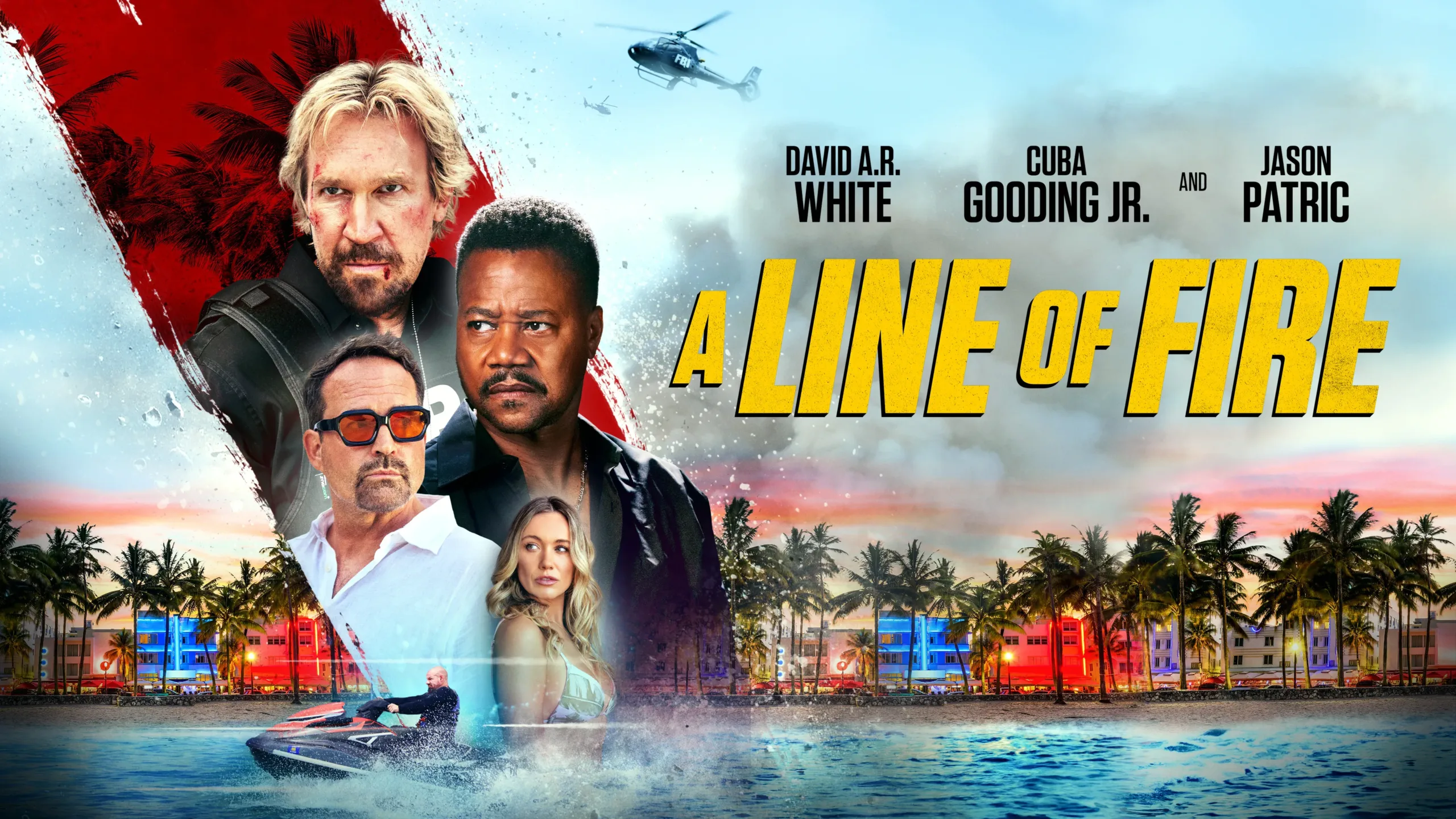

Some histories are not meant to be escaped. They linger like phantom limbs, waiting for a single, jarring moment to remind a person of what they once were. For Jack ‘Cash’ Conry, a former federal agent played by David A.R. White, that history was meant to be buried beneath a quiet life of making pancakes and raising his two young daughters.
This peaceful facade, constructed in the wake of personal tragedy, proves to be fragile. The past arrives not with a whisper but with a panicked phone call from Jamie, the niece of a slain former colleague, who is being hunted by assassins. This call acts as the film’s inciting spark, dragging Cash back into the violent world he desperately tried to leave behind.
What follows is a film that feels like a cultural artifact unearthed from another time. A Line of Fire consciously mimics the aesthetic and narrative simplicity of 1990s direct-to-video action features, a subgenre with its own distinct codes and rhythms. It is a cinematic echo, a straightforward tale of protection and conspiracy playing out in the present day.
The Mechanics of Incoherent Violence
An action film’s primary contract with its audience is to deliver kinetic spectacle through a clear visual language. A Line of Fire breaches this contract repeatedly, presenting motion without a sense of impact or geography. The hand-to-hand combat is strangely lethargic, staged with slow, telegraphed movements where the space between a fist and a face is often plainly visible.
This lack of convincing physicality removes any sense of visceral danger. The numerous gunfights suffer from a similar deficiency. The combatants display such remarkably poor aim that the exchanges feel less like life-or-death struggles and more like noisy, choreographed routines where the outcome is never in doubt. This robs the action of its most vital ingredient: stakes.
The film’s most critical failure, however, lies in its editing. The camera work and cutting style actively work against spatial awareness. During the fight sequences, particularly one set within the tight confines of an airplane, the editing becomes a flurry of disorienting cuts. This technique, meant to convey chaos, instead creates visual confusion, making it impossible to follow the characters’ movements or understand their tactical positions.
The direction shows a fundamental misunderstanding of pacing, frequently mistaking lengthy shots for suspense. Repetitive, poorly integrated flashbacks further fragment the narrative, adding layers of confusion instead of providing the intended character backstory. The film’s visual storytelling is a study in contradiction, striving for high-octane energy while being systematically undermined by its own technical execution.
Familiar Faces in a Narrative Void
The performances in A Line of Fire highlight a disconnect between the actors and the material. David A.R. White’s portrayal of Cash is a central problem. He seems ill-suited to the demands of a cynical action hero, his earnest screen presence clashing with the gritty persona the role requires.

The result is a performance that feels wooden and unconvincing, lacking the essential world-weariness that defines the archetype. As the protected witness Jamie, Katrina Bowden is given little to work with beyond the tropes of a damsel in distress. Her character is reactive, defined by clichéd dialogue, and is strangely sidelined for a significant portion of the runtime. This decision reduces her role to a mere plot device rather than a fully realized character.
The involvement of veteran actors Cuba Gooding Jr. and Jason Patric exemplifies a common practice in the low-budget market: using recognizable names for marquee value. Their appearances are fleeting, almost anecdotal. They are presented as formidable villains but spend most of their limited screen time delivering exposition over the phone, detached from the central action.
They register less as antagonists and more as remote managers in a criminal enterprise, their disengaged performances suggesting they were on set for a very short time. This sense of detachment permeates the film, most noticeably in the rushed and unearned romance between Cash and Jamie, a relationship that appears without any emotional foundation.
A Flawed Blueprint with Accidental Sincerity
The screenplay feels less like a unique story and more like an assemblage of pre-existing parts from other, better films. Its reliance on formula is absolute, resulting in a predictable plot and dialogue that lacks any distinct voice. The script’s creative exhaustion is perfectly symbolized by its choice of a villain moniker, the profoundly uninspired “Mr. X.”

This kind of narrative shorthand is a clear signal that invention was not a priority. The film’s internal logic is similarly weak, creating moments that shatter immersion. A tense scene at a gas station is undone by baffling character choices, while Cash’s decision to discard his body armor after it sustains a single impact is nonsensical.
Yet, amid the manufactured drama and logical gaps, the film finds moments of unexpected truth. The scenes depicting Cash’s home life with his two daughters possess a warmth and authenticity that is absent elsewhere. This is because the girls are played by White’s own children, and their natural, unforced chemistry with their father bleeds through the fiction.
These interactions feel genuine, providing a stark contrast to the stilted performances and contrived plot points that surround them. They are small islands of sincerity in a sea of artifice. These moments, however, are not enough to elevate the project. A Line of Fire remains a case study in how a film can fail on nearly every technical and narrative level, its few redeeming qualities appearing by accident rather than by design.
The movie A Line of Fire is an action and suspense thriller released in 2025. The plot follows Jack Conry, an ex-secret agent for the FBI known as “Cash,” who left the force after his wife passed to focus on his two daughters. When a friend calls for help, Cash is reluctantly pulled back into a dangerous underworld of corruption and intrigue. The film is available to rent or buy on platforms like Amazon Prime Video and Apple TV.
Full Credits
The Review
A Line of Fire
A Line of Fire is an interesting failure, a film that feels like a relic from a past era of direct-to-video action. Its ambitions are consistently sabotaged by clumsy execution, from uninspired fight choreography and incoherent editing to a script built on tired formulas. While the lead performance is miscast and its veteran actors are wasted in hollow roles, the picture is saved from being a complete write-off by brief, authentic moments of family connection. These flashes of sincerity, however, are not enough to redeem this largely forgettable and technically deficient thriller.
PROS
- The scenes between the protagonist and his daughters feel genuine and sincere.
CONS
- Action sequences are poorly choreographed and lack impact.
- Disorienting and frantic editing obscures the on-screen events.
- A generic script relies heavily on predictable clichés.
- The lead actor feels unconvincing in the action hero role.
- Recognizable supporting actors are given minimal, inconsequential screen time.