


















![Kingdom Hearts Collection [I-III] Review](https://gazettely.com/wp-content/uploads/2026/10/Kingdom-Hearts-Collection-I-III-1-360x180.webp "Kingdom Hearts Collection [I-III] Review: KHII Holds Steady as Newer Entries Fluctuate 40")


Is it possible for a man to unwrite himself from the world? To retreat so far into the wilderness that the echoes of his own name fade? This is the central, unspoken question of Anemone. The film opens not on a story, but on the aftermath of one. We find Ray Stoker living in a state of willed oblivion, his cabin in the Northern English woods less a home and more a cell constructed of silence and timber.
His is an existence of severe ritual, a physical penance for a spiritual crime we do not yet comprehend. He is a man attempting to become a ghost. But the past is a relentless cartographer, and it has mapped this remote corner of his exile.
The world’s memory arrives in the form of his brother, Jem, a man whose face is a record of the life Ray abandoned. Jem carries a letter, a debt notice from a history that refuses to be forgotten. It speaks of a violence in the next generation, a dark inheritance. The conflict is thus established: a battle between a man’s desperate wish for nothingness and the world’s insistence that he was, and still is, someone.
Faces Carved from Grief
The film is anchored by a performance from Daniel Day-Lewis that feels less like acting and more like a prolonged act of haunting. His portrayal of Ray is a deep physical meditation on the weight of a life defined by a single, catastrophic moment. He moves with the stiff caution of a man whose own body is a minefield of memory.
His silences are vast and textured, communicating a spectrum of rage, shame, and sorrow that dialogue could only dilute. When he does speak, the words are eruptions from a sealed chamber. His monologue detailing a profane act of revenge on an abusive priest is a masterpiece of controlled psychosis, a story told with a chilling glee that reveals a soul’s search for agency in an act of ultimate defilement. It is a terrifying assertion of will.
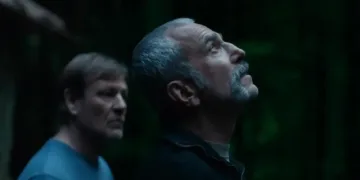
A later confession about his actions during The Troubles carries a different gravity. It is the sound of a man dismantling himself, word by word, revealing the moral vacancy at his core. Sean Bean’s Jem is the essential counterpoint, the brother who ran toward structure, toward faith, as Ray ran toward the void. He is the keeper of the social contract Ray tore up. Their scenes together crackle with the tension of a shared, ruinous origin, a palpable history of love and resentment.
They are a fractured mirror, each reflecting the other’s forsaken path. The other characters, however, exist as satellites to this central agony. Samantha Morton’s Nessa is the living embodiment of Ray’s abandonment, while Samuel Bottomley’s Brian is the trauma made flesh. They are convincing presences, yet the script renders them as thematic devices, their own interior worlds left unexplored in the blinding light of Ray’s collapsed star.
An Unquiet Canvas
Ronan Day-Lewis directs his debut feature with the meticulous eye of a painter, yet sometimes with a storyteller’s hesitancy. Each frame is a carefully composed study of isolation, freezing the characters in their bleak landscapes like figures in a melancholic portrait.

This visual precision gives the film an undeniable aesthetic power, but it also creates a ponderous, suffocating atmosphere that can hold the narrative captive. Ben Fordesman’s widescreen cinematography is instrumental to this effect.
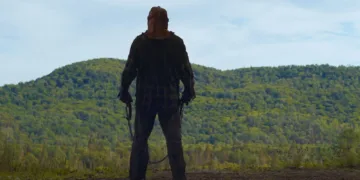
The vast, indifferent wilderness of Northern England becomes a psychological space, the desaturated palette reflecting a world leached of grace. The sweeping vistas create a sense of profound agoraphobia; here is a man utterly alone yet terrifyingly exposed.
The camera’s gaze is patient, almost punishingly so. This deliberate style is amplified by a soundscape that offers little comfort. Bobby Krlic’s score is the sound of spiritual tinnitus, a droning, synth-heavy shroud that often overwhelms the quiet desperation of a scene, creating an emotional distance. The film’s rhythm is further fractured by Nathan Nugent’s editing.
The jarring cuts between the brothers’ claustrophobic cabin and Brian’s parallel turmoil feel like schisms in a broken memory, preventing any emotional momentum from building. The viewer is forced to experience the same sense of temporal and psychological disorientation that plagues the protagonist. The result is a film that is often stunning to behold but difficult to inhabit.
Fragments of a War
Anemone is a film that grapples with immense philosophical concerns. It treats history as a hereditary disease, a contagion passed from one generation to the next. Ray’s self-imposed exile is a futile quarantine against the past. The narrative examines the grim architecture of male violence, exploring how it is constructed from silence, sanctified by codes of honor, and perpetuated through bloodlines.

These are potent ideas, but the screenplay struggles to articulate them through compelling action. The structure is opaque, and its narrative feels less like a story and more like a collection of thematic artifacts presented for our consideration. It gestures toward its profound subjects but rarely commits to a full exploration, defaulting instead to the static revelation of its monologues.
This makes the film feel at times like a philosophical text rather than a lived drama, its characters serving as vessels for ideas about trauma and penance. This structural reticence culminates in a final act that employs a jarring shift into magical realism.
A hallucinatory vision and a sudden, violent hailstorm feel like a metaphysical panic button, an admission that the story’s own grounded logic has reached an impasse. The storm is not a cleansing earned through character development. It is an aesthetic intervention, a director imposing a moment of symbolic catharsis from the outside because it has not been allowed to grow organically from within the narrative.
The Magnificent Ruin
The singular, undeniable reason to engage with Anemone is to witness the seismic event of Daniel Day-Lewis’s performance. It is a work of breathtaking control and terrifying vulnerability, a portrait of a soul so thoroughly scoured by guilt that his continued existence feels like a miracle of endurance.

He is the film’s sorrowful, magnificent center, and his presence is almost enough to sanctify the entire endeavor. The film itself is a more complicated entity. It is an exquisitely crafted failure, a work of profound artistic intention that remains intellectually and emotionally remote. It is a difficult, distancing experience, a beautiful container for an immense and lonely performance.
The final impression is one of a haunting imbalance. The parts are greater than their troubled whole, leaving the spectator with the full weight of an actor’s spiritual excavation but only the ghost of a film to remember it by. It is a work of undeniable power and undeniable flaws, a piece of art that achieves a strange, fractured, and unforgettable grandeur.
Anemone is a 2025 psychological drama and supernatural horror film that marks the feature directorial debut of Ronan Day-Lewis, who co-wrote the screenplay with his father, Daniel Day-Lewis. The film is notable as it features Daniel Day-Lewis’s highly anticipated return to acting after his retirement in 2017. Produced by Plan B Entertainment, the film premiered on September 28, 2025, at the New York Film Festival (NYFF), with a theatrical release in the United States scheduled for October 3, 2025, distributed by Focus Features. While it will initially be released in theaters, its international distribution by Universal Pictures suggests it will follow a standard release window to be available on VOD and streaming platforms afterward.
Full Credits
Director: Ronan Day-Lewis
Writers: Ronan Day-Lewis, Daniel Day-Lewis
Producers and Executive Producers: Dede Gardner, Jeremy Kleiner
Cast: Daniel Day-Lewis, Sean Bean, Samantha Morton, Samuel Bottomley, Safia Oakley-Green, Adam Fogerty
Director of Photography (Cinematographer): Ben Fordesman
Editors: Nathan Nugent
Composer: Bobby Krlic
The Review
Anemone
A magnificent but frustrating work, Anemone is a film of profound imbalance. It is essential viewing for Daniel Day-Lewis’s monumental performance, a soul-scouring portrayal of a man erased by his past. Yet, this towering achievement is housed within a ponderous, emotionally remote narrative that values aesthetic gloom over connection. It is a beautiful, flawed, and ultimately haunting ruin of a film that is more to be admired than felt.
PROS
- A monumental and magnetic lead performance from Daniel Day-Lewis.
- Strong, grounding work from Sean Bean and palpable chemistry between the brothers.
- Stunning, painterly cinematography that creates a potent atmosphere.
- Ambitious exploration of dark, existential themes like trauma and memory.
CONS
- An emotionally distant and alienating tone.
- The script is structurally flawed, meandering, and overly reliant on monologues.
- An intrusive and often overbearing musical score.
- Underdeveloped supporting characters who serve more as plot devices than people.