
























![Kingdom Hearts Collection [I-III] Review](https://gazettely.com/wp-content/uploads/2026/10/Kingdom-Hearts-Collection-I-III-1-360x180.webp "Kingdom Hearts Collection [I-III] Review: KHII Holds Steady as Newer Entries Fluctuate 37")




Only Murders in the Building returns as the televisual equivalent of a weighted blanket, a comforting presence in a chaotic streaming landscape. We settle back into the plush, quirky confines of the Arconia, a place where death is a recurring inconvenience, like a leaky faucet or a noisy neighbor. That comfort is punctured almost immediately.
Lester, the doorman, the building’s stolid and constant gatekeeper, is found dead in the courtyard fountain. His murder is an attack on the building’s very foundation of normalcy, a shattering of the thin veneer of civility that separates the residents from the city’s ambient menace. This is not just another body; this is a foundational pillar removed.
The trio is soon pulled into two distinct orbits of criminality. One is the old world of mobsters, represented by the theatrical Sofia Caccimelio (a superb Téa Leoni), who needs her missing husband found. The other is the new world of frictionless wealth, a triumvirate of tech and real estate billionaires with opaque motives.
These plotlines intertwine, dragging our podcasters into a conflict with antagonists who are not merely eccentric but genuinely powerful. Season five thus poses a central question about its own identity: Can a cozy mystery survive a direct collision with the genuinely un-cozy forces of organized crime and late-stage capitalism? The show’s charming absurdity must now contend with authentic peril.
A Plot Both Labyrinthine and Porous
The season’s central puzzle connects Lester’s demise to the disappearance of a Staten Island gangster, a narrative thread stitched together with appropriately bizarre clues. A severed finger discovered among Oliver’s wedding leftovers serves as a piece of grotesque iconography, a bit of Godfather-esque grimness dropped into a world of seven-layer dip.
The discovery of a secret underground casino provides a literal stage for the building’s subterranean secrets. The show wisely dedicates an episode to Lester’s backstory, a necessary piece of televisual eulogy that grants history and agency to a character who was functionally scenery. It’s a quiet commentary on the often invisible labor that makes buildings like the Arconia run, a life story told only after that life has been extinguished.
The show’s narrative pacing feels intentionally arrhythmic. It will drop a major piece of evidence and then dedicate the next ten minutes to a debate over theatrical headshots. This structural choice frustrates the tidy conventions of the whodunit genre, suggesting the mystery itself is secondary to the messiness of life.
The plot is porous, allowing the characters’ anxieties and eccentricities to seep in at every turn, delaying and diverting the forward momentum. The whodunit is less a puzzle box to be solved and more a chaotic framework upon which to hang the far more interesting character studies. The real investigation is not into who killed Lester, but into how these three people manage to survive themselves and each other.
This season’s antagonists represent a significant shift. Past killers were driven by recognizable human flaws like passion or jealousy. The mobsters and moguls introduced here are systems of power. They are institutions. The threat of a libel lawsuit is, in its own way, a weapon far more insidious than a poisoned drink. It is an attack on the trio’s voice, a corporate silencing that threatens their entire podcasting enterprise.
Three Solitudes in a Single Frame
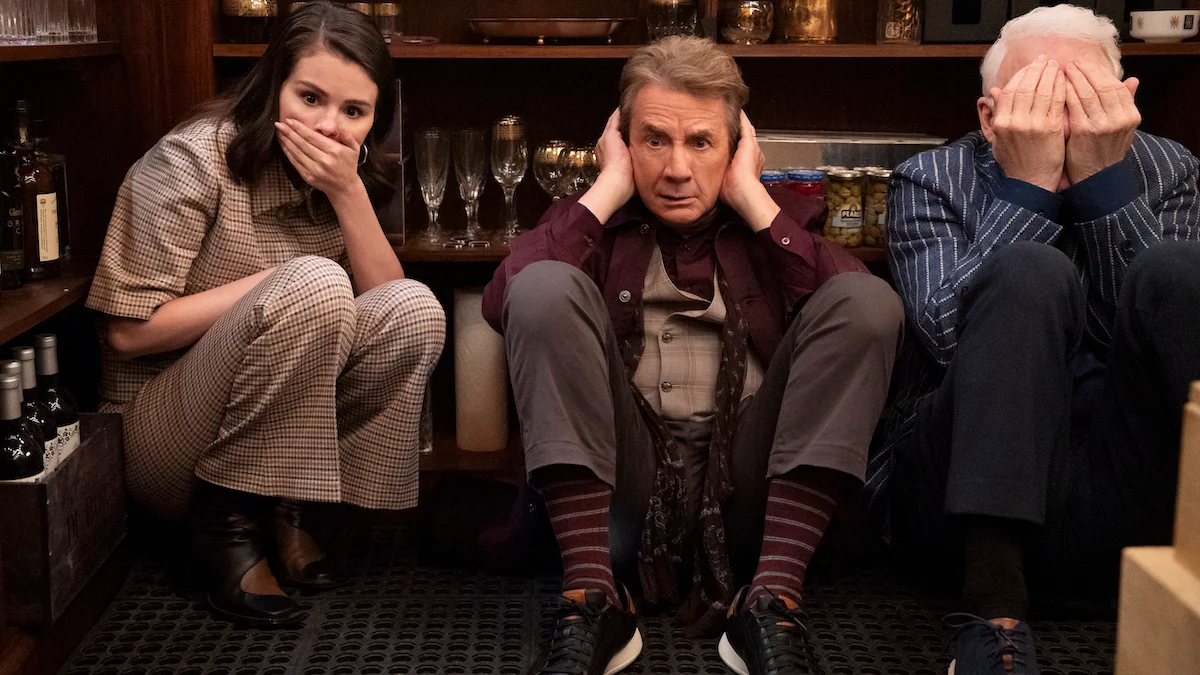
The characters continue to be studies in elegantly managed distress. Charles-Haden Savage’s newfound swagger is a brittle shield for his profound loneliness. His grief for Sazz, his literal body double, feels like a grief for a braver, more decisive version of himself. Steve Martin’s gift for physical comedy is deployed perfectly; his slapstick is the tragicomedy of a man whose body constantly undermines his attempts at dignity. His tentative entanglement with the mob wife Sofia is a desperate reach for vitality in a life defined by quiet, well-appointed isolation.

Oliver Putnam’s confrontation with his own bottomless narcissism provides the season with its most potent psychological material. His relentless theatricality has always been a defense mechanism, a truth made explicit through flashbacks to his formative years. These glimpses turn what could be a one-note caricature into a poignant character study of a boy who learned to hide behind a curtain of his own making. Martin Short finds the deep well of pathos beneath the flamboyant scarves. His contemplation of leaving the Arconia feels like a genuine threat to the show’s emotional geography.
Mabel Mora, long the group’s anchor of millennial ennui, begins the season with a suspicious, almost discordant, optimism. Her subsequent identity crisis, sparked by the reappearance of a childhood frenemy (a perfectly vapid Beanie Feldstein) now transformed into a pop star, is a sharp critique of curated social media personas versus authentic selfhood.
Selena Gomez continues to master a kind of minimalist performance, where a simple eye-roll conveys paragraphs of internal monologue. Her growing mentorship with Detective Williams signals a quiet maturation, a shift from accidental sleuth to a more serious student of human darkness. Their chemistry remains the show’s foundational magic, a weirdly functional family unit forged in trauma and a shared love of gossip.
The Cameo Industrial Complex
The series has firmly established itself as a prime destination for the A-list cameo, a sort of high-brow Love Boat for actors looking to have some fun. The guest stars this season are not mere window dressing; they function as archetypes. Téa Leoni’s Sofia Caccimelio is the platonic ideal of the mob wife, equal parts charm and menace.
Christoph Waltz arrives to do what Christoph Waltz does, delivering silky, articulate threats with an unnerving smile. He is so perfectly cast that it almost feels too easy. Renée Zellweger and Logan Lerman embody the twin pathologies of the new billionaire class: icy, aestheticized control and the petulant whims of a boy-king.
The returning supporting cast provides the essential texture that makes the Arconia feel like a real, if deeply strange, place. Da’Vine Joy Randolph’s Detective Williams is the show’s weary conscience, the voice of civic order constantly exasperated by the trio’s chaotic methods.
Michael Cyril Creighton’s Howard gets a darkly funny subplot involving the building’s new robot doorman, a strange romance that serves as a commentary on automation and the human desire to connect with anything, even a machine. The continued presence of Meryl Streep’s Loretta adds a certain gravitational pull, a supernova whose light occasionally threatens to wash out the other stars in this carefully balanced constellation.
The Architecture of Anxiety
The Arconia is more than a setting; it is a character in its own right, a vertical village that serves as a microcosm of Manhattan life. This season deepens our understanding of the building, revealing new secret passages that suggest it, like its residents, possesses an inexhaustible supply of hidden histories. The central theme is a quiet class war fought in the hallways and service elevators.

We see the conflict between the building’s staff and the oblivious residents they serve, a tension exacerbated by the threat of automation in the form of a menacingly efficient robot doorman. The invasion of the mob and the billionaires is an assault on the Arconia’s cloistered ecosystem, a battle for the soul of the building itself.
The show has become a meta-commentary on its own formula. It leans into its identity as a “hangout show” that uses the framework of a murder mystery to explore friendship, loneliness, and the absurdities of modern urban life. It understands that the real mysteries are interpersonal, not criminal. This repetition of its structure is either a comforting ritual or a sign of creative stagnation, a question the series seems to be asking itself in real time.
The production itself remains impeccable. The warm cinematography creates a false sense of security, the mischievous score keeps the tone light even as the body count rises, and the costumes continue to be masterful pieces of character work. Oliver’s scarves are his armor; Mabel’s sweaters are her shield.
Only Murders in the Building Season 5 premiered on September 9, 2025, on Hulu. The season follows Charles, Oliver, and Mabel as they investigate the mysterious death of their doorman, Lester, which leads them out of the Arconia and into a dangerous web of secrets connecting powerful billionaires and mobsters. The season will have 10 episodes, with new episodes releasing weekly on Tuesdays.
Full Credits
Director: John Hoffman
Writers: Steve Martin, John Hoffman, Madeleine George, Kristin Newman, Ben Smith
Producers and Executive Producers: Dan Fogelman, Jess Rosenthal, John Hoffman, Steve Martin, Martin Short, Selena Gomez, Jamie Babbitt
Cast: Steve Martin, Martin Short, Selena Gomez, Michael Cyril Creighton, Meryl Streep, Cara Delevingne, Paul Rudd, Jane Lynch, Tina Fey, Nathan Lane, Da’Vine Joy Randolph, Aaron Dominguez, Amy Ryan, Jackie Hoffman, Jayne Houdyshell, Teddy Coluca, Ryan Broussard, James Caverly, Melissa McCarthy, Eugene Levy, Eva Longoria, Zach Galifianakis
Composer: Siddhartha Khosla
The Review
Only Murders in the Building Season 5
Only Murders in the Building remains one of television's most intelligent comforts. While the season's central mystery occasionally meanders, its function is merely to serve a richer exploration of loneliness, class, and the strange families we build by accident. The show's self-aware formula is pushed to its limits by genuinely menacing antagonists, but its success rests, as always, on the irreplaceable, lightning-in-a-bottle chemistry of its three leads. It is a brilliant comedy of manners hiding inside a murder investigation, and it has never been sharper, funnier, or more quietly poignant.
PROS
- The central trio’s chemistry is as sharp and delightful as ever.
- Strong character development with meaningful emotional arcs for Charles, Oliver, and Mabel.
- An outstanding guest cast, with Téa Leoni as a particular standout.
- Witty dialogue and masterful physical comedy.
- Smart thematic exploration of class dynamics and technology within the Arconia.
CONS
- The pacing of the central mystery can feel erratic and unfocused.
- A reliance on the established formula makes some narrative beats feel predictable.
- Significant plot threads are sometimes abandoned for long stretches.
- The large, star-studded cast occasionally distracts from the core narrative.







