



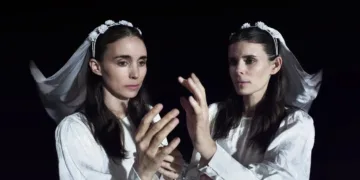

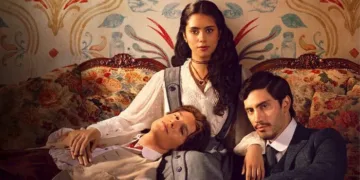











Julian Sklar, a painter who once mattered, now lives inside his own museum of decay. His sprawling London townhouse, a hoarder’s paradise and a curator’s nightmare, is less a home than a tomb for a career. The old lion of the British art scene, a man whose canvases once fetched millions, now makes his rent recording personalized videos for starstruck fans (£149 a pop, thank you very much).
This is the state of legacy in the 21st century: a great artist reduced to a gig economy ghost, hawking digital signatures. Into this stasis step his two adult children, Barnaby and Sallie, with a plan of breathtakingly modern venality.
They aim to hire an expert to forge the completion of their father’s unfinished masterwork, the “Christopher” series, ensuring a hefty inheritance. Their chosen instrument is Lori Butler, a quiet, watchful art restorer whose own creative ambitions have flatlined. She agrees to pose as Julian’s assistant, though her reasons for entering the lion’s den are far murkier than a simple paycheck.
A Combative Restoration
The film locks us inside the house with its two antagonists, transforming the cluttered space into a psychological arena. This is a classic two-hander, a pressure cooker of dialogue where every word is a move in an elaborate game. The house itself becomes a third character, a repository of memories that Julian wields like weapons and Lori scrutinizes for weaknesses.
His verbal style is a sardonic hurricane, a torrent of flamboyant pronouncements, condescending barbs, and acidic observations designed to keep everyone off balance. He pontificates about the death of culture while wearing a stained bathrobe. Lori, in contrast, is an immovable object of quiet judgment. She absorbs his monologues with a poker face that masks a furiously calculating mind.
What begins as a straightforward con job quickly evolves into something far stranger. The deception becomes a pretext for a kind of combative restoration, not of the paintings, but of two broken people. When Julian unexpectedly demands the canvases be destroyed, the power dynamic shifts violently. The simple heist is off.
Their conversations become a form of excavation, with Julian digging into his past with his lover, Christopher, and Lori being forced to confront the foundational trauma of Julian himself publicly destroying her confidence years ago on a dreadful television show called Art Fight. That long-ago moment of casual critical cruelty explains her every guarded move.
The Cantankerous and The Contained
Ian McKellen does not so much play Julian Sklar as he unleashes him. It is a ferocious, gale-force performance, a masterclass in portraying the magnificent awfulness of a man who has weaponized his own wit against the world and himself. McKellen’s physicality is key; he prowls the dilapidated rooms of his home like a deposed king in a crumbling castle, his flowing robes doing little to hide his fragility.

He is abrasive, inappropriate, and frequently cruel, yet McKellen allows flickers of deep-seated pain and regret to show through the cracks in the facade. His bluster is the armor of a man terrified of his own irrelevance. Acting opposite this is Michaela Coel as Lori, who offers a potent study in stillness.
Her strength is in her containment, a tactical choice that forces Julian to continually escalate, to fill the vacuum she creates with his own confessions and anxieties. Her posture is a shield, her unblinking gaze a forensic tool of appraisal. Her silence is her sharpest weapon. Their rapport is a tense, asymmetrical duel, a magnificent collision of performance styles that gives the film its electric charge.
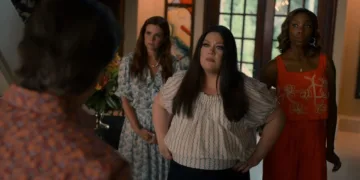
The children, played with pantomime greed by Jessica Gunning and James Corden, are little more than plot devices. They represent the crass commodification of family legacy, the one-note catalysts required to light the fuse on the film’s far more interesting central conflict.
The Anxiety of Influence
Steven Soderbergh directs with a loose, unmanicured sensibility, stripping the film of any stylistic gloss. His handheld camera often feels like a third person in the room, an unsettled observer creating a sense of viewer complicity in the invasion of Julian’s life. The aesthetic is raw and immediate, appropriate for a story that is essentially a staged play.
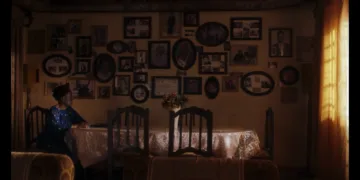
The house itself is the film’s most significant visual statement: a dusty, overstuffed archive of a life, its disarray a perfect mirror for Julian’s internal chaos. The half-finished canvases collecting dust are the most obvious symbols of an interrupted existence. Soderbergh uses this setting to ask difficult questions about creation and ownership, questions with a particular weight in our current moment.
In an era of sampling, AI-completed symphonies, and digitally resurrected actors, what does originality even mean? Who has the right to finish another person’s work? Is it an act of tribute or an act of violation? The film offers no easy answers, suggesting that an artist’s greatest creation is their own story.
Creation is a way to “last in the minds of others,” yet The Christophers shows how that memory can be altered, re-edited, and even forged. The artist, it seems, never gets the final say; their work is merely the opening statement in a long, often hostile, negotiation with the future.
The Christophers is a 2025 black comedy film directed by Steven Soderbergh and written by Ed Solomon. It premiered on September 7, 2025, at the Toronto International Film Festival. The movie tells the story of the estranged children of a famous artist who hire a forger to complete his unfinished paintings so they can be sold after his death. The movie is not yet widely available to watch, as it recently premiered at a film festival.
Full Credits
Director: Steven Soderbergh
Writers: Ed Solomon
Producers and Executive Producers: Iain Canning, Jim Parks, Michael Schaefer, Mike Larocca
Cast: Ian McKellen, Michaela Coel, James Corden, Jessica Gunning
Director of Photography: Peter Andrews
Editors: Mary Ann Bernard
Composer: David Holmes
The Review
The Christophers
A riveting showcase for two actors at the peak of their powers, The Christophers is a sharp, talky delight. Ian McKellen’s ferocious performance is matched beat for beat by Michaela Coel’s quiet intensity. While the narrative scaffolding is slight and its supporting characters are mere sketches, the film thrives as a witty, intelligent examination of artistic legacy and authenticity. It is a potent reminder that a battle of wits, when expertly waged, is its own form of spectacle.
PROS
- Exceptional lead performances from Ian McKellen and Michaela Coel.
- A sharp, intelligent, and witty screenplay filled with acidic dialogue.
- The compelling central dynamic between the two leads.
- A thoughtful exploration of complex themes like artistic legacy and authenticity.
CONS
- Supporting characters are one-dimensional and underdeveloped.
- The plot is relatively simple, acting mostly as a vehicle for the character interactions.
- Its contained, play-like structure might feel static to some viewers.