






![Kingdom Hearts Collection [I-III] Review](https://gazettely.com/wp-content/uploads/2026/10/Kingdom-Hearts-Collection-I-III-1-360x180.webp "Kingdom Hearts Collection [I-III] Review: KHII Holds Steady as Newer Entries Fluctuate 37")




Every so often a work comes along that reconfigures your understanding of its medium. It feels less like a constructed piece of art and more like a raw nerve exposed to the air. Ross McElwee’s Remake is one of these experiences. It begins not with a premise but with a wound. For decades, McElwee’s filmmaking method has been to document his own life, creating intimate cinematic essays like Time Indefinite and Photographic Memory that map his personal history.
Here, that lifelong project turns into a painful reckoning. McElwee uses his vast archive of home video to assemble a portrait of his son, Adrian, who died of a fentanyl overdose in 2016. The result is a staggering work of autofiction that functions as both a memorial and an interrogation. He isn’t just replaying memories; he is putting his entire career on trial, searching the frames for clues, for moments of wrong turns, and for an answer to the question that haunts every parent who has lost a child: Was I somehow responsible?
Life, Rerendered
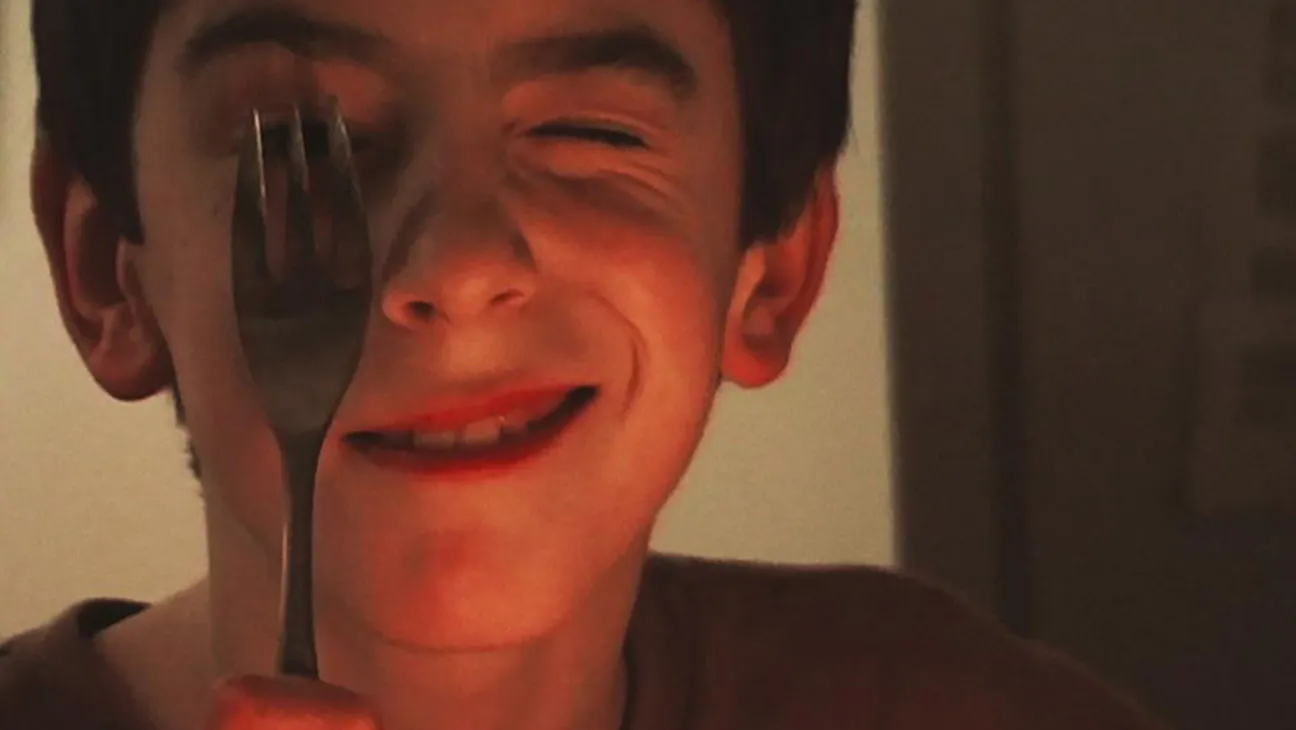
The film’s structure operates like a fractured memory, cutting between two seemingly disparate narratives that slowly reveal their thematic connections. The dominant story is the devastating arc of Adrian’s life. We see him through his father’s lens, from a smiling, bright-eyed child showing early artistic promise to a teenager expelled from school.
The footage charts his descent into a battle with bipolar disorder and addiction, showing stints in rehab and moments of painful clarity. This perspective is deepened by the inclusion of footage Adrian shot himself. On his own camera, he was a talented filmmaker, capturing the kinetic grace of skiing through snowy forests or documenting the lives of his friends. This dual perspective creates a collaboration across time, allowing Adrian’s own voice and eye to contribute to his story.
This deeply personal timeline is interwoven with a strange, almost surreal subplot: a Hollywood director’s attempt to create a fictional comedy remake of McElwee’s 1986 classic, Sherman’s March. The absurdity of pitch meetings and discussions about turning his artistic past into a commercial product provides a stark contrast to the gravity of his personal loss.
The film’s title, Remake, directly links these two threads. The Hollywood project is a literal remake, but the word’s true weight comes from McElwee’s unspoken, impossible desire to remake his own past to save his son. The connection becomes sharper with the knowledge that Adrian, more commercially minded than his father, thought the remake was a good idea. The subplot becomes a meditation on legacy and control. As strangers attempt to reshape his artistic legacy, McElwee grapples with the permanent, unchangeable legacy of his son’s shortened life.
The Camera as Witness and Accomplice
Remake is a profound examination of the very act of documentation. McElwee has built a career on the belief that filming life is a way to understand it, but here he confronts the dark side of that impulse. In his narration, he voices a gut-wrenching fear that a life lived constantly on camera gave his son a “distorted sense of reality,” a life of performance that may have contributed to his destabilization. This idea is powerfully visualized in a childhood drawing Adrian made of his father as a figure who is half-man, half-camera, a heartbreakingly clear symbol of the emotional distance the lens can create.
The film forces us to consider the ethics of personal filmmaking. What does it mean to turn family members into characters? The most devastating sequence explores this tension during a visit with his longtime friend, Charleen Swansea. Charleen was a charismatic force in his earlier films, a brilliant and funny counterpoint to McElwee’s own persona. Now, in her old age, she has dementia. As McElwee sits with her, camera rolling, he gently tries to prompt her memory of their shared past and the films they made together. She looks at him with affection but has no recollection of them.
“Things just disappear,” she says, a simple statement that lands with immense force. In that moment, McElwee’s life’s work of preservation collides with the biological reality of decay. The film archive proves that these things happened, yet for the person who lived them, they are gone. The footage becomes a ghost, a record of a memory that no longer exists, making McElwee’s entire project feel both essential and heartbreakingly futile.
A Portrait of Unresolved Grief
The film’s emotional impact is amplified by a structure that refuses easy resolutions. Its non-linear progression, circling back on certain moments and images, mirrors the recursive nature of grieving. It’s not a story with a beginning, middle, and end; it is an ongoing state of being.
The loss of Adrian is compounded by other endings that populate the film’s landscape, including McElwee’s divorce and the sale of the family home, events that heighten the sense of a world being dismantled piece by piece. Remake is an unflinching depiction of a parent’s sorrow, powerful because it offers no comfort. McElwee does not find a neat answer or absolve himself of his guilt.
The film’s ultimate achievement is that it is a tribute born from this radical honesty. It is not a sanitized memorial but a full, complicated portrait of a young man who was charming, talented, and deeply troubled.
The love is found in the willingness to show every facet of his life, the beautiful and the painful alike. In the end, the act of making the film becomes McElwee’s way of continuing a conversation that was cut short. It is a final, powerful expression of a father’s love, one that uses the camera not to find answers, but to learn how to live inside the questions.
Remake is a documentary film directed by Ross McElwee. It premiered at the 82nd Venice International Film Festival on September 3, 2025. The film follows McElwee as he evaluates his filmmaking approach after his son’s death and the effort to adapt his 1986 film, Sherman’s March. It had theatrical runs in Los Angeles, Boston, Detroit, and Austin starting on August 1, 2025.
Full Credits
Director: Ross McElwee
Writers: Ross McElwee
Producers and Executive Producers: Mark Meatto, Ross McElwee, Giant Squid, Impact Partners
Cast: Ross McElwee, Adrian McElwee, Charleen Swansea, Hyun Kyung Kim
Director of Photography (Cinematographer): Ross McElwee, Adrian McElwee
Editors: Ross McElwee, Joe Bini
The Review
Remake
Remake is a courageous and devastating piece of filmmaking. Ross McElwee confronts his own life's work and a parent's deepest fears with unflinching honesty. The film is an emotionally raw experience that refuses to offer simple answers, instead finding its power in a vulnerable and open-hearted examination of love, loss, and the complicated space between life and the recording of it. It is a shattering, essential, and unforgettable tribute.
PROS
- A profoundly honest and vulnerable depiction of grief.
- Intelligent self-interrogation of the filmmaking process and its ethical implications.
- The inclusion of Adrian's own footage provides a powerful dual perspective.
- Connects its narrative threads in a thoughtful, thematically rich way.
CONS
- The subject matter is intensely painful and can be a difficult viewing experience.
- Its non-linear, meditative pace might not appeal to all viewers.
- The deep dive into a personal archive could feel esoteric for those unfamiliar with McElwee's style.