
















![Kingdom Hearts Collection [I-III] Review](https://gazettely.com/wp-content/uploads/2026/10/Kingdom-Hearts-Collection-I-III-1-360x180.webp "Kingdom Hearts Collection [I-III] Review: KHII Holds Steady as Newer Entries Fluctuate 33")






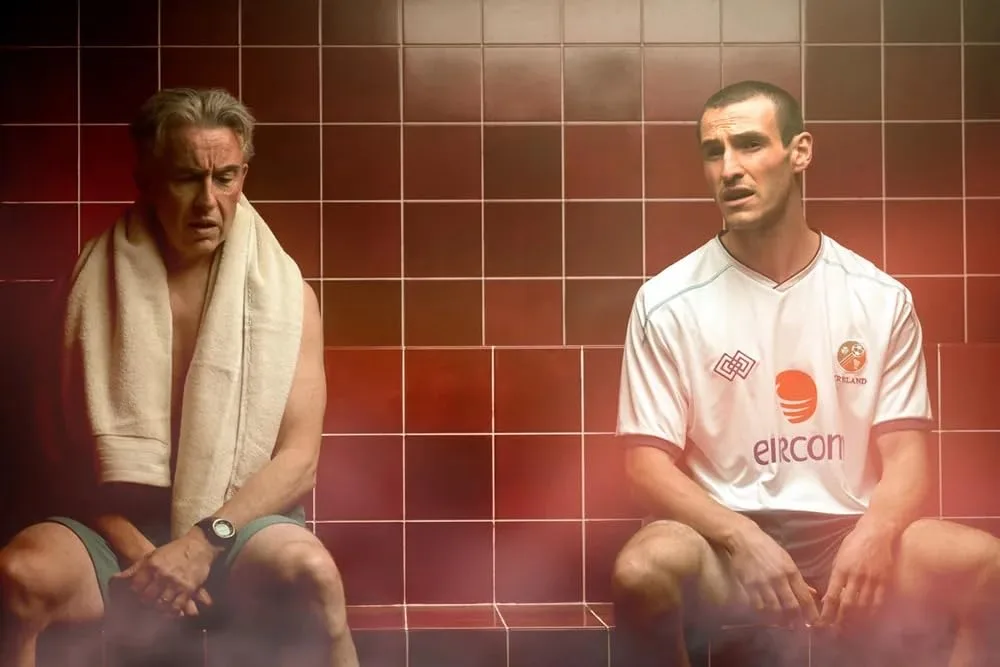

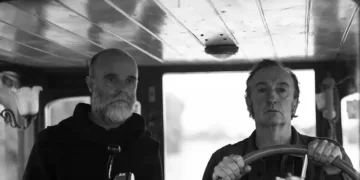
Great national dramas often find their stage in the most unlikely of venues. Saipan revisits one such episode, a moment when the destiny of Irish football was debated not on a hallowed pitch, but in the humid, dilapidated setting of a Pacific island. The film captures the Republic of Ireland in 2002, a nation buoyant with hope on the eve of the World Cup.
At the center of this hope are two figures locked in a fragile truce: the team’s pragmatic manager, Mick McCarthy, and its star player, Roy Keane, a man who treated the sport with monastic severity. McCarthy’s decision to move the team’s training camp to Saipan, ostensibly to acclimate the players to Asian weather, proves to be the spark in a powder keg.
What unfolds is less a story about sport and more a high-stakes psychological standoff, a bitter clash of personalities fueled by pride and wildly divergent professional standards.
An Irresistible Force Meets a Movable Object
The film’s power resides almost entirely in its two central performances, a study in opposition. Éanna Hardwicke’s Roy Keane is a figure of searing, righteous intensity. His anger is not petulance; it is the logical reaction of a purist whose identity is wholly fused with his professional code. For him, an insult to the standard of preparation is an existential threat. Hardwicke’s coiled physicality, a portrait of constant tension, makes this clear before he even speaks.
The film expertly frames his frustration as an understandable response to systemic amateurism, from a crumbling hotel to a training pitch more suitable for grazing goats than for elite athletes (who were, for a time, without footballs). Hardwicke finds the profound, almost tragic, isolation within Keane’s fury, showing a man whose singular commitment makes him an exile among his more relaxed teammates. He makes the player’s legendary intransigence feel less like a flaw and more like a sympathetic, if destructive, virtue.
Against this force, Steve Coogan offers a subtle, reactive portrait of Mick McCarthy. His performance is a masterclass in quiet desperation. Coogan’s McCarthy is a fundamentally decent man, a pragmatist whose primary tool is placation, a style of leadership completely mismatched for the uncompromising modernity Keane represents.
His every facial expression conveys a man running frantic mental calculations to find the right words to defuse an impossible situation. With a hesitant posture and an almost apologetic air, Coogan shows us a manager painfully aware that he is out of his depth, trying to reason with a hurricane. McCarthy’s goal is functional morale, a sharp contrast to Keane’s singular, agonizing pursuit of victory at any cost.
A Fever Dream in Archival Footage
Directors Lisa Barros D’Sa and Glenn Leyburn construct the film’s atmosphere with remarkable skill. They weave in archival news clips and frantic radio reports from 2002, a technique that does more than provide context. It creates a documented reality that envelops the fictionalized scenes, making the private arguments feel like stolen moments happening just beyond the camera flashes.
The editing reflects the protagonist’s agitated mind, with quick, jarring cuts that ratchet up the sense of impending collapse, mirroring a nervous system fraying in real time. The story’s tension is amplified by its claustrophobic settings. Key arguments unfold not in boardrooms but in the cramped confines of an airplane toilet and a sweltering hotel sauna.
These are not just rooms; they are pressure cookers that strip away public personas, leaving only raw ego and conflict. This directorial choice gives the film a tone that oscillates brilliantly between a tense thriller and a dark comedy of errors.
The humor is derived from the absurdly small catalysts (like the quality of sandwiches) for such a monumental fallout. It is a symptom of the situation’s profound absurdity, underscored by a cool indie-rock soundtrack that feels jarringly modern against the very uncool, bureaucratic mess on screen.
An Allegory of Irish Modernity
The film’s scope extends beyond the football pitch, functioning as a sharp workplace drama about the eternal war between the idealist and the manager. Keane is the disruptive visionary, impossible to manage but essential for progress, while McCarthy is the beleaguered executive tasked with keeping the project on schedule, even if it means sacrificing true quality.
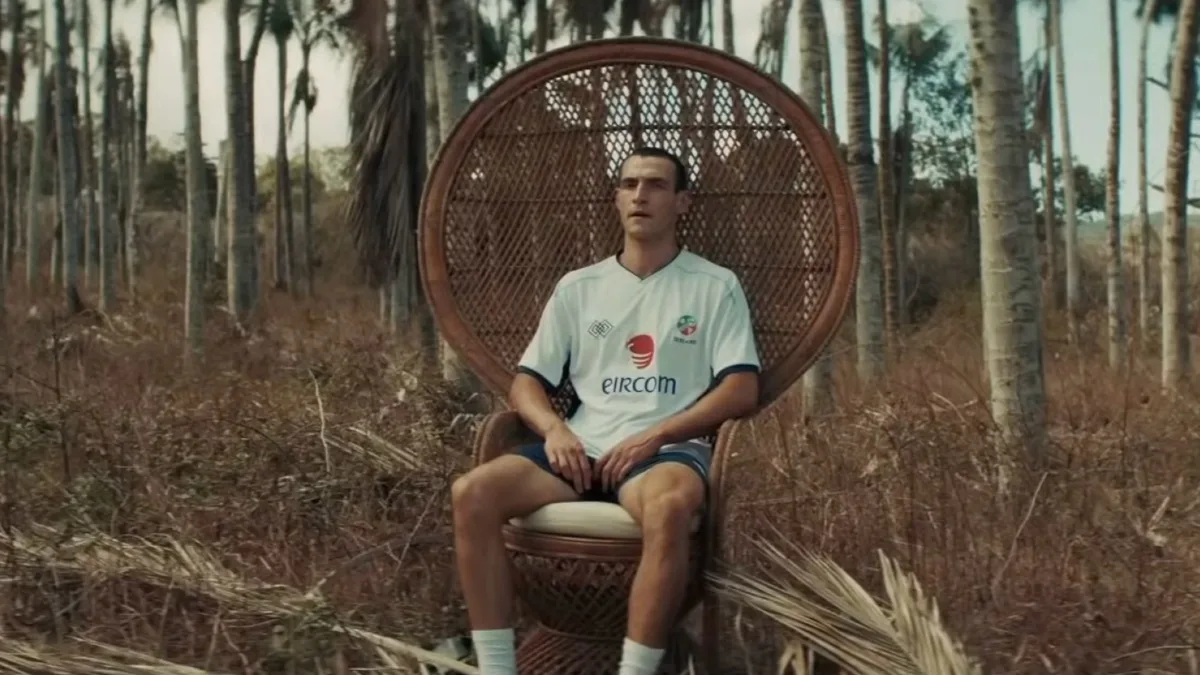
The stubborn pride on display, the catastrophic inability of two men to find an inch of common ground, makes for a potent tragedy of masculine ego. Yet the story also serves as a fascinating examination of Irish national identity at a turning point. The conflict can be read as a clash between two Irelands. Keane, the intense Corkman, embodies a more assertive, post-Celtic Tiger confidence that refuses to be seen as second-rate.
He displays an open disdain for the performative, happy-go-lucky Irish stereotype he sees in the lax atmosphere of the camp. The film thus presents a central conflict not just between two men, but between two competing ideas of what it means to be Irish on the world stage, a potent look at the difficult, often destructive, path required to achieve excellence in a world that prefers comfortable compromise.
“Saipan” had its world premiere at the Toronto International Film Festival (TIFF). The film is scheduled for a theatrical release in the United Kingdom and Ireland in 2025, with distribution handled by Wildcard and Vertigo Releasing. It is a co-production between the UK and Ireland, with international sales managed by Bankside Films.
Full Credits
Director: Lisa Barros D’Sa, Glenn Leyburn
Writers: Paul Fraser
Producers and Executive Producers: Macdara Kelleher, John Keville, Trevor Birney, Olly Butler, Patrick O’Neill, Eoin Egan, Rupert Preston, Ed Caffrey, Stephen Kelliher, Sophie Green, Greg Martin, Ursula Devine, Rachael O’Kane
Cast: Steve Coogan, Éanna Hardwicke, Harriet Cains, Alice Lowe, Jamie Beamish, Alex Murphy, Peter McDonald, Aoife Hinds, Jack Hickey, Niall McNamee
Director of Photography (Cinematographer): Piers McGrail
Editors: John Murphy, Gavin Buckley
Composer: David Holmes
The Review
Saipan
Saipan is a blistering character study disguised as a sports film. Anchored by two towering performances from Éanna Hardwicke and Steve Coogan, it transforms a footnote of football history into a sharp, tense, and surprisingly funny examination of pride, professionalism, and national identity. It is a compelling psychological drama that smartly uses its specific setting to explore universal conflicts, making for a fascinating and intellectually rewarding watch.
PROS
- Exceptional lead performances that capture the complex central dynamic.
- An intelligent script that explores deep themes of professionalism and national identity.
- Tense, effective direction that skillfully blends archival footage with dramatized scenes.
- A successful and distinct tone that mixes high-stakes drama with dark humor.
CONS
- The niche subject matter might be a barrier for viewers unfamiliar with the real-life incident.
- Its narrative viewpoint is heavily aligned with one character, which may feel one-sided.
- The intentionally claustrophobic focus on interiors may disappoint those expecting a visually expansive sports movie.