































Dynasty is a word that carries immense weight in the Hindi film industry, suggesting a lineage of creative inheritance but also a closed system of privilege. It is from within this gilded cage that creator Aryan Khan launches his debut, The Ba*ds of Bollywood.
The series presents an immediate paradox: an ultimate insider telling an outsider’s story. This tension animates the entire production, which follows the dizzying ascent of Aasmaan Singh (Lakshya), a gifted actor from Delhi.
After his first film becomes an unexpected blockbuster, he is pulled into the industry’s orbit, a world governed by manipulative producers, powerful families, and unwritten rules. Aasmaan’s journey from newcomer to commodity forms the show’s narrative spine, setting up a potent exploration of the perennial conflict between artistic merit and inherited power in one of the world’s most prolific film cultures.
Life Imitating Art Imitating Headlines
The series distinguishes itself through a persistent meta-commentary, positioning itself within a global tradition of self-critique seen in shows that deconstruct their own industries. Its analysis feels particularly timely, tapping into a contemporary Indian cultural conversation about fairness and access.
The show’s most direct confrontation with this topic occurs in a brilliantly staged newcomers’ roundtable. Here, Aasmaan openly questions star-kid Karishma (Sahher Bambba) about her privilege, a scene that meticulously recreates the awkward silences and coded language of a real-life viral interview that captured the nation’s attention. This sequence is more than a simple parody; it is a cultural artifact, reflecting a post-internet audience’s demand for transparency from its stars.
This self-aware lens extends to a broader satire of industry mechanics. The show exposes the machinery behind the glamour with pointed accuracy. We see the predatory nature of contracts through the character of producer Freddy Sodawallah, whose cynical monologues about turning actors into brands feel chillingly authentic. The frenetic, almost disorienting editing during paparazzi sequences captures the invasive nature of modern celebrity culture. The series also winks at its audience with plotlines involving drug scandals and manufactured media feuds, narrative threads that feel ripped from recent headlines.
A key element of this meta-narrative is the use of celebrity cameos. These are not mere decorative appearances; they are functional. Director Karan Johar, a central figure in the real-world nepotism debate, delivers a sharp performance as a heightened, egocentric version of himself, obsessed with box office returns and petty rivalries. His self-parody is a risky, effective choice that lends the satire a startling legitimacy.
Other appearances from superstars like Salman Khan and Shah Rukh Khan serve a different function, reinforcing the hierarchical nature of the industry where a single phone call from a titan can alter a career. The script’s most personal dimension comes from its allusions to creator Aryan Khan’s own highly publicized legal battles, a choice that infuses the satire with a layer of raw, autobiographical honesty.
Bonds of Friendship, Fault Lines of Romance
The series grounds its high-concept satire in the personal journey of Aasmaan Singh. Lakshya portrays him with a charismatic blend of ambition and naivete. His performance captures the subtle shifts in a newcomer’s identity, from an artist driven by passion to a player learning the rules of a rigged game.
We see his moral compass tested in small moments, like when he hides a binding contract from his manager, suggesting that the industry’s corruption is not just external but insidious. His character arc subtly updates the classic “Angry Young Man” archetype of 1970s Hindi cinema for a modern era, his rebellion aimed not at the state but at the opaque power structures of his chosen profession.
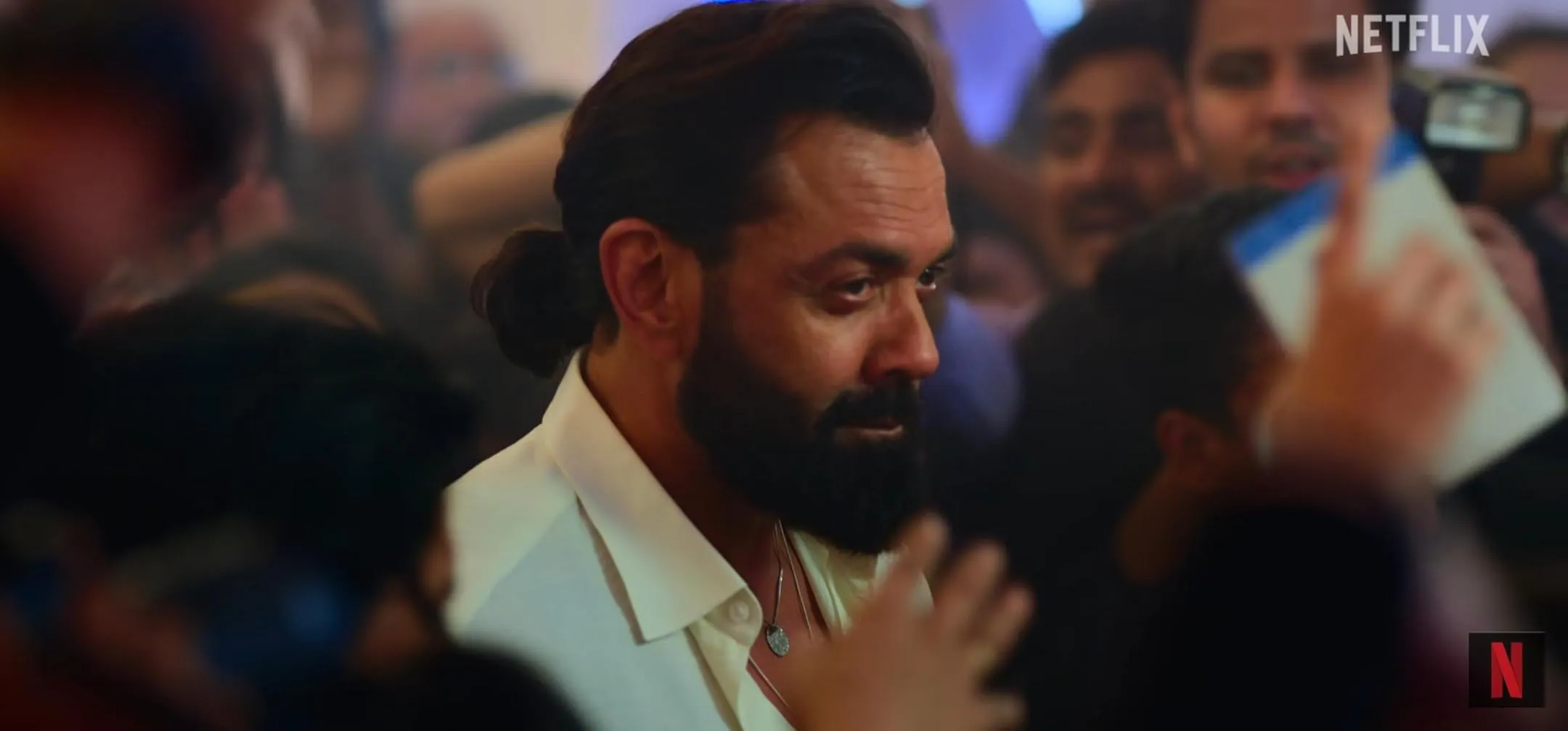
His primary antagonist is Ajay Talvar, a veteran star played by Bobby Deol. Deol’s performance portrays him as a product of the very system he perpetuates. His attempts to sabotage Aasmaan stem from a mix of patriarchal control over his daughter and a deep-seated fear of losing relevance. He represents the old guard, a gatekeeper whose power is absolute.
The show’s emotional core lies in Aasmaan’s relationships, which are presented with starkly different levels of success. The bond with his best friend Parvaiz (Raghav Juyal) is the narrative’s heart. Their easy chemistry and street-smart dialogue provide both comic relief and genuine warmth. Parvaiz acts as Aasmaan’s link to his life before fame, a grounding force against the industry’s artifice. Their dynamic has a specific cultural resonance, reflecting the tapori (street-wise) archetype that celebrates loyalty above all.
In sharp contrast, the romantic plotline between Aasmaan and Karishma is unconvincing. Beyond a simple lack of chemistry, the writing gives them few meaningful scenes together. Their interactions are brief and functional, lacking the depth or vulnerability required to build a believable emotional connection.
The failure of this central romance creates a void in the narrative, leaving Aasmaan’s motivations feeling incomplete and making the stakes of his professional rivalry with Karishma’s father feel impersonal. While the supporting cast, particularly Mona Singh as Aasmaan’s mother and Manoj Pahwa as his artistically unfulfilled uncle, add layers of emotional history, they cannot fully mend the narrative fissure left by the weak central romance.
A Satire at War With Itself
For a debut project, The Ba*ds of Bollywood is directed with a notable confidence and visual flair. Aryan Khan demonstrates a keen eye for composition and pacing in the show’s stronger satirical moments. The series’ greatest flaw, however, is a profound tonal inconsistency that suggests a creator at war with his own subject.

The show cannot decide if it wants to be a critique of the Bollywood machine or a love letter to its aesthetic. This confusion is evident in the cinematic language itself. The visual grammar shifts jarringly from the raw, handheld style of a documentary during tense backroom deals to the glossy, slow-motion crane shots of a commercial blockbuster during action sequences.
This split identity is further reinforced by the use of music. The score effectively uses nostalgic hit songs to cue the entries of stars like Shah Rukh Khan and Bobby Deol. While this technique works as an inside joke for Bollywood fans, it also reinforces the very star worship the show ostensibly critiques. The editing, while slick, contributes to an uneven rhythm, lingering on dramatic moments that feel unearned while rushing through crucial character development.
These technical and tonal contradictions culminate in a final-act twist that is surprising but ultimately hollow. By choosing a shocking reveal over an emotionally complex resolution, the series pulls its punches.
This “safe” ending feels connected to the creator’s insider status. It suggests a willingness to lampoon the industry’s eccentricities but a reluctance to deliver a truly damning indictment of its foundational flaws. The show exposes the circus but leaves the systemic structure intact, resulting in a work that is often intelligent and entertaining but stops short of being truly subversive.
The Ba*ds of Bollywood is a satirical action comedy series that premiered on September 18, 2025. You can watch it on the streaming platform Netflix.
Full Credits
Director: Aryan Khan
Writers: Aryan Khan, Bilal Siddiqi, Manav Chauhan
Producers: Gauri Khan
Executive Producers: Bonnie Jain, Akshat Verma
Cast: Lakshya Lalwani, Sahher Bambba, Bobby Deol, Raghav Juyal, Anya Singh, Mona Singh, Gautami Kapoor, Manoj Pahwa, Rajat Bedi, Manish Chaudhari, Arshad Warsi, Vijayant Kohli
Director of Photography: Jay Pinak Oza
Editor: Nitin Baid
Composers: Shashwat Sachdev, Anirudh Ravichander, Ujwal Gupta
The Review
The Ba***ds of Bollywood
Aryan Khan’s debut is a sharp, entertaining, and often insightful satire of the Hindi film industry. The series excels when it leans into its meta-commentary, lampooning industry politics with a self-aware wit. It is hampered by a significant tonal imbalance, frequently abandoning its critical edge for conventional Bollywood melodrama. A weak romantic subplot and a safe, underwhelming climax prevent it from delivering the truly subversive critique it promises. It is a confident, intelligent, but ultimately conflicted piece of work that pulls its punches when it matters most.
PROS
- Intelligent and sharp satire of the Bollywood industry.
- Confident direction and a bold, self-aware script.
- The strong central friendship provides an emotional core.
- Clever use of celebrity cameos, especially Karan Johar's self-parody.
CONS
- Significant tonal inconsistency, shifting between satire and melodrama.
- The central romantic storyline is underdeveloped and lacks chemistry.
- Uneven pacing across the season.
- The climactic twist feels underwhelming and like a safe choice.