
























![Kingdom Hearts Collection [I-III] Review](https://gazettely.com/wp-content/uploads/2026/10/Kingdom-Hearts-Collection-I-III-1-360x180.webp "Kingdom Hearts Collection [I-III] Review: KHII Holds Steady as Newer Entries Fluctuate 37")





Some stories operate on a premise so simple it feels elemental. In a broken, post-war America, an annual event called “The Long Walk” offers a grim spectacle. Teenage boys volunteer to walk. The rules are few: maintain a certain pace, receive three warnings if you falter, and on the fourth infraction, you are shot.
The last boy standing is granted a fortune and any wish he desires. This is the stark foundation of The Long Walk, a film that uses its brutal setup to conduct a harrowing exploration of human endurance. It is a story about the friendships forged and the despair faced when every step forward is a step closer to a terrible end.
A Brutal Premise, A Human Core
The world of The Long Walk feels uncomfortably close because it is not a gleaming, high-tech dystopia but a gritty, run-down version of our own. It is an America suffering from economic collapse and creeping authoritarianism, a reality where the promise of the grand prize is a desperate, tangible dream.
Overseeing the morbid proceedings is The Major, a figure played by Mark Hamill with a chilling sense of detached cruelty. He is not a hands-on villain but a remote administrator of death, often seen observing from the comfort of his vehicle. His calm announcements over a loudspeaker about the rules and the current number of walkers remaining are a constant, unnerving presence. He is the face of a system that has turned the lives of young men into a blood sport.
The mechanics of the walk itself function like a perverse game loop. The constant need to maintain a three-mile-per-hour pace creates a monotonous rhythm, a long, grueling grind that attacks the mind as much as the body. The psychological toll of this repetition is immense, wearing down the participants with every step.
This agonizing baseline is punctuated by sudden, jolting acts of violence. The electronic beep of a warning is a sharp, terrifying sound, followed by a cold, numerical announcement and, eventually, the finality of a gunshot. The film does not shy away from the physical decay: the blisters that form and burst, the pain of sunstroke, the sheer exhaustion that leads to hallucinations.
Yet, within this rigid system designed for elimination, something unexpected happens. The shared trauma forges an environment for deep human connection. The narrative shifts its focus from the competition to the relationships that form on the road. We see small acts of camaraderie: sharing a precious tube of food concentrate, offering a word of encouragement, or simply talking to keep each other sane.
This creates a powerful paradox where boys actively help the very people they must outlast to survive. This emerging brotherhood becomes the story’s emotional anchor, making each walker’s inevitable failure more potent and deeply painful.
Star-Making Turns on a Doomed Road
A film with such a spare concept lives or dies on its performances, and the cast here is exceptional across the board. Cooper Hoffman carries the emotional weight of the story as Raymond Garraty, our essential window into the walk.

His performance is a nuanced storm of simmering anger at the world, deep regret for his choices, and the fragile hope that he cannot quite extinguish. Garraty is our anchor in the madness. He is matched perfectly by David Jonsson’s Peter McVries, a magnetic and complex presence who is at once commanding with his world-weary knowledge of the walk and deeply generous with his support for Garraty.
The chemistry between Hoffman and Jonsson is the lifeblood of the film. Their quiet conversations, often about seemingly mundane topics from their past lives, become the narrative backbone, revealing character depth and backstory while the physical horror unfolds around them. Their unspoken glances and subtle gestures build a bond that feels real, vital, and ultimately tragic.
Against their grounded, raw reality, Mark Hamill’s Major operates on a different frequency. His performance is theatrical and at times verges on cartoonish, but it serves a crucial purpose. He is the inhuman face of the contest, a figure of authority completely removed from the dirt and pain of the road. This detachment makes the violence he oversees seem even more perverse, as if it is all just a well-managed show for him.
The supporting cast adds incredible depth to the doomed parade, ensuring the other walkers are more than just numbers. Ben Wang provides much-needed levity as the foul-mouthed Hank Olson, whose constant stream of jokes acts as a desperate defense mechanism against the encroaching horror. Tut Nyuot brings a gentle warmth as Arthur Baker, representing a flicker of goodness and a moral conscience within the group.
Even Judy Greer, in a few brief but powerful scenes as Ray’s mother watching from the crowd, leaves a devastating impact, conveying a universe of pain without needing many words. Other performers like Garrett Wareing, Charlie Plummer, and Joshua Odjick ensure that even the more antagonistic walkers are humanized, showing their own moments of fear and weakness before they are tragically eliminated.
The Art of Restrained Dread
Director Francis Lawrence understands that the true horror of The Long Walk is not in spectacle but in atmosphere. His directorial approach is restrained and patient, building psychological tension that slowly tightens around you like a vice. He uses long, unbroken takes to emphasize the grueling duration and monotony of the journey, refusing to cut away from the suffering.
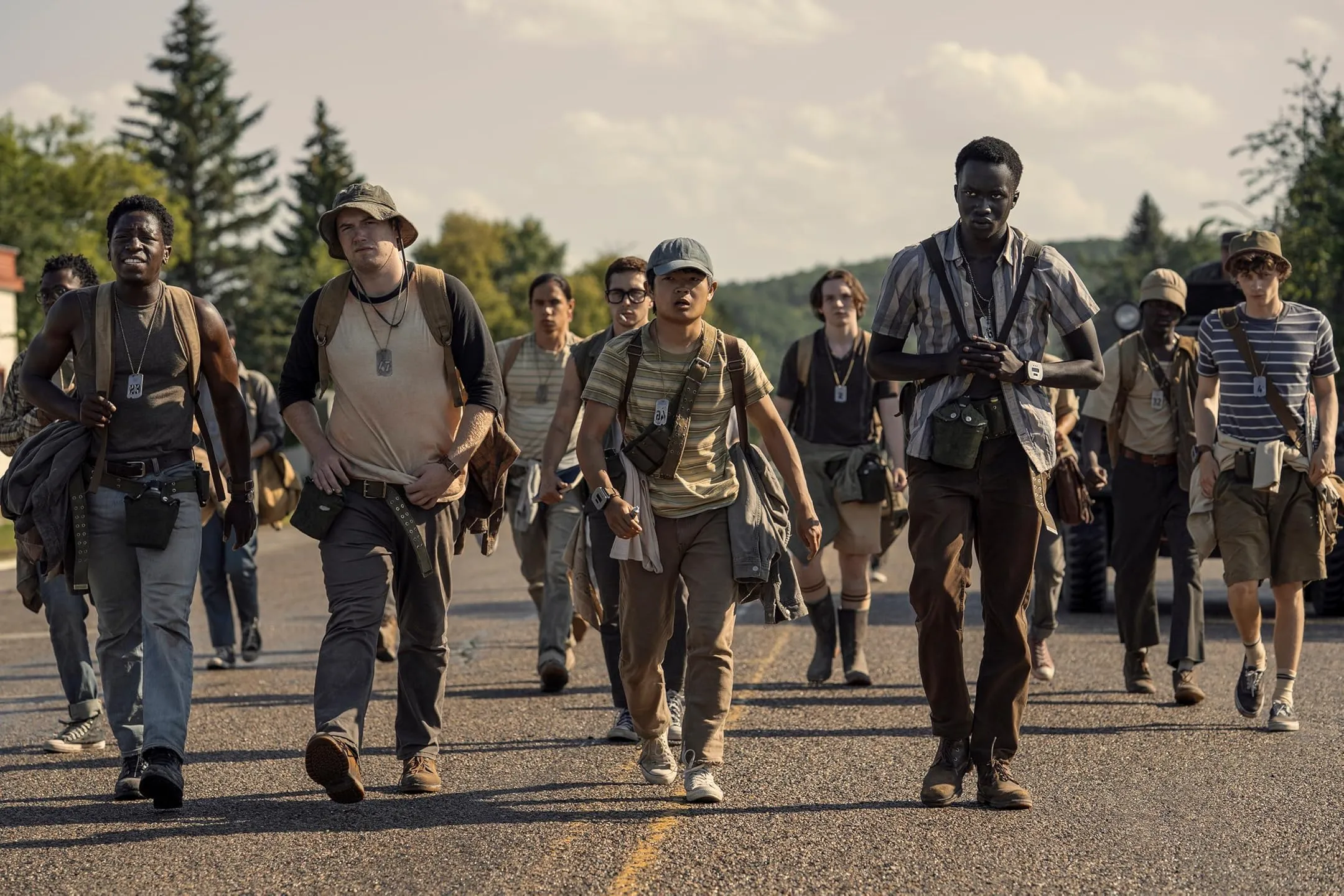
The framing of his shots often makes the vast, open road feel claustrophobic and inescapable, with no horizon offering any real hope. His camera focuses intently on the boys’ faces, caked in dirt and streaked with sweat, to convey their deteriorating internal states far better than any dialogue could. The decision to shoot the film in sequence pays off brilliantly, as the actors’ physical and mental exhaustion becomes visibly authentic with each passing mile.
JT Mollner’s script is equally smart, using dialogue to manage the film’s pacing. Since the physical action is intentionally repetitive, the conversations provide the narrative momentum. The script trusts the audience to remain engaged without constant set pieces, much like a slow-burn narrative game that prioritizes character over action.
The effective choice to keep the camera’s focus squarely on the boys, making us a silent member of their group, is what makes the experience so personal. The sound design is a key tool in this immersive dread. The audio mix creates a state of constant anxiety.
The baseline is the sound of dozens of pairs of shoes on pavement, the whisper of the wind, and the distant, muffled cheers of the crowd. This is pierced by the sharp, electronic beep of a warning signal or the sudden, sharp crack of a rifle. Benign environmental sounds sit side-by-side with the audio cues of death, ensuring no moment of peace is ever truly safe.
The Weight of the Walk
The Long Walk is a profound exploration of friendship as a form of rebellion. The connections the boys forge are not just for comfort; they are acts of defiance against a system designed to isolate them and turn them against each other. The bond between Garraty and McVries is portrayed with the intensity of a tragic love story.

The film also functions as a potent allegory for the cruel logic of “last man standing” systems, a critique of the “pull yourself up by your bootstraps” mentality shown in its most literal, horrifying form. It examines the theme of motivation; what memories and dreams do the boys cling to in order to keep moving, and how do those very thoughts become a source of both strength and torture?
The film’s emotional impact is significant and lasting. It is an exhausting, difficult, and emotionally obliterating experience that stays with you long after the credits roll. The experience is not cathartic in a traditional sense. Instead, the viewer is left feeling as hollowed out and weary as the lone survivor.
This is a deliberate and powerful choice, reinforcing the film’s message about the terrible cost of “winning” in a broken world. It stands as a masterful and faithful adaptation of King’s novel, comparable to other grim and uncompromising works like The Mist. Its refusal to offer easy answers or comfort is precisely what makes it such a significant and unforgettable piece of filmmaking. Its grim nature might deter some, but for those who are willing to take the first step, it is an essential experience.
The Long Walk, a 108-minute American dystopian horror thriller film based on the Stephen King novel of the same name, is scheduled for a wide theatrical release in the United States by Lionsgate on September 12, 2025. Directed by Francis Lawrence, known for his work on the Hunger Games franchise, the film stars a young cast along with veterans Mark Hamill and Judy Greer.
Full Credits
Director: Francis Lawrence
Writers: JT Mollner, Stephen King
Producers and Executive Producers: Francis Lawrence, Roy Lee, Steven Schneider, Cameron MacConomy, Stephen King, Andrew Childs, K. Blaine Johnston, Mika Saito, Christopher Woodrow
Cast: Cooper Hoffman, David Jonsson, Garrett Wareing, Tut Nyuot, Charlie Plummer, Ben Wang, Roman Griffin Davis, Jordan Gonzalez, Josh Hamilton, Judy Greer, Mark Hamill, Joshua Odjick
Director of Photography (Cinematographer): Jo Willems
Editors: Mark Yoshikawa, Peggy Eghbalian
Composer: Jeremiah Fraites
The Review
The Long Walk
The Long Walk is a masterpiece of sustained dread, a film that is as emotionally devastating as its premise is brutal. Anchored by phenomenal, star-making performances from Cooper Hoffman and David Jonsson, it is a harrowing and unforgettable look at human connection in the face of certain death. Director Francis Lawrence crafts an atmospheric, psychologically grueling experience that will leave you hollowed out. It is a faithful, powerful Stephen King adaptation, but its unrelenting bleakness makes it a difficult, yet essential, watch for those who can endure the path.
PROS
- Phenomenal lead performances from Cooper Hoffman and David Jonsson.
- Incredible chemistry between the two leads creates a powerful emotional core.
- Masterful direction that builds a sustained, atmospheric dread.
- Unflinching and psychologically intense storytelling.
- A powerful exploration of friendship, hope, and humanity.
- A faithful and top-tier adaptation of the Stephen King novel.
CONS
- The unrelentingly bleak and emotionally devastating tone can be a difficult watch.
- Its intentionally monotonous pacing may alienate viewers seeking more action.
- The main antagonist's theatrical performance may feel tonally distinct from the grounded realism of the walkers.







