





















Past actions possess a strange permanence, often lying dormant before resurfacing with quiet force. Cai Shangjun’s film, The Sun Rises On Us All, is a story about two people permanently chained together by such a shared, ruinous secret.
The narrative centers on Meiyun (Xin Zhilei), a woman whose life is in a state of constant uncertainty. She runs a modest clothing shop from a small boutique, livestreaming her wares, while managing an unstable pregnancy with her married lover, Qifeng. Her precarious present is shattered during a hospital visit.
There, she has a chance encounter with her ex-lover, Baoshu (Zhang Songwen), a man she has not seen in years. The reunion is thick with shock and unspoken tension, a gravity made heavier by the revelation that he is there for cancer treatment. The film immediately establishes a brittle, somber mood, where repressed emotions and a deep sense of guilt permeate every frame.
The Bonds of Guilt
The source of this tension is a defining event from seven years prior, a moment that acts as the story’s moral axis. Meiyun was the driver in a fatal hit-and-run accident. In a profound act of devotion, Baoshu took the blame, accepting a five-year prison sentence in her place. This immense sacrifice is poisoned by a subsequent betrayal: she stopped visiting him just one year into his term, effectively abandoning him to his fate.

This abandonment, whether an act of weakness or self-preservation, complicates her current guilt and reframes his resentment as something earned. Their reunion does not spark a simple rekindling of romance. Instead, it builds a complex dynamic where every interaction is a negotiation of debt. He initially rebuffs her attempts at amends, then turns the tables, exploiting her guilt by demanding money and moving into her small apartment.
His presence creates a cursed triangle with her lover Qifeng, disrupting her attempt at a new life. This is not a Western-style drama of passionate choices, but a distinctly Chinese dilemma rooted in obligation, face, and an inescapable past.
The performances give this difficult relationship its believability. Xin Zhilei portrays Meiyun with a stoic facade that conceals a storm of internal conflict. Zhang Songwen’s physical performance is remarkable; he carries the weight of both terminal illness and deep-seated bitterness in his weary posture and hollowed expressions, making their shared scenes crackle with an awkward, painful history.
A World Without Solace
The film’s examination of sacrifice and moral ambiguity is relentless, posing questions that resonate differently across cultural contexts. How much does Meiyun truly owe Baoshu for what he did? Can his later actions toward her be understood through the lens of his betrayal?
The picture is more interested in posing these questions than in providing any straightforward answers, reflecting a worldview where karmic retribution is a slow, grinding process. This personal turmoil is mirrored in the atmospheric setting of Guangzhou.
Cai Shangjun and cinematographer Kim Hyunseok present the city as a grim, gray, and impersonal world. This is a place of smoke-filled rooms, humid air, and indifferent crowds, far from the gleaming, sanitized image of a modern Chinese metropolis. The visual storytelling often focuses on the quiet aftermath of dramatic events, emphasizing a world where characters must live with the consequences of their actions. This bleak environment is not merely a backdrop; it is an active participant in the characters’ misery.
Meiyun’s professional life, with its faulty clothing consignments and the impersonal nature of livestreaming, echoes her own morally compromised state. The anonymous, harassing texts Qifeng receives suggest a society where secrets are currency and privacy is an illusion. The city itself becomes an external representation of their existential unhappiness, a physical manifestation of a society where empathy is a scarce resource and individual salvation feels perpetually out of reach.
Melancholy and Melodrama
Director Cai Shangjun’s restrained, observational approach aligns with a tradition of Chinese social realism. He demonstrates a patient focus on the minute details of his characters’ lives, allowing the film’s deliberate, slow pacing to build a specific kind of tension.
This quiet drama is periodically interrupted by Guo Sida’s score, which introduces an electric, thriller-like quality that creates a sharp contrast with the overarching melancholy. A key sequence in a stuck elevator is a powerful, claustrophobic representation of their entire relationship. The confined space forces an emotional confrontation, acting as a symbolic pressure cooker and a miniature replay of their history of sacrifice in a moment of crisis.
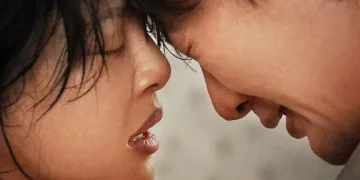
The film’s third act shifts away from realism toward a more surprising and operatic register, a choice that may feel abrupt. The final moments leave a lasting impression. The two are seen in a painful embrace, suggesting they are fated to remain locked together. The title, The Sun Rises On Us All, ultimately reads with a deep irony. Here, the sun’s light does not cleanse; it merely exposes. The film’s ambivalent resolution offers a challenging view of a world where breaking the cycle of guilt may not be possible.
The Sun Rises On Us All, a Chinese drama film, had its world premiere at the 82nd Venice International Film Festival on September 5, 2025. It was also selected for the Toronto International Film Festival in 2025. The film is known in Chinese as “Rì guà zhōng tiān”.
Full Credits
The Review
The Sun Rises On Us All
Cai Shangjun crafts a demanding and somber drama, anchored by exceptional lead performances from Xin Zhilei and Zhang Songwen. The film's deliberate pacing and unyielding bleakness will not appeal to everyone, and its final turn toward the operatic may feel jarring. For those willing to engage with its difficult questions about guilt and atonement, The Sun Rises On Us All offers a potent, atmospheric study of two lives permanently intertwined by a single, ruinous choice. It is a grim yet memorable piece of contemporary Chinese cinema.
PROS
- Exceptional lead performances that convey a complex history.
- A potent, atmospheric depiction of an impersonal modern China.
- A deep and challenging examination of guilt, sacrifice, and moral ambiguity.
- Effective use of a restrained directorial style to build tension.
CONS
- The deliberate, slow pacing can be demanding for some viewers.
- An abrupt tonal shift toward melodrama in the final act.
- Its unyielding bleakness can make for a difficult viewing experience.