

























![Kingdom Hearts Collection [I-III] Review](https://gazettely.com/wp-content/uploads/2026/10/Kingdom-Hearts-Collection-I-III-1-360x180.webp "Kingdom Hearts Collection [I-III] Review: KHII Holds Steady as Newer Entries Fluctuate 37")





Thirty years have passed since the Great Frost first claimed the world, and the survivors of New London have learned to carve civilization from ice and desperation. Frostpunk 2 drops players into this expanded reality where the struggle has evolved beyond mere survival into something far more complex: the burden of leadership over tens of thousands of lives hanging in the balance of every decision.
This sequel transforms the intimate, building-by-building construction of its predecessor into a grand-scale district management system. Where once you carefully placed individual workshops and homes, now you’re sketching entire neighborhoods across the frozen landscape. The personal connection to each structure gives way to something grander yet more detached – you become an architect of communities rather than individual shelters.
The political dimension transforms every choice into a moral crucible. Factions emerge organically from your population, each with their own vision of how humanity should survive in this frozen world. These groups watch your every move, judging whether you lean toward authoritarian efficiency or democratic idealism. The game presents these tensions through the lens of survival, where the “right” choice often leads to the worst outcomes, and pragmatic decisions leave you feeling like you’ve betrayed your principles.
This console edition arrives as a carefully crafted adaptation of the 2024 PC release, redesigned specifically for gamepad navigation. The development team has rebuilt the interface from the ground up rather than simply mapping keyboard shortcuts to controller buttons.
The Dance of Districts and Dissent
The mechanical heart of Frostpunk 2 beats with the rhythm of constant expansion and political maneuvering. Resource management flows through three critical streams: food to feed your growing population, fuel to power the massive generators that keep everyone alive, and the abstract yet vital currency of political goodwill. Each district you construct specializes in particular functions – industrial zones churn out materials while residential areas house your citizens, creating supply chains that stretch across the icy expanse.
The faction system breathes life into what could have been dry population statistics. Groups form around shared beliefs, splitting and merging as your decisions shape their worldviews. Technocrats push for scientific advancement while traditionalists cling to familiar ways of surviving. These aren’t simple binary choices between good and evil – each faction offers compelling arguments for their vision of humanity’s future. A law that satisfies the industrialists might outrage the environmentalists, creating ripple effects that spread through your entire population.
The Council serves as your primary political battlefield, where proposed laws face scrutiny from these competing voices. Passing legislation requires careful calculation of which groups you can afford to alienate and which ones you need to keep satisfied. Some laws unlock new technologies or districts, while others reshape the social fabric of your city. The system forces you to consider the long-term consequences of short-term gains, creating genuine tension around decisions that might seem straightforward on the surface.
Frostland Teams add another layer of strategic depth by venturing beyond your city’s borders. These expeditions search for new resource deposits and establish supply lines to distant locations. The exploration mechanics create a constant push-and-pull between expanding your reach and consolidating your existing infrastructure. Time becomes your most precious resource as each action requires careful scheduling, and the ever-present threat of dropping temperatures means you can’t afford to stand still.
The moral weight of leadership permeates every system. Efficiency often demands harsh measures – work camps might boost production while destroying morale, and authoritarian laws can streamline decision-making at the cost of personal freedom. The game excels at presenting scenarios where all available options carry significant downsides, forcing you to choose which values you’re willing to compromise.
Controller Choreography in the Cold
The transition from mouse and keyboard to gamepad control represents one of the most successful adaptations of a complex strategy game for consoles. The redesigned interface centers around radial menus that feel intuitive once you adjust to their rhythm. Holding the right shoulder button brings up context-sensitive options, while the D-pad cycles through different menu categories with satisfying precision.
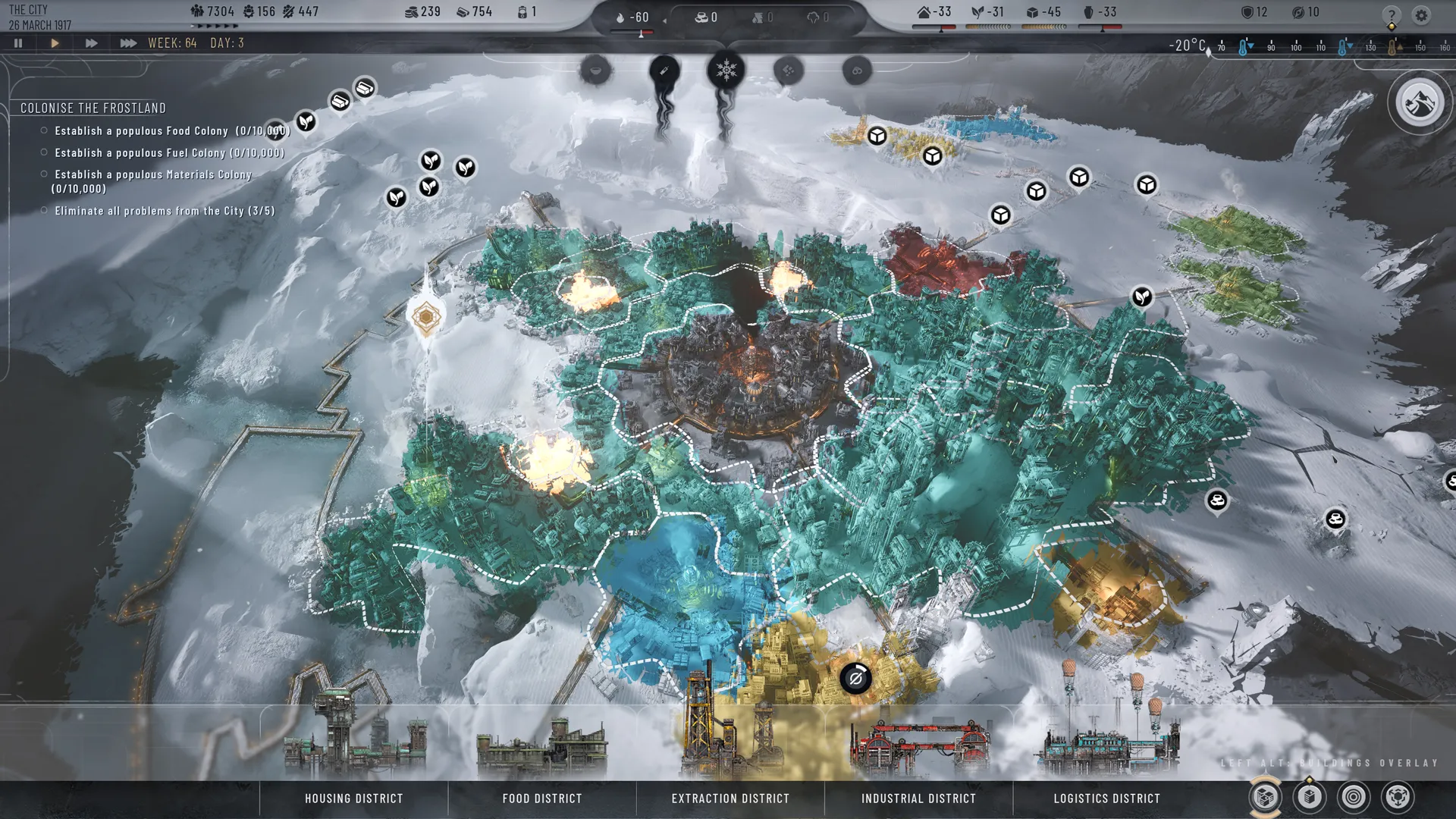
District navigation works particularly well with analog stick control, allowing smooth camera movement across your expanding city. The shoulder buttons let you quickly jump between different areas, maintaining the flow of city management without the constant menu diving that plagues many console strategy games. Building placement feels natural through this system, with clear visual feedback showing valid construction zones and resource connections.
However, some interactions reveal the limitations of controller input. Fine-tuned adjustments to production quotas or detailed examination of individual buildings can feel cumbersome compared to point-and-click precision. Extended menus sometimes suffer from navigation quirks where the cursor doesn’t land exactly where you intended, requiring multiple attempts to select specific options. These moments never break the game but serve as reminders that some interfaces simply work better with mouse control.
Visual performance scales across three modes that cater to different preferences. Fidelity mode showcases the game’s impressive art direction at 30fps, letting you appreciate the detailed texture work on frozen structures and the dramatic lighting effects that emanate from your city’s heat sources. Performance mode doubles the frame rate to 60fps, creating smoother camera movement and more responsive controls at the cost of some visual fidelity. The middle-ground Balanced mode offers 40fps for displays that support 120Hz refresh rates, striking an appealing compromise between visual quality and smooth performance.
Larger cities can stress the system as the screen fills with districts, citizens, and environmental effects. Frame drops occasionally occur during rapid camera movements across sprawling settlements, though these hiccups rarely impact gameplay significantly. Load times remain reasonable, and the UI scales well to television displays, maintaining readability even when playing from across the room.
The console version feels like a genuine adaptation rather than a hasty port, with clear attention paid to making the complex systems accessible through gamepad control.
Frozen Beauty and Endless Winters
The visual language of Frostpunk 2 creates one of gaming’s most effective atmospheric experiences through the stark contrast between humanity’s warm glow and nature’s hostile indifference. Your city radiates golden light across the landscape, creating pools of civilization that push back against the encroaching darkness. Steam rises from industrial districts while residential areas flicker with the gentle light of occupied homes, each visual element reinforcing the theme of life persisting against impossible odds.
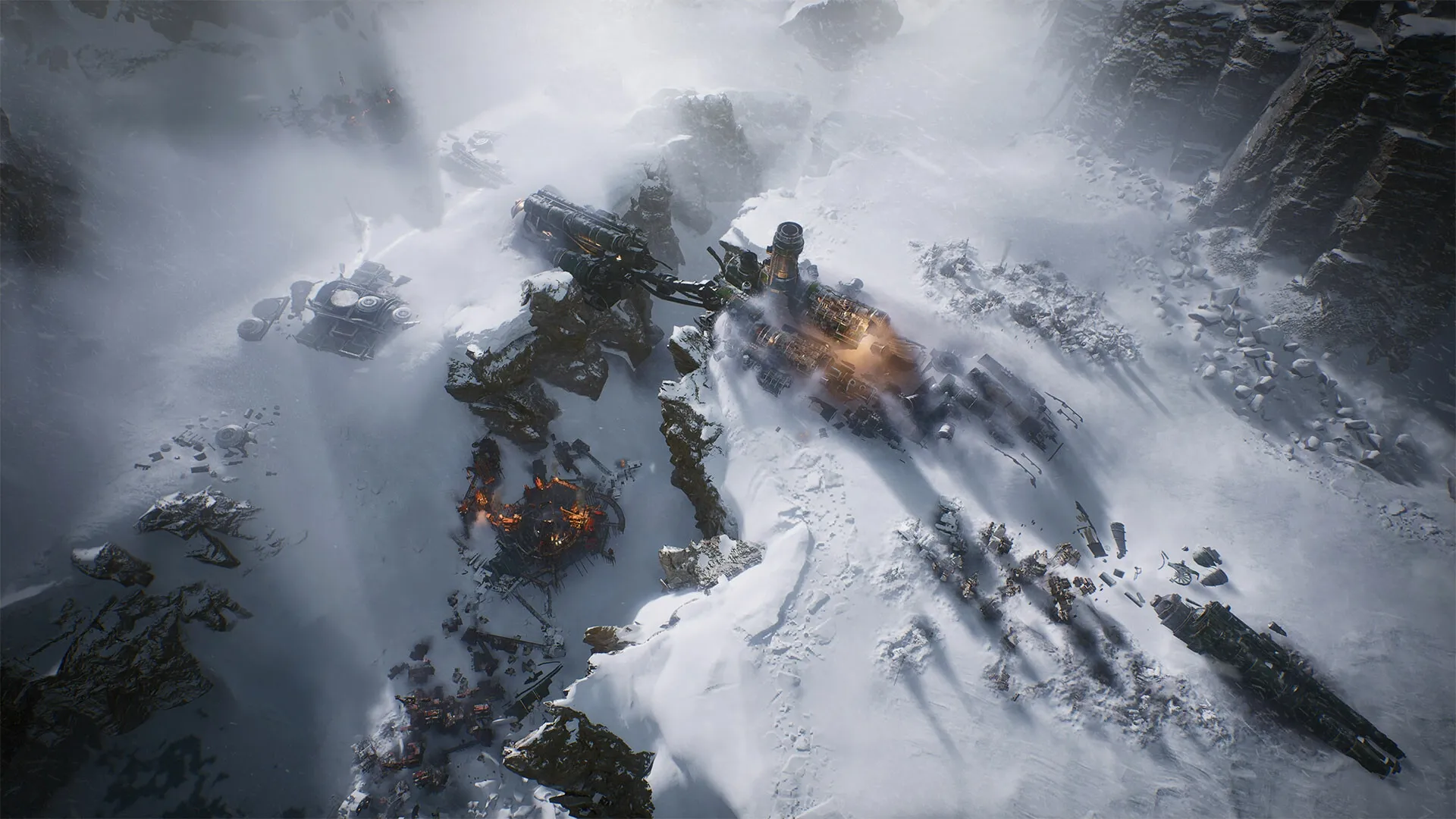
Weather effects transform the environment into a living character. Blizzards sweep across the landscape with convincing weight, obscuring distant structures and creating moments of genuine claustrophobia as visibility drops to mere meters. Snow accumulates realistically on surfaces, and the subtle animation of frost forming on windows adds tactile believability to the harsh conditions. The steampunk aesthetic grounds these fantastical elements in recognizable industrial design, making the impossible seem plausible.
The orchestral soundtrack amplifies every emotion the visuals evoke. Strings swell during moments of hope and growth, while harsh brass punctuates difficult decisions and mounting crises. Ambient sound design layers wind, machinery, and distant voices into a soundscape that makes the city feel alive. You can hear the rhythmic pounding of construction work, the hiss of steam vents, and the creaking of structures under winter’s pressure. These audio details transform spreadsheet management into something that feels viscerally real.
The cinematic quality emerges from how these elements work together to create dramatic weight around mundane activities. Placing a new district becomes an act of defiance against the elements, while passing controversial laws feels like scenes from a political thriller. The game achieves something remarkable by making city-building feel emotionally engaging rather than mechanically dry.
Replayability stems from the branching paths created by factional politics and moral choices. The Utopia Builder sandbox mode strips away narrative constraints, letting you experiment with different approaches to city design and political management. Each playthrough reveals new faction combinations and diplomatic challenges, encouraging multiple runs to explore different ideological paths.
The learning curve remains steep, demanding patience as you absorb the interconnected systems governing your city’s survival. New players might find themselves overwhelmed by the competing demands of resource management, political balance, and expansion planning. The game provides guidance through its tutorial systems but expects you to learn through failure rather than hand-holding. Accessibility options remain basic, focusing on standard visual and audio adjustments rather than comprehensive support for players with specific needs.
The Review
Frostpunk 2: Console Edition
Frostpunk 2: Console Edition delivers a masterclass in atmospheric city-building that successfully transforms complex PC mechanics into an engaging console experience. The political intrigue and moral weight of leadership create genuine emotional stakes, while the district-based construction maintains strategic depth without overwhelming micromanagement. Though some controller interactions feel less precise than mouse input, the thoughtful interface redesign and stunning audio-visual presentation make this a compelling survival experience that lingers long after the screen goes dark.
PROS
- Exceptional atmosphere through audio-visual design
- Meaningful political choices with lasting consequences
- Well-adapted console controls and interface
- Engaging moral complexity in survival scenarios
- Strong replayability through faction dynamics
CONS
- Steep learning curve with limited guidance
- Some controller navigation feels imprecise
- Occasional frame drops with larger cities
- Less intimate than the original game
- Basic accessibility options







