
























![Kingdom Hearts Collection [I-III] Review](https://gazettely.com/wp-content/uploads/2026/10/Kingdom-Hearts-Collection-I-III-1-360x180.webp "Kingdom Hearts Collection [I-III] Review: KHII Holds Steady as Newer Entries Fluctuate 37")



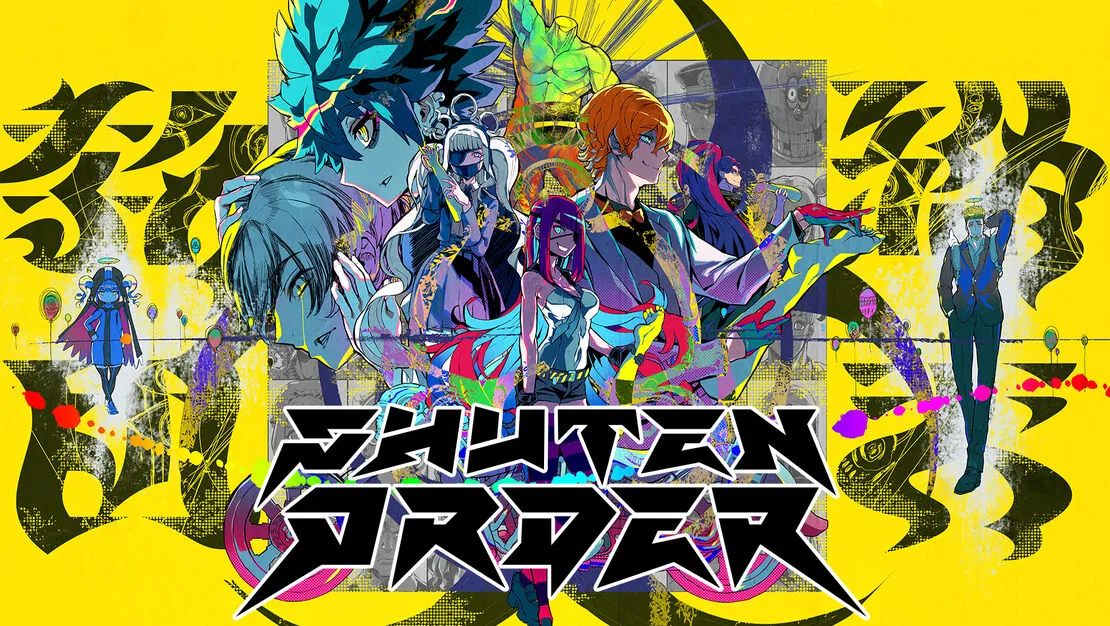

It is not every day a game opens with your own dismembered body falling from the sky. Shuten Order begins with this exact bizarre image, immediately setting a strange, compelling tone. You awaken as Rei Shimobe, an amnesiac inhabiting a temporary vessel, greeted by a pair of business-like angels. They give you a mission with the highest possible stakes: solve your own murder in just a few days.
The suspects are the five ministers of the Shuten Order, a cult you supposedly founded. This all happens in the city of Shuten, a place where countdown clocks for the apocalypse are a common sight. The game’s premise is a fantastic narrative hook, throwing you into a deep mystery where you are both the detective and the victim.
A Genre for Every Suspect
The central structure of Shuten Order is its most ambitious feature. After the introduction, you must accuse one of the five ministers of your murder. This choice locks you into a distinct story route, each with a completely different style of gameplay. The game essentially contains five smaller games, each a tribute to a different genre.
This design choice is a bold experiment in interactive storytelling, attempting to align the mechanics of play with the specific conflict of each narrative branch. You must play through all five of these scenarios to piece together the full story, with each minister’s chapter offering a different lens through which to view the world and its central mystery.
Accusing the head of the Ministry of Justice, for example, throws you into a detective investigation. This route feels heavily inspired by the Ace Attorney series. The gameplay loop consists of examining environments, gathering clues, and confronting a cast of characters tied to a contested family will. You must find contradictions in their testimonies and present the correct evidence at the right time.
The story here is filled with ludicrous murder plots and requires some thrilling leaps of logic to connect the dots. The “Power of God” mechanic manifests here as the ability to mentally add evidence to a case file, a clever way of integrating a supernatural element into the otherwise grounded process of deduction. It’s a compelling slice of a detective game that effectively captures the feeling of unraveling a complex crime.
In contrast, the route for the Minister of Health is a tense death game. This section will feel familiar to fans of games like Zero Escape or Danganronpa, which is unsurprising given the creator’s background. Rei finds herself trapped with several other people, forced to solve puzzles to survive. One part of this scenario cleverly incorporates a metatextual layer, showing the mastermind’s VTuber streaming overlay on the screen.
This allows Rei to see the streamer’s comments, which can sometimes provide hints. The actual gameplay, however, consists of navigating sterile corridors in first-person and solving extremely basic puzzles, like fitting Tetris-like shapes into slots or completing sliding tile pictures. The thematic weight of a life-or-death situation is present, but the mechanical challenge is minimal.
The tonal shifts continue with the Ministry of Education’s route, which transforms the game into a school-based romance simulation. This chapter openly references classics like Tokimeki Memorial, even incorporating similar user interface quirks. Here, Rei is tasked with identifying and winning the affection of a minister who has disguised herself among the student body.
The narrative structure is further complicated by forcing Rei to pursue three different girls, one after another, within the short time frame. This approach rushes the romantic development and leaves little room for the characters to become anything more than collections of common tropes. Elements like “bomb-clocks” appear on conversational partners, but these mechanics have very little impact on the linear progression of the story.
The final two routes explore survival horror and choice-driven storytelling. Accusing the Minister of Security initiates a full-on survival-horror game. Rei must search for evidence while being stalked by a grotesque legendary killer known as Nephilim. The gameplay involves navigating mazes, finding items, and using the environment to hide or block the pursuer.
Locking a gate or hiding in a locker is often enough to diffuse any threat. The Minister of Science offers a multi-perspective visual novel where Rei must work with her supposed enemy to repel an invasion. This route is heavy on decision-making, where wrong choices can lead to a bad ending, but the game always allows you to backtrack and try a different path.
A Fragmented Experience
This multi-genre approach keeps the experience varied, preventing any single mechanic from growing stale. The execution of these ideas, however, feels uniformly underdeveloped. Each gameplay style is functional but lacks the depth needed to be truly satisfying on its own. The problem is that each vertical slice of a game genre feels like a watered-down version of a dedicated title. The survival horror segment, for instance, builds an unsettling atmosphere but fails to generate lasting tension.

The monstrous Nephilim is easy to avoid, and since you can save your progress almost anywhere, the penalty for being caught is negligible. Any sense of danger quickly evaporates. The escape room puzzles in the death game route are similarly shallow. They are often dull, repetitive, and feel disconnected from the narrative context, acting as simple gates to the next piece of dialogue instead of being integrated challenges.
The narrative structure produces its own set of challenges that directly affect the player’s emotional investment. The central mystery surrounding the Founder’s murder is cleverly constructed, and the game does a good job of slowly feeding you clues across all five routes. There is a real satisfaction in having a detail from one minister’s story suddenly re-contextualize an event from a different one.
A unified list of clues pertaining to your murder is available at all times, empowering the player to make their own deductions. This mechanic works against the game’s biggest pacing issue: Rei’s memory resets with each new route. While this makes sense within the story’s logic, it creates a constant disconnect. The player retains all knowledge, but Rei reacts to old information with fresh surprise again and again. You are forced to watch the protagonist catch up to what you learned hours ago, which repeatedly stalls the story’s forward momentum.
This structural choice also leads to some awkward information delivery. Many routes conclude their self-contained mystery and then end with a lengthy conversation where a minister dumps a great deal of exposition. This new information often feels completely unrelated to the gameplay and story you just experienced. It makes the preceding hours feel like a preamble to a fifteen-minute reveal. The game’s non-linear design is one of its most interesting experiments.
The ability to tackle the routes in any order means that each player’s journey of discovery will be different. What is a shocking twist for one person might be foundational knowledge for another. This creates a unique and personal progression through the mystery, though it is a quality hampered by the repetitive nature of Rei’s amnesia.
A Stylized Apocalypse
Where the gameplay systems are inconsistent, the presentation is a constant strength. Shuten Order’s art direction is its most successful and memorable element. The visual style is striking and highly stylized, using a bright, vibrant color palette that creates a fascinating contrast with the game’s dark, miserable story. The world is filled with bold shades of pink, blue, and yellow.
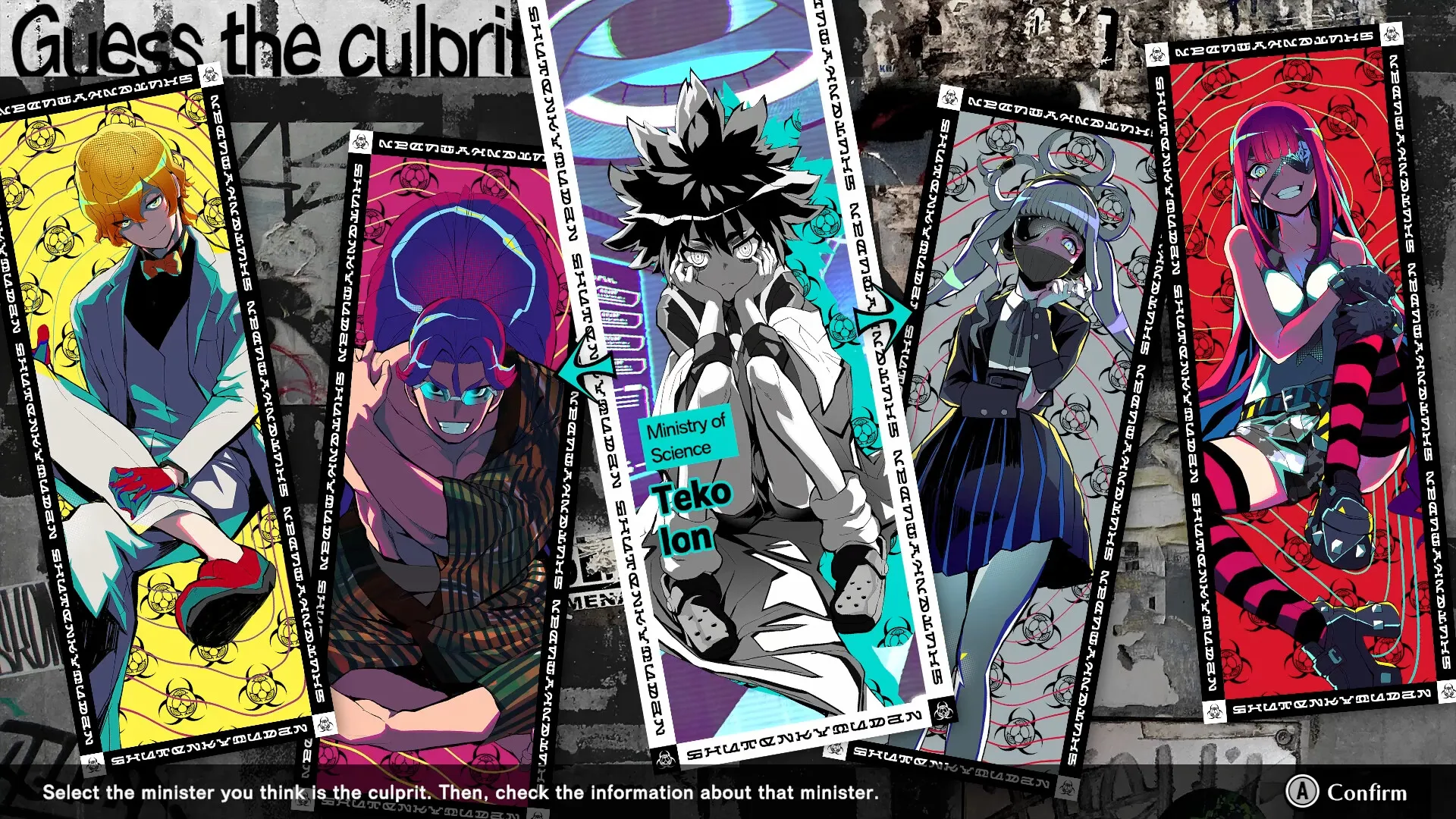
This aesthetic choice gives the city of Shuten a unique identity that is both alien and alive. The character designs are sharp, with outstanding silhouettes, and the user interface is chunky and colorful. Dialogue is often presented in a comic-book style that makes great use of a limited budget. This consistent visual language does wonders for tying the disparate gameplay sections into a cohesive whole. The music is also consistently engaging, shifting its tone effectively to match the genre of whatever route you are playing.
The characters are the true anchor of the experience, providing the emotional core that holds the fragmented story together. The protagonist, Rei Shimobe, is a refreshing main character. She is anxious and confused by her situation but also surprisingly sharp and capable. She sells her role as a detective through her deduction skills alone. Her design is wonderfully androgynous; characters frequently misgender her, and she seems unconcerned, correcting them only when necessary.
Her collection of sprites is incredibly emotive, always giving you a clear sense of what she is feeling. The five ministers are also interesting and complex figures. They are the central mystery, and getting to know each of them is a primary motivation to keep playing. Some are more developed than others, but each one adds an important piece to the larger puzzle.
This artistic confidence makes the lack of polish in other areas more apparent. The English localization suffers from numerous typos, grammar mistakes, and awkward text formatting. In some instances, voiced animated scenes with on-screen text are left completely untranslated. The game also lacks an English voice option, which might be a barrier for some.
The PC port is quite basic, with very few settings to adjust. These technical shortcomings suggest a project that was rich in ambition but lacked the resources for proper refinement. Shuten Order is a game of great ideas and inconsistent execution. Its striking visual identity and memorable characters provide a powerful reason to see its central mystery through to the very end, even when the gameplay itself is not the main attraction.
The Review
Shuten Order
Shuten Order is a wildly ambitious experiment that doesn't quite stick the landing. Its attempt to blend five different game genres into one narrative results in shallow, underdeveloped mechanics across the board. The story suffers from pacing issues caused by its fragmented structure. However, the game is saved by its absolutely stunning art direction, a cast of memorable characters, and a central mystery that is genuinely compelling. It is a flawed, often frustrating experience, but one worth seeing through for its sheer creative vision and style. Recommended for patient mystery fans who prioritize art over gameplay.
PROS
- Striking and highly stylized art direction.
- A compelling and intricate central mystery.
- Memorable characters, especially the protagonist, Rei.
- A bold and creative multi-genre concept.
CONS
- Gameplay mechanics in all routes are shallow and underdeveloped.
- Narrative pacing is hindered by a repetitive structure.
- Lack of technical polish and localization issues.
- Gameplay can feel like a chore between story segments.







