
























![Kingdom Hearts Collection [I-III] Review](https://gazettely.com/wp-content/uploads/2026/10/Kingdom-Hearts-Collection-I-III-1-360x180.webp "Kingdom Hearts Collection [I-III] Review: KHII Holds Steady as Newer Entries Fluctuate 37")





A television franchise, particularly a successful one, eventually develops a clear formula. The 9-1-1 universe operates on a reliable alchemy of high-stakes spectacle and earnest character drama. Its newest iteration, 9-1-1: Nashville, arrives not as a quiet experiment, but as a loud declaration of its specific place within that tradition.
The pilot opens on a city threatened by a looming tornado, a fitting metaphor for a story that has no interest in a slow build. It introduces its central figures, Firehouse 113’s Captain Don Hart and his son Ryan, only to immediately shatter their stable world with a secret from the past.
The show announces from its first sequence that it will be an exercise in heightened reality, where personal histories are as destructive as natural disasters, and the line between a first-responder procedural and a primetime family saga is deliberately and gleefully blurred.
The Hart of the Matter
The narrative architecture of 9-1-1: Nashville is constructed around a single family, making the firehouse less of a workplace and more of an inherited kingdom. Our introduction to Captain Don Hart, played by Chris O’Donnell, and his son Ryan, played by Michael Provost, is telling. We first see them not saving lives but competing in a rodeo, their victory establishing them as local royalty, embodying a specific brand of competent, celebrated Southern masculinity.
Their bond appears seamless, a professional hierarchy reinforced by paternal affection, all observed by the family’s poised matriarch, Blythe (Jessica Capshaw), whose wealth and influence form the bedrock of their comfortable existence. This carefully curated image of the perfect American dynasty is, of course, primed for demolition.
The wrecking ball arrives in the form of Blue Bennings (Hunter McVey), Don’s heretofore unknown son. The show’s commitment to camp is cemented in his introduction. At the scene of an accident, a stripper in a firefighter costume, with the stage name “Captain Smokeshow,” is the first to provide expert medical aid.
This sequence is a marvel of narrative efficiency; it establishes Blue’s outsider status, his innate competence, the show’s playful tone, and the central conflict in a single, audacious scene. Don’s subsequent decision to bypass protocol and install Blue as a trainee at Firehouse 113 ignites the story’s primary fuse. The confrontation with Ryan is immediate and raw, a son’s sense of betrayal crashing against a father’s sudden, guilt-ridden sense of duty.
To complicate matters further, the show introduces a classic soap opera archetype: the rival mother. Blue’s mother, Dixie Bennings, is a former singer portrayed with a calculated, bitter edge by LeAnn Rimes. Her manipulation of Blue, encouraging him to connect with his father as part of a scheme to fund her vocal surgery, frames her as the story’s initial antagonist.
Dixie’s scrappy, resentful energy, born from a failed career in the very city that lionizes success, creates a potent class and character contrast with the refined, old-money world of Blythe Hart. This structural choice, to build the show around a pre-loaded, multi-generational family conflict, is a significant departure from the slow formation of a “found family.” It injects immediate, high-stakes personal drama into the series, though it runs the considerable risk of making the entire firehouse a mere backdrop for one family’s intricate and ongoing implosion.
Music City Mayhem
The show’s procedural elements are staged with the same maximalist philosophy as its personal conflicts. Choosing to launch the series with a massive, multi-episode tornado arc is a clear statement of scale. The sequence at the Kane Brown concert is designed for pure spectacle, a symphony of collapsing scaffolding, panicked crowds, and impending doom.
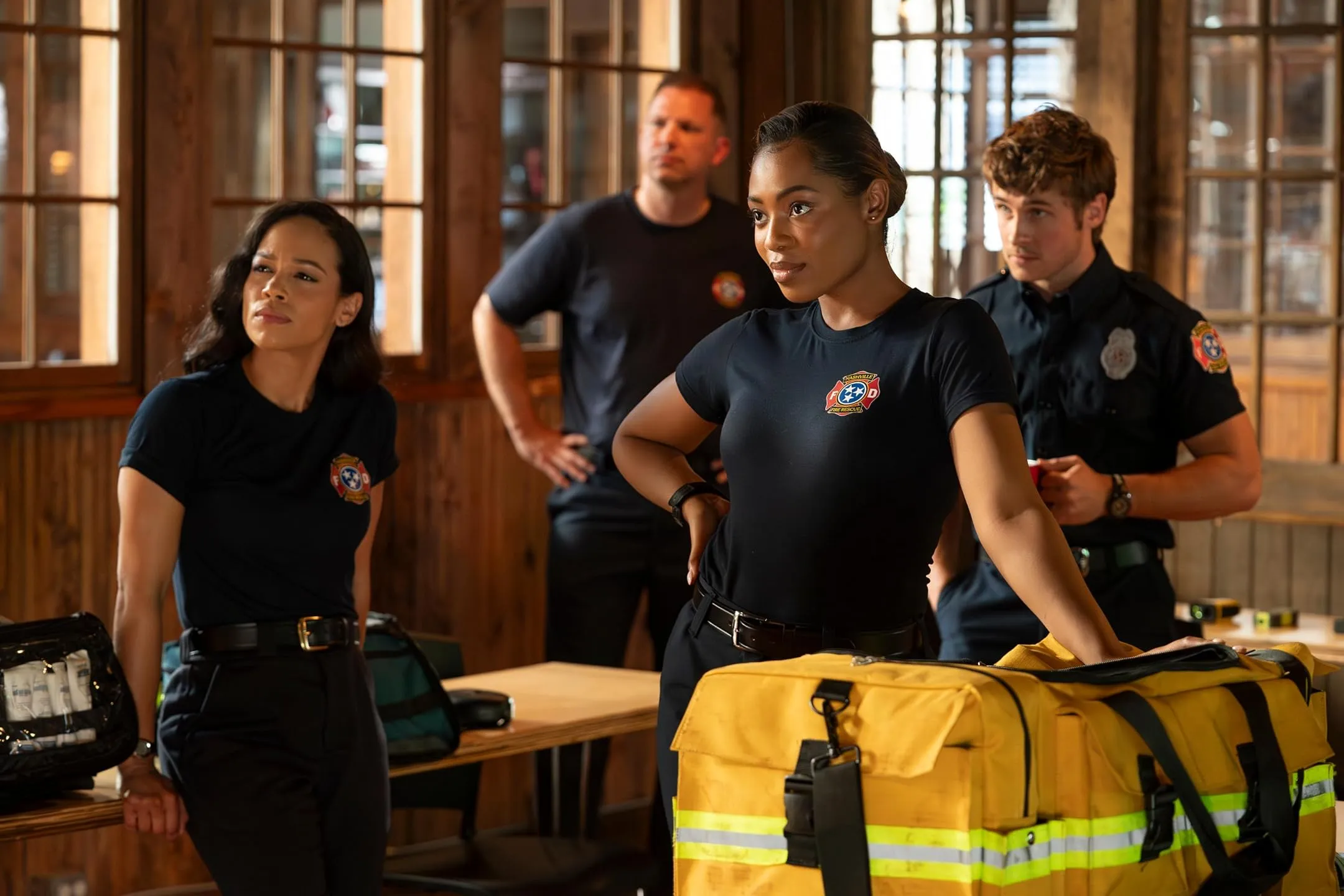
It is a bold, if risky, gambit. By unleashing such a catastrophic event before the audience has formed any significant emotional attachment to the characters, the show bets heavily on the power of the spectacle itself. The tension is derived from the immediate physical threat, not from a deep-seated concern for the well-being of characters we have only just met. It asks the audience to invest in the action first, promising that an investment in the people will follow.
Complementing this central disaster are smaller, more eccentric emergencies that serve to establish the show’s particular brand of heightened reality. A bachelorette party’s “pedal pub” vehicle crashes spectacularly on Broadway, while another call involves a young girl being lofted into the air by a giant kite, requiring an absurdly clever rescue. These incidents are a core component of the franchise’s DNA, a promise to the viewer that the laws of probability will frequently be suspended in favor of entertainment.
They provide moments of levity and reinforce the idea that in this world, the bizarre is a daily occurrence. The Nashville setting itself is employed with a similar lack of subtlety. The pilot is a dense collage of regional signifiers: rodeos, sprawling horse farms, and the ever-present dream of country music stardom embodied by firefighter Taylor Thompson. At times, this reliance on cultural shorthand feels less like authentic world-building and more like applying a thematic veneer to a pre-existing formula, ensuring the location is constantly announced rather than organically felt.
The Ensemble on the Sidelines
A necessary consequence of the pilot’s intense focus on the Hart family is the marginalization of its supporting cast. The other members of Firehouse 113 are, for now, little more than sketches waiting to be filled in. Paramedic Dr. Roxie Alba (Juani Feliz) is presented as a capable and dedicated professional, but her character is defined almost exclusively by her job.

Similarly, firefighter Taylor Thompson (Hailey Kilgore) is given a single defining trait outside her profession: a powerful singing voice and the ambition to match. They exist on the fringes of the central drama, their roles largely functional. They are present at the emergencies, but their personal lives and perspectives remain entirely unexplored, making them feel like employees in a family business rather than integral members of a team.
This sense of disconnection extends to 911 dispatcher Cammie Raleigh (Kimberly Williams-Paisley). In the franchise’s established structure, the dispatcher often acts as the narrative nexus, the calm voice that connects disparate emergencies and characters. Here, her role is more isolated. She efficiently handles calls, but her main personal connection to the firehouse is a slightly contrived subplot where she acts as a vocal coach for Taylor. This structural choice creates an imbalance.
The strength of many workplace procedurals lies in the slow, rewarding development of camaraderie among a diverse group of individuals. By concentrating so heavily on the inherited conflicts of one family, the show creates an insular world that is difficult for other characters, and by extension the audience, to fully penetrate. The pilot leaves one wondering if there is enough space in the Harts’ story for anyone else’s to truly begin.
A Self-Aware Spectacle
There is no mistaking 9-1-1: Nashville for a gritty, realistic drama. The show is, from its opening frame, a self-aware and unapologetic piece of primetime soap opera, merely using the procedural genre as its flashy container. The narrative is built from the foundational elements of melodrama: a long-lost child, a vengeful former lover, bitter rivalries, and explosive secrets.

These are not flaws in the storytelling; they are its primary purpose. The show’s creative team understands that its appeal is rooted in this theatricality, in its willingness to embrace the exaggerated and the emotional. It operates on a logic established by its predecessors, where the plausibility of an emergency is secondary to its entertainment value. The show’s commitment to its own over-the-top nature makes it a compelling, if frequently unbelievable, weekly diversion.
This new chapter in the 9-1-1 saga represents a deliberate recalibration of the franchise’s emotional core. It consciously trades the slow-burn satisfaction of watching strangers become a family for the immediate, high-temperature conflict of a family being torn apart. This shift changes the viewing experience, replacing the warmth of found community with the captivating chill of dynastic strife.
While doing so, it still dutifully delivers the key components of the brand’s success. The pilot is filled with breathtaking action sequences, moments of genuine humanity where strangers help one another, and a cliffhanger engineered for maximum narrative tension. 9-1-1: Nashville proves that the franchise formula is flexible enough to accommodate different kinds of drama, even if it means putting all its chips on a single, very complicated, family.
9-1-1: Nashville is the third installment in the popular procedural drama franchise, blending high-stakes emergency response with family drama set in Music City. The series premiered on ABC on October 9, 2025. The plot centers on Captain Don Hart, a rugged firefighter and former rodeo star, who leads Nashville’s busiest firehouse while navigating a complex personal life, including a recently discovered secret son. Viewers can watch the series on the ABC network.
Full Credits
The Review
9-1-1: Nashville
9-1-1: Nashville is a loud, self-aware, and unapologetically soapy addition to the franchise. By anchoring its narrative to the dynastic drama of a single family, the series provides immediate, high-stakes conflict at the expense of developing a compelling ensemble. It delivers the requisite larger-than-life spectacle and entertains with its commitment to melodrama. However, those seeking the warm, found-family chemistry of its predecessor may find this new chapter's focus on a fractured bloodline a less rewarding, if still watchable, affair.
PROS
- A strong, central family conflict provides an immediate source of compelling drama.
- Fully embraces its over-the-top, soapy nature, resulting in an entertainingly silly tone.
- Delivers the large-scale action sequences and high-stakes emergencies the franchise is known for.
- Establishes a classic primetime rivalry between the characters played by Jessica Capshaw and LeAnn Rimes.
CONS
- The supporting cast and wider ensemble are severely underdeveloped in the pilot.
- The Nashville setting is often reduced to an over-reliance on Southern clichés.
- The "found family" dynamic, a core strength of the original series, is largely absent.
- Spectacle is often prioritized over building genuine, character-driven emotional stakes.







