





























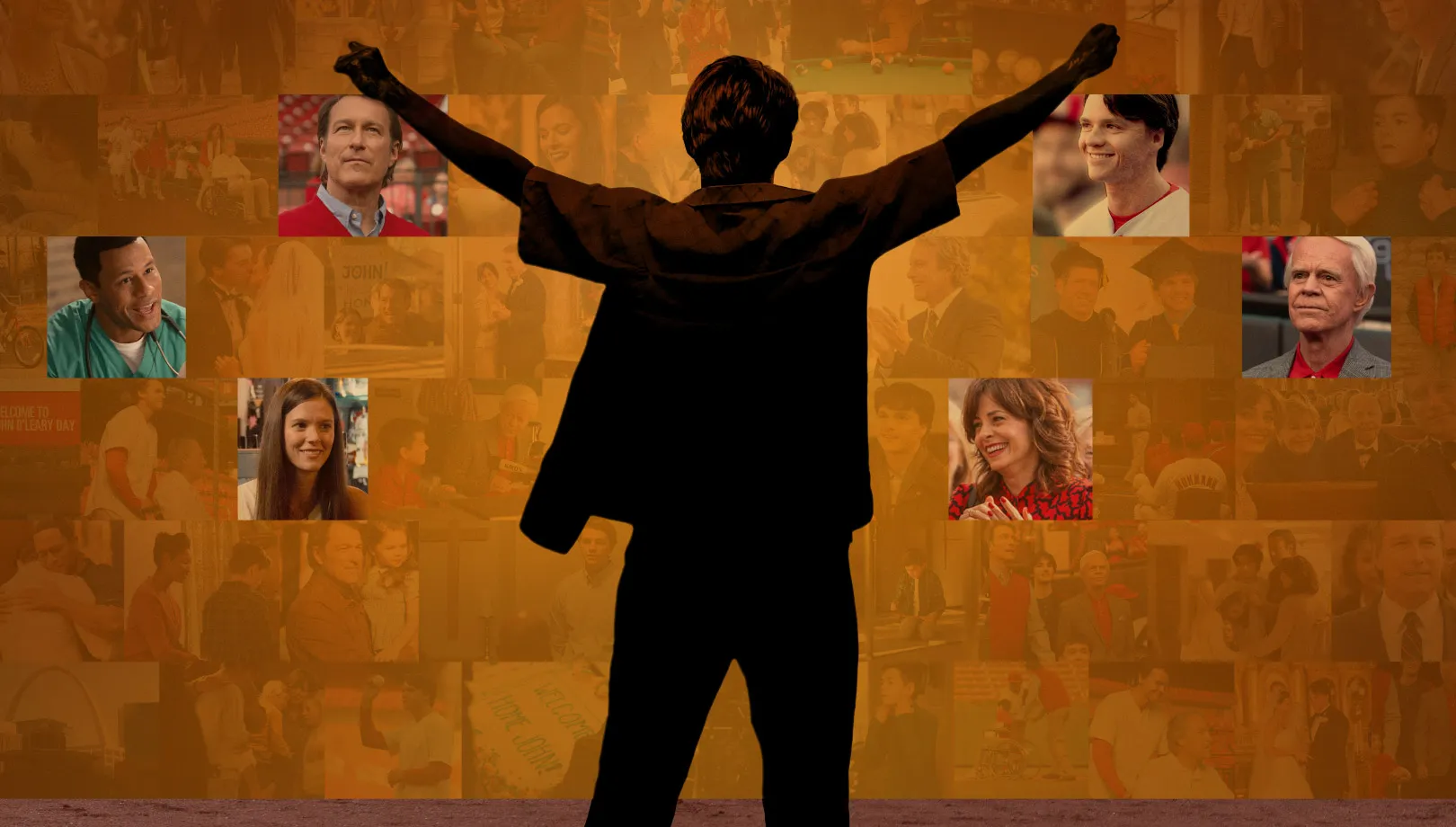

Turning an inspiring life into an inspiring film is a tricky bit of alchemy. A person’s lived experience is inherently messy, full of quiet doubts and unglamorous struggles that don’t fit neatly into a three-act structure. The temptation for a filmmaker is to sand down those rough edges, to present a polished, pre-packaged version of resilience. John O’Leary’s story, a genuine chronicle of survival against unimaginable odds, is potent source material.
As a nine-year-old, a catastrophic accident with fire left him with burns across his entire body. “Soul on Fire” sets out to adapt his arduous journey. The film is earnest in its attempt to portray a story of recovery, family, and faith. Its execution, however, demonstrates how easily the raw power of a true story can be diluted by a heavy-handed approach, one that prefers simple sentimentality to the more difficult, and more rewarding, emotional truth.
A Fractured Timeline and a Script Full of Signposts
Modern biopics often play with time, hoping to draw thematic lines between a subject’s past and present. “Soul on Fire” adopts this non-linear structure, jumping between the 1987 accident, John’s college years, and his adult life as a budding public speaker. The intent is clear: to show how the trauma of the past directly shapes the insecurities of the present. This technique does keep the narrative moving, preventing it from getting bogged down in any single period.
Yet, the effect is one of emotional fragmentation. Just as we begin to feel the claustrophobic horror of his hospital stay, we are whisked away to a college party. Just as we start to invest in his tentative romance with Beth, we flash back to a painful physical therapy session. This constant shuffling prevents the audience from fully sinking into John’s experience, keeping us at an analytical distance when we should be feeling the story in our bones.
The screenplay by Gregory Poirier contributes to this feeling of detachment. Its greatest weakness is a fear of subtext. Characters don’t just feel things; they announce them. A father doesn’t show his unwavering love through quiet actions; he states it in a perfectly crafted, aphoristic line. This approach leaves little for the audience to discover.
The dialogue is filled with these kinds of tidy pronouncements, which disrupt the natural flow of human interaction and feel more like inspirational quotes than actual speech. The writing points toward John’s inner turmoil, particularly his feeling of being an “emotional coward,” but it never truly lets us inhabit that conflict. We are told about his pain and his doubt, but we are rarely allowed to witness it in a way that feels unscripted and real.
A Cast Anchored by One, Adrift in Simplicity
A film’s emotional core often rests on its central performance, and “Soul on Fire” asks a lot of its actors. As the young John, James McCracken conveys a great deal of suffering and resolve, a difficult feat given that his face is often obscured by bandages. Joel Courtney, as the older John, has an innate likability that makes the character easy to root for.

The script, however, limits his performance. His insecurities are stated but never seem to fully manifest in his actions or demeanor, making his internal journey feel more theoretical than visceral. He is a capable actor swimming in shallow water.
The film’s performance anchor is, without a doubt, William H. Macy as the sportscaster Jack Buck. Macy delivers a performance of remarkable subtlety and warmth. He feels like a real person who has wandered in from a different, more nuanced movie. His scenes provide a welcome sense of authenticity, and the gentle friendship between his character and John is the film’s most believable and touching element.
His grounded presence, however, inadvertently highlights the artificiality of some of the other performances. John Corbett and Stephanie Szostak, as John’s parents, are tasked with portraying unwavering beacons of support. They project goodness and love, but the characters are written without any hint of the fear, exhaustion, or frustration that any parent would feel in such a situation. They become saintly figures in a fable, which makes the family dynamic feel less like a real unit and more like a support system designed for maximum inspiration.
Sentiment Over Substance
There is a distinct style to the mainstream inspirational drama, one that prioritizes clear emotional cues over ambiguity. “Soul on Fire” is a textbook example of this mode of filmmaking. Director Sean McNamara’s approach is to amplify every emotional beat with sentimental flourishes. A poignant moment is underlined with a swell in the score; a tearful reunion is shot in soft, glowing light.

This directorial insistence robs the story of its intrinsic power. It is a film that doesn’t trust its audience to feel the right things on their own, so it guides them at every turn. This creates a viewing experience that can feel less like an emotional journey and more like a guided tour.
The film follows the genre’s familiar path without offering a fresh perspective. Key moments that should be deeply personal and complex are staged with a startling lack of intimacy. The wedding night scene, where John first reveals the full extent of his scars to his new wife, is a prime example. This could have been a scene of profound vulnerability, fear, and acceptance. Instead, it is handled with a procedural quickness that diffuses all its potential dramatic weight.
The direction consistently shies away from the messiness of recovery. It presents a sanitized version of John’s ordeal, one that is painful but ultimately tidy. The film’s ideas about faith and triumph are similarly simplified. Success is measured by external validation: public speaking engagements, applause, and cheering crowds. It is a vision of resilience that seems curiously tied to public acclaim, a message that feels out of step with a story about discovering internal worth.
The Sights and Sounds of a Familiar Story
The technical elements of “Soul on Fire” reinforce its conventional, often artificial, feel. The soundtrack choices are particularly telling. Popular songs from the past are deployed not to evoke a sense of time or place, but to comment directly on the action.
A Neil Diamond or Journey song will kick in at a moment of breakthrough, turning a small, personal victory into something that feels like a pre-packaged movie montage. Mark Isham’s score is similarly predictable, providing a pleasant but unmemorable wash of emotion that rises and falls exactly when you would expect it to. The soundscape lacks any texture or originality, serving only to underline what is already obvious.
Visually, the film is competent but generic. The most dramatic sequences, like the initial house fire, are hindered by unconvincing visual effects that create a jarring sense of fakeness right at the story’s inciting incident. This artificiality extends to the production design.
The world of the film feels strangely clean and untouched by the chaos of the events unfolding within it. A glaring example is the family home itself. We are told it was almost destroyed in the fire, yet a few months later it appears perfectly rebuilt, without a trace of the disaster. It is a small detail, but it is emblematic of the film’s broader reluctance to engage with the messy, lasting reality of trauma. It opts for a clean, comforting image, even when the story demands something raw and unsettling.
Soul on Fire is a biographical drama directed by Sean McNamara, inspired by the miraculous true story of St. Louis native John O’Leary, who overcame a near-fatal burn accident as a child. The film is based on O’Leary’s 2016 bestselling book, On Fire: The 7 Choices to Ignite a Radically Inspired Life. It is distributed by Sony Pictures Releasing through its Affirm Films banner and is scheduled for a nationwide theatrical release on October 10, 2025.
Full Credits
Director: Sean McNamara
Writers: Gregory Poirier, John O’Leary
Producers and Executive Producers: J. Todd Harris, Margaret French Isaac, Sean McNamara, David Brookwell, Linda B. Huntington, John O’Leary, Terry Schnuck, Michael W. Riney, Quirsis V. Riney, Gregory Poirier
Cast: Joel Courtney, John Corbett, William H. Macy, Stéphanie Szostak, Masey McLain, DeVon Franklin, Natalie Buck, James McCracken
Composer: Mark Isham
The Review
Soul on Fire
"Soul on Fire" adapts an undeniably powerful true story of resilience, but its cinematic translation lacks the necessary grit and nuance. While anchored by a wonderfully subtle performance from William H. Macy, the film ultimately succumbs to heavy-handed sentimentality, a superficial script, and a direction that prefers inspirational platitudes over genuine emotional complexity. It's a well-intentioned film that tells an incredible story, but it unfortunately fails to make the audience truly feel its weight.
PROS
- The inherent strength and inspiration of John O'Leary's true story.
- A grounded and affecting performance by William H. Macy.
- A sincere, family-friendly message about hope and perseverance.
CONS
- An overwhelmingly sentimental and schmaltzy tone.
- On-the-nose dialogue that lacks subtext and emotional realism.
- Generic direction that sanitizes the story's inherent pain.
- Underdeveloped supporting characters who feel more like archetypes.
- Unconvincing visual effects and a predictable musical score.