













What is a life but an archive of moments, a collection of half-recalled sensations and conversations overheard through a bedroom door? A child inherits this archive, becoming the unwilling curator of a parent’s existence. Andrew Durham’s Fairyland is a profound meditation on this strange inheritance. It examines the life of Alysia Abbott, who received from her poet father, Steve, not a stable home but a chaotic portfolio of his own becoming.
After the sudden death of his wife, Steve flees the Midwest with his young daughter, seeking in the vibrant labyrinth of 1970s San Francisco a place to finally live his truth as a gay man. His liberation becomes her education; his artistic and romantic explorations form the very architecture of her world.
Based on Alysia’s memoir, the film is an unflinching look at a bond forged in the twin crucibles of love and neglect. It poses a difficult question about the nature of parenthood: what is the psychic cost when a child’s formative years are spent as the primary audience for their parent’s own deferred adolescence?
Archives of a Half-Remembered World
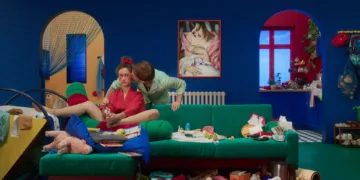
The film renders Alysia’s early years as a sensory ethnography of a lost time. Shot on grainy 16mm, the images themselves feel like artifacts, their texture suggesting the fragile, imperfect surface of memory. Durham’s camera often sits at a child’s hip-level, looking up at a world of giants whose motivations are mysterious and absolute.
The San Francisco they inhabit is a bohemian dreamscape, their shared apartment a waystation for a revolving cast of artists, drug dealers, and lovers who constitute a surrogate, if ephemeral, family. This is an upbringing of radical dualities. Alysia is given the gift of a world without prejudice, where she learns about style from a genderqueer roommate and accepts her father’s boyfriends with a quiet curiosity. She is surrounded by a kind of sprawling, unconventional affection.
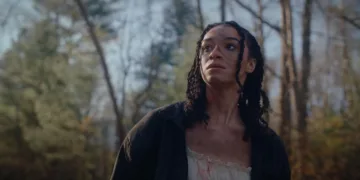
Yet this expansive freedom is also a profound absence of structure. Steve’s pursuit of personal and artistic honesty often manifests as a deep parental neglect, leaving Alysia to navigate the city’s dangers alone, a small figure adrift in her father’s grand experiment. Nessa Dougherty’s performance as young Alysia is one of stunning stillness; she is a recording device, her watchful eyes absorbing the beauty and the chaos with an unnerving calm, postponing judgment for a future self.
The Rebellion Against a Name
As the narrative shifts into the 1980s, the film’s hazy nostalgia evaporates, replaced by the harsh, clarifying light of adolescence. Emilia Jones takes over as Alysia, and her performance is a study in contained fury. Her rebellion is not the typical teenage push against rules, for her life has had none. Instead, she wages a desperate war against the formlessness of her own identity.
Having been raised in a world that rejected all convention, she finds herself craving its certainties. She is ashamed of their bohemian poverty and deeply conflicted about her father’s sexuality, which she conceals from her new-wave friends. This internal struggle for a coherent self is set against the backdrop of a larger, more sinister change, as whispers of a “gay cancer” begin to circulate, casting a long shadow over their community.
The film’s aesthetic hardens with Alysia’s perspective, the soft-focus dream of the seventies giving way to the sharp edges and grounded reality of the eighties. Her anger is complex; it is directed at a father who gave her a world without boundaries, failing to understand that a child needs something solid to push against to discover the shape of her own being. His identity, once a symbol of liberation, now becomes a source of private fear and public shame.
The Final Configuration of Love
The story culminates in a devastating and sorrowful inversion. Alysia, now a young woman building her own life, is called home to become the guardian of her father’s end. The child must now parent the parent, imposing a final, terrible structure on a man who lived his life in defiance of all constraints.

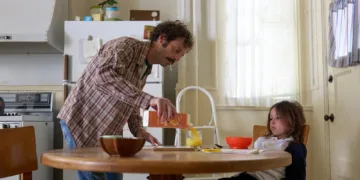
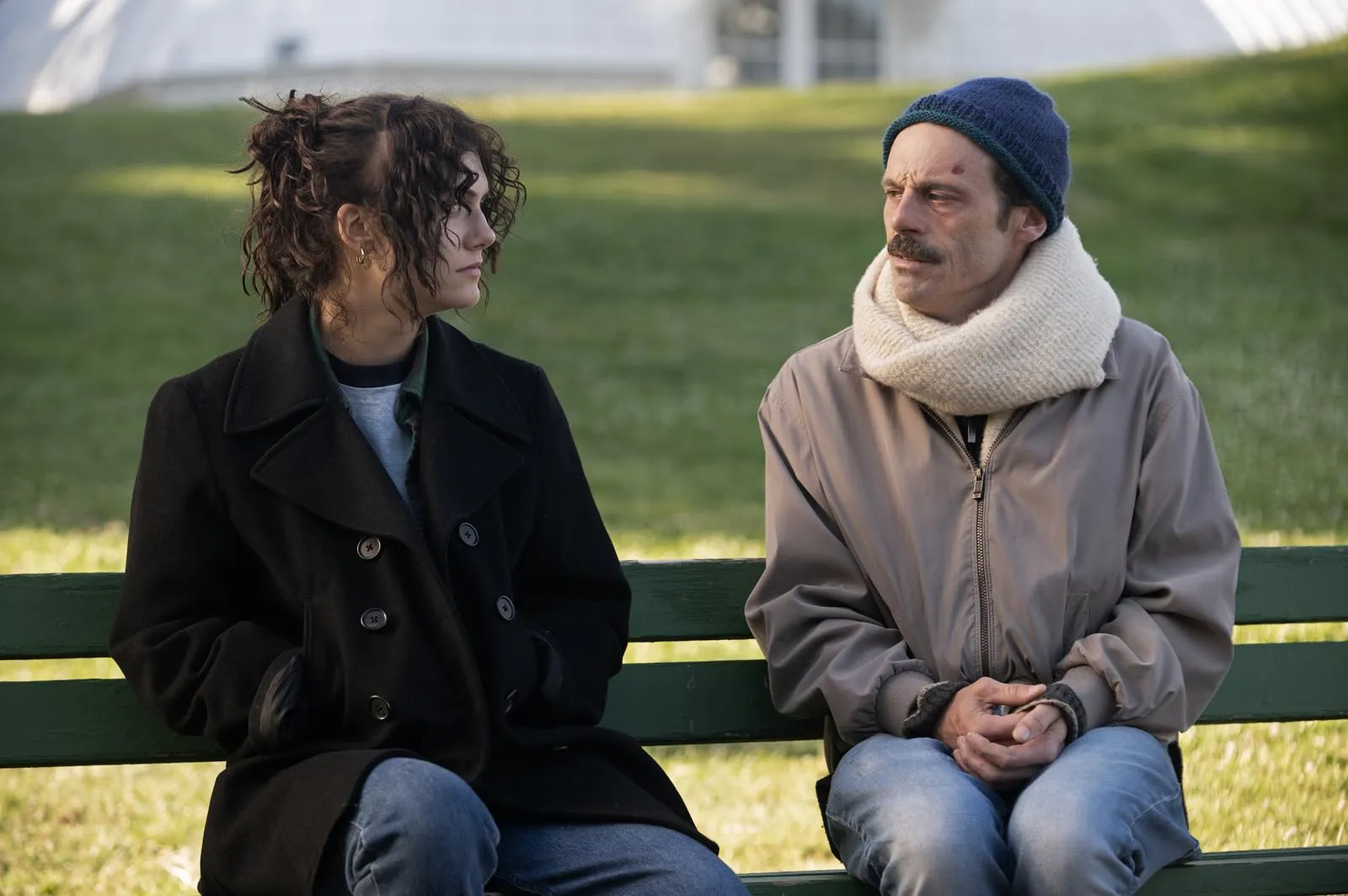
It is here that the film’s emotional power becomes almost unbearable, anchored by two extraordinary performances. Scoot McNairy, in a career-best turn, portrays Steve not just as a man succumbing to illness, but as a soul confronting the full weight of his past. His physical frailty is secondary to the spiritual reckoning in his eyes, a silent plea for an absolution he cannot name.
Emilia Jones is his perfect counterpart, navigating Alysia’s journey from a walled-off resentment to a place of profound, aching compassion. Her eventual state is something beyond simple forgiveness; it is a full, clear-eyed acceptance of the brilliant, flawed, and deeply human man who was her father. The film offers no easy emotional release, suggesting instead that love’s ultimate function is not to save, but to bear witness, to hold the archive of a life until the very last light fades.
The movie Fairyland (2023) is a powerful coming-of-age drama based on Alysia Abbott’s memoir, Fairyland: A Memoir of My Father. Set against the vibrant cultural scene of San Francisco in the 1970s and ’80s, the film chronicles the evolving, bittersweet relationship between a young girl and her openly gay, bohemian father, eventually leading into the heartbreaking era of the AIDS crisis. The film premiered at the 2023 Sundance Film Festival on January 20, 2023, and was later released in the United States by Lionsgate and Willa on October 10, 2025. The film is available to watch on streaming platforms such as Plex in some regions, though availability may vary.
Full Credits
Director: Andrew Durham
Writers: Andrew Durham, Alysia Abbott
Producers and Executive Producers: Alysia Abbott, Elena Baranova, Megan Carlson, Roman Coppola, Sofia Coppola, Liz Destro, Andrew Durham, Susan Landau Finch, Camille Floquet, Rebecca Gang, Vincent Grashaw, Hanna Griffiths, Gary Hamilton, Ryan Hamilton, Gale M. Harold III, Will Karr, Greg Lauritano, Anton Lessine, Leo Matchett, Francesco Melzi d’Eril, James T. Mockoski, Gabriele Bebe Moratti, Michael Musante, Siena Oberman, Jesse Ozeri, Brooks Price, Karen Salveson, Sasha Shapiro, Nicole Alexandra Shipley, Jeffrey Sobrato, Eileen Spitalny, Mike Spitalny, Laure Sudreau, Raffaella Viscardi, Elizabeth Woodward, Ying Ye
Cast: Emilia Jones, Scoot McNairy, Geena Davis, Cody Fern, Maria Bakalova, Adam Lambert, Nessa Dougherty, Bella Murphy, Ryan Thurston, Becky Leia Sandrine, Matt Standley
Director of Photography (Cinematographer): Greta Zozula
Editors: Peter Cabadahagan, Lawrence Klein
Composer: Michael Penn
The Review
Fairyland
A devastatingly intimate chronicle of a life assembled from fragments. Fairyland is an emotionally shattering meditation on memory, identity, and the complicated inheritance of a parent’s choices. Anchored by a career-defining performance from Scoot McNairy and a profoundly sensitive turn from Emilia Jones, it is a quiet, haunting, and unforgettable piece of filmmaking that lingers long after the credits roll.
PROS
- A pair of powerful, deeply moving lead performances from Scoot McNairy and Emilia Jones.
- Evocative cinematography that skillfully captures the distinct textures of childhood memory and adult reality.
- An honest and unflinching exploration of an unconventional and complex father-daughter relationship.
- A poignant and heartbreaking depiction of love and loss during the AIDS crisis.
CONS
- The narrative pace can feel uneven, particularly during the transition into Alysia’s teenage years.
- Some historical context is occasionally delivered through clunky exposition.
- Certain supporting characters feel underdeveloped, functioning more as set pieces in Alysia’s memory.