































Finding Mr. Christmas Season 2 returns as Hallmark Channel’s reality casting call, where sentiment meets high-stakes aspiration on a meticulously decorated Utah ranch. Ten men compete for a single career-making prize: a starring role in a 2025 Countdown to Christmas movie. The season settles the format with Jonathan Bennett again hosting, his cheer fully intact.
He presides with lead judge Melissa Peterman, an energetic and decisive pairing. The production leans into earnest holiday cheer, a tone that mirrors the Hallmark movie world and treats it as a system with clear rules. By turning the search for a leading man into the narrative engine, the show treats casting as both story and social barometer, revealing how a network defines romance, kindness, and marketable warmth for a streaming-era audience.
Training a Romantic Hero for the Streaming Era
The competition follows an eight-episode rhythm with weekly eliminations. Each episode tests the men in two stages that measure speed, composure, and screen presence. The Festive Face-Off opens with a brisk themed task. The premiere asked contestants to build a standout Santa costume, and the winner carried a tangible advantage into the main round.
The Star Quality Challenge delivers the real audition. Contestants act through classic meet-cute set pieces, a design that spotlights timing, eye contact, and emotional clarity. Season 2 raises the difficulty with “crazier challenges,” including memorizing a scene while skiing downhill. Cameos from Hallmark stars such as Janel Parrish serve as scene partners and guest judges, which raises expectations and narrows the definition of what counts as camera-ready charm.
The judging rubric is explicit: humor, charm, kindness, a great sense of humor, and heart. The list emphasizes pleasantness and warmth over technique, a signal about how contemporary romantic leads are packaged for quick recognition on streaming platforms where instant appeal drives clicks and continued viewing.
Contradictions in the Quest for Authenticity
The cast of ten includes models, personal trainers, a former pro footballer, and a new father, which maps a familiar picture of masculinity through the Hallmark filter of wholesomeness and composure. Many arrive with limited acting backgrounds, and the show records both endearing vulnerability and stretches of visible awkwardness.
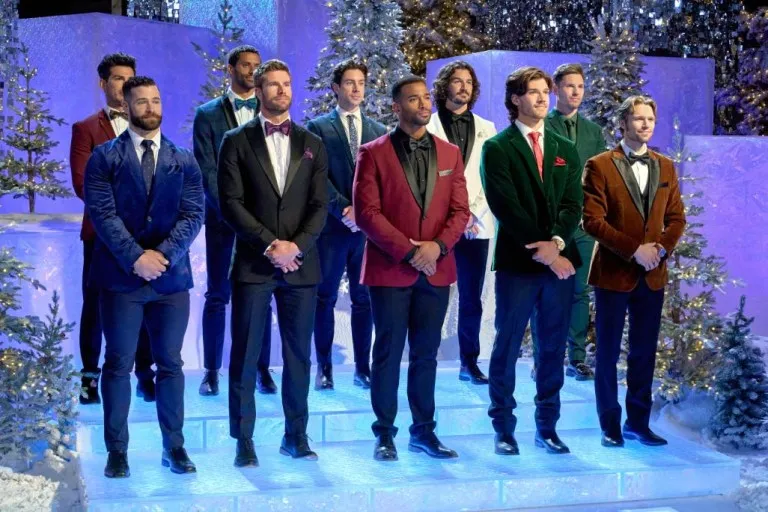
The highly polished setting meets hesitant melodrama, and that friction supplies the stakes. Competition remains good-natured rather than hostile, which aligns with the network’s brand of civility. Davey speaks openly about becoming a father, and that detail anchors scenes with a note of everyday responsibility. Craig emerges with a sharpened antagonist profile that the edit highlights, a reminder that reality formats still require narrative shape even within a kinder tone.
Gabriel’s nerves read on camera, and the series frames his effort as proof of commitment to Hallmark spirit. The show treats sincerity as labor. It measures who can perform wholehearted sentiment on cue, hold the gaze, say the line cleanly, and leave enough softness for audiences who come to Hallmark for comfort during a holiday cycle that now extends across cable and streaming menus.
Packaging Nostalgia and Future Talent
Production value carries the series. Sets arrive saturated with ornamentation, creating a Santa’s country home atmosphere that aligns with the channel’s seasonal output and gives contestants an immediate visual world to play inside.
Bennett keeps the machine moving with puns, cue-to-cue precision, and ad-friendly polish that smooths the commercial spine of the format. His status as a Hallmark fixture signals institutional approval. Finding Mr. Christmas assembles elimination ceremonies, timed challenges, and confessional interviews into a template shaped by reality-TV tradition, then reframes that playbook for holiday moviemaking.
The hybrid delivers a watchable audit of what the channel values in a romantic lead: approachability, warmth, and the ability to hit sentimental beats on schedule. For fans of Hallmark titles, the series supplies entertainment and a transparent index of performance criteria.
For anyone curious about the mechanics of holiday media consumption, it reads as a case study in how a brand recruits faces for an expanding pipeline that feeds a seasonal slate on both linear TV and on-demand platforms. The promise is immediate discovery and future employability, which turns every candy-cane set and scripted meet-cute into a small referendum on the kind of hero Hallmark plans to promote next year.
Finding Mr. Christmas Season 2 is a reality competition series from Hallmark Media that premiered on October 27, 2025. Airing on the Hallmark Channel and streaming on Hallmark+, the show features ten aspiring actors who compete in holiday-themed acting and physical challenges. Hosted by Jonathan Bennett and judged by Melissa Peterman, the contestants are vying for the grand prize: a leading role in an upcoming 2025 Countdown to Christmas movie. Each episode runs between 41–55 minutes as the hopefuls demonstrate the heart and charm required to become Hallmark’s next big star.
Credits
Title: Finding Mr. Christmas Season 2
Distributor: Hallmark Channel, Hallmark+, Hallmark Media
Release date: October 27, 2025
Running time: 41–55 minutes (per episode)
Producers and Executive Producers: Adam Cohen, Ben Roy, Cara Tapper, Joanna Vernetti, Jonathan Bennett, Kelley Coorloff, Taylor Cochoran, David Lutz
Cast: Jonathan Bennett, Melissa Peterman, Angel Garet, Craig Geoghan, Davey Fisher, Drake Kuyper, Gabriel Thaxton, Rustin Sailors
The Review
Finding Mr. Christmas Season 2
Finding Mr. Christmas Season 2 succeeds by exposing the mechanics of casting while delivering peak holiday escapism. The show’s strength lies in the contrast between the highly earnest, sometimes clumsy attempts of the contestants and the polished, high-budget production. It is a fascinating hybrid that defines the specific, desirable archetype of the modern romantic hero. It offers a surprising amount of insight into media culture alongside genuine fun. A highly effective piece of self-aware reality programming.
PROS
- Exposes the mechanics and explicit criteria for casting the romantic male lead.
- Successfully hybridizes reality tropes with a specific holiday aesthetic.
- The host, Jonathan Bennett, offers a charismatic and professional performance.
- Contestants show genuine, endearing vulnerability despite the demanding format.
- Lavish, high-quality production with maximally decorated Christmas sets.
- Provides an appealing look behind the scenes of Hallmark movie production.
CONS
- Moments of cringe-worthy awkwardness due to limited acting experience.
- The format includes noticeable product placement and commercialism.
- Focuses on promoting a highly specific, saccharine male archetype.
- One contestant's "villain" edit feels aggressively engineered.







