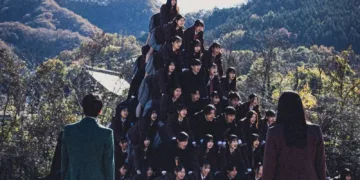































Yuta Shimotsu’s second feature, New Group, confirms the director’s command of abstract storytelling as a tool for pointed social commentary. After Best Wishes to All, Shimotsu stages another deeply unsettling scenario tied to the pressures of contemporary Japanese life. The premise declares its absurdity from the outset.
A high school soccer field becomes the site of an escalating phenomenon in which students, compelled by a trance-like pull, begin forming a massive, living human pyramid. The spectacle starts as curiosity and swells into a single heaving mass. The film defines itself through surreal body horror and sharp social satire, and it sustains a cold, unnerving tone that still finds spikes of dark humor.
The Dual Lens of Identity: Ai and Yu
The story frames its conflict through two protagonists whose names set the theme in motion. Ai, played by Anna Yamada, appears as a timid, inward-facing student. She complies outwardly and carries a private urge to step in when she sees bullying, even as the placid surface of her family life unsettles her. She embodies the inner strain of a person pressed to conform.
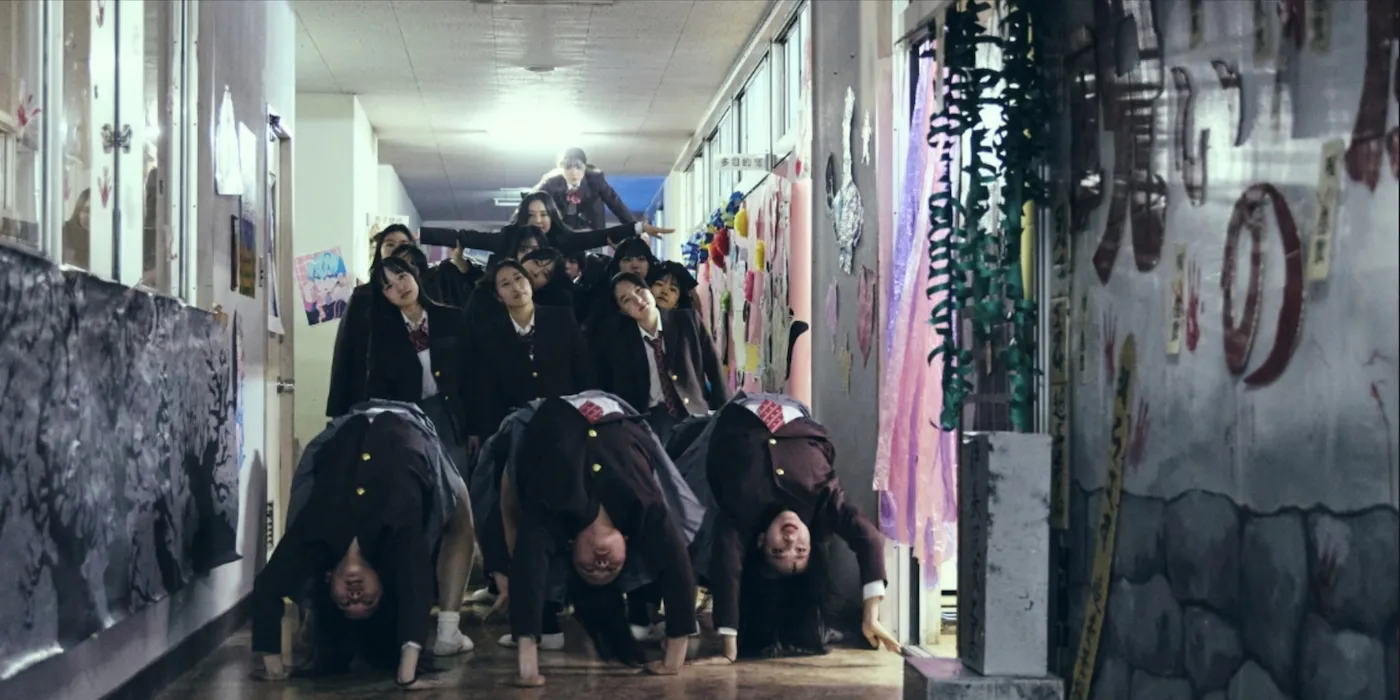
Her counterpart is Yu Kobayashi, played by Yuzu Aoki, a transfer student with time abroad who questions group structures and the demand for blanket conformity. The pairing of Ai and Yu becomes a clear device for mapping pressure from within and pressure from outside, the comfort of belonging and the need for self-definition.
This struggle unfolds as the school yields to the bizarre event. The pyramid starts small and quickly gathers bodies under a strange compulsion. The faculty encourages the absorption. The principal, played by Pierre Taki, and the P.E. teacher praise the growing formation as a positive act that unifies the student body.
The administration enforces a rigid order across campus life, from synchronized marching to the suppression of individual expression in art class. Yu’s abstract drawing is displayed as a fault to correct. The collective hardens into the only sanctioned route to security and acceptance.
Cultural Critique and the Satirical Edge
The film turns the expanding pyramid into a concentrated symbol. Shimotsu uses a Japanese school setting to examine hierarchy, obedience, and corrosive groupthink with implications that travel across borders. The pyramid visualizes the sacrifice of self for the comfort of a unified whole.
The satire cuts cleanly at large-scale conformity, state control, and fear-driven obedience. The school’s leadership endorses that atmosphere. The principal teaches that fear ranks as the most effective emotion for control, and the gym teacher orders students to do the same as everyone else.
The film links this repressive climate to exploitation through casual bullying that precedes the mass event. The visual approach makes the bizarre feel ordinary. As the pyramid dominates the frame, it shifts from shock to a static object within the image. The audience, like the compliant students, learns to stop reacting, which mirrors a social numbness to mass compliance.
The critique arrives at a troubling question about pleasant ignorance. If the assimilated students look blissful inside the structure, what does that say about the costs of that comfort. New Group asks the viewer to face the polished surface of order and the hollow core that can sit behind it.
Visual Storytelling and Execution
New Group operates as sly genre cinema, mixing surreal body horror with pitch-black comedy and sustaining an unnerving dream logic from scene to scene. Shimotsu stages the central spectacle with invention. Sweeping shots of hundreds of students contorting and moving in eerie sync leave a strong imprint. The production relies on practical effects and carefully integrated CGI, and the craft strengthens the film’s thematic aims.
The feature runs about 82 minutes and moves with lean momentum that keeps the absurdity from exhausting its charge. The tight length builds a steady rise in dread. The ensemble steadies the surreal elements. Anna Yamada plays Ai with quiet delicacy, conveying persistent anxiety and a gradual, necessary shift in feeling. Yuzu Aoki gives Yu a measured, grounded energy that articulates a stance against the group’s pull. Pierre Taki dominates his scenes as the principal, a zealot for order who cheers the erasure of individual identity.
New Group is a 2025 Japanese horror film directed and written by Yuta Shimotsu, whose previous work also blended social commentary with abstract horror. The movie centers on a bizarre cult-like phenomenon at a high school where students begin forming a massive human pyramid, turning the pressure of conformity into a nightmarish body horror spectacle. The film had its world premiere at the Fantasia International Film Festival in 2025, where it received a Special Mention. Its international sales and distribution are handled by Kadokawa Corporation, with a theatrical release set to come from Shudder. It has a lean running time of 82 minutes.
Credits
Title: New Group
Distributor: Kadokawa Corporation, Shudder
Release date: 2025 (Festival Premiere), TBD
Rating: Not Rated (NR)
Running time: 82 minutes
Director: Yuta Shimotsu
Writers: Yuta Shimotsu
Cast: Anna Yamada, Yuzu Aoki, Pierre Taki
The Review
New Group
New Group is an extraordinary entry into modern J-horror, succeeding through its sheer audacity and precision. Yuta Shimotsu crafts a visually unforgettable, politically sharp allegory about the dangers of groupthink and the crushing cost of individualism. The film's short runtime and highly focused narrative elevate its unsettling premise. It challenges the audience with both grotesque, meticulously choreographed imagery and serious, culturally resonant questions about social compliance. This is a must-see for viewers seeking provocative, culturally relevant cinema.
PROS
- Unforgettable, surreal imagery of the human pyramid; stunning choreography.
- Sharp, effective critique of conformity, hierarchy, and social pressure.
- Swift, lean runtime (82 minutes) that maintains tension.
- Anchored by balanced performances from Anna Yamada and Pierre Taki's chilling zealotry.
CONS
- The satirical points are sometimes communicated with a lack of subtlety in the dialogue.
- The high level of the bizarre may alienate viewers unfamiliar with experimental J-horror.
- The final resolution risks reflecting the conformity it critiques, complicating the message.