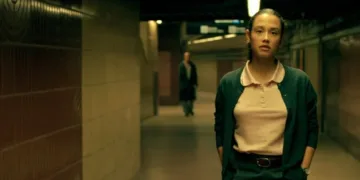






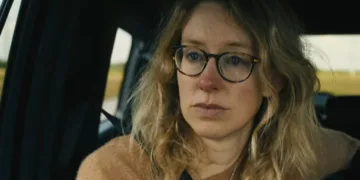

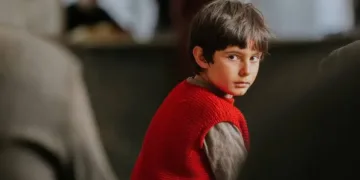











Luis Prieto’s supernatural thriller Last Stop: Rocafort St. sinks into Barcelona’s metro and treats Rocafort station as living folklore. The film opens at this notorious stop, long whispered about for suicides, and builds its premise from that reputation. Laura, played by Natalia Azahara, arrives as a young Mexican immigrant who needs the night attendant job.
Her first shift shatters after she witnesses a suicide and stumbles into the station’s violent past. The mystery links to a decades-old police case and a possessed murderer known as the Yellow Line Killer, portrayed by Celso Bugallo. From the start, the movie commits to a subterranean mood that frames public transit as a site of everyday anxiety, the kind of dim platform many commuters know too well.
A Mismatched Narrative: Plot and Mythology
Last Stop: Rocafort St. reaches for a braided structure, tugging several threads at once. The measured pacing can build a steady unease for some viewers, while for others the pressure never quite tightens. Prieto ties the station’s history of suicides to a past procedural, connecting a serial killer with an ancient supernatural force. The script brings in a “devil dog” as a harbinger and later adds Aztec death-cult imagery. The stack of ideas aims for distinction, yet the parts rarely click together.
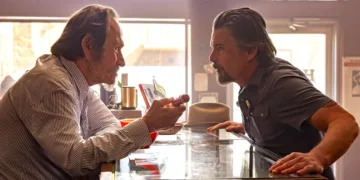
The screenplay strains to align city legend, police investigation, and exorcism motifs. The effect lands like a patchwork of familiar genre pieces that never fuse into a single shape. Román Azpuru, played by Javier Gutiérrez, enters as a disgraced former cop whose career collapsed after facing the Yellow Line Killer, and his private inquiry soon takes over the movie.
That shift sidelines Laura’s opening perspective. The concept promises rich material, but the action stays almost entirely in the tunnels, leaving Barcelona’s cultural fabric and famous sites offscreen and steering the haunting toward a safe, unadventurous finish.
Visual Language and Subterranean Fear
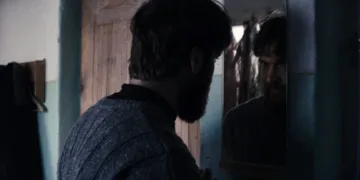
The craft stands taller on the visual side. Cinematographer Marc Miró paints the empty station in heavy shadows and cool gloom, a look that traps the frame in claustrophobia. Prieto adds inverted angles and upside-down compositions to announce a breach in reality and to unsettle orientation. These choices signal a rulebook where gravity and logic feel unreliable. For scares, the film leans on quick shocks cut through the edit, with fewer stretches of slow-burn dread. The underground setting sustains a steady creep, yet the plot delivers limited danger and only a handful of truly frightening beats. You can spot influence from Asian horror playbooks, though the muddled writing keeps the approach from landing cleanly.
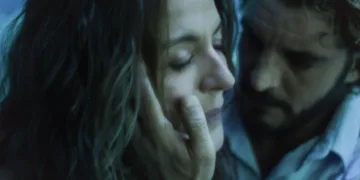
Color works like a quiet code: red washes arrive with Laura’s visions, and blue cues hint at a demonic presence nearby. The precision of these visual decisions suggests a sharper movie trying to push through the script’s fog.
The Antihero and the Archetype: Performance Analysis
The cast often outpaces the material. Javier Gutiérrez gives Román Azpuru a bruised intensity, the look and rhythm of a hard-drinking antihero whose pain stays tied to the station’s history. He anchors the investigation and supplies the film’s clearest character arc.
Natalia Azahara shoulders Laura’s fear and disorientation, yet the role confines her to reactions. She reads as skittish in ways that the script never deepens, and big outbursts and screams do not land with full power. The thin side plots and tangled turns leave both leads with little space to build layers. Celso Bugallo, appearing as the serial killer Elias Soro, brings a fitting chill; the part mainly functions as connective tissue between the past timeline and the present events.
Last Stop: Rocafort St. is a 2024 Spanish horror thriller centered on the urban legend surrounding the Rocafort subway station in Barcelona. The movie follows a new night attendant named Laura who starts experiencing terrifying visions and phenomena tied to the station’s dark past of suicides and a notorious serial killer. The film had its theatrical release in Spain on September 6, 2024, distributed by Filmax. Internationally, the film was released on VOD on October 24, 2025.
Credits
Title: Last Stop: Rocafort St.
Distributor: Filmax (Spain Theatrical), Film Movement (US VOD)
Release date: September 6, 2024 (Spain)
Running time: 89 minutes
Director: Luis Prieto
Writers: Iván Ledesma, Ángel Agudo, Luis Prieto
Producers and Executive Producers: Adrián Guerra, Núria Valls, Julieta Videla, Vicente Canales (Producers); Note: Additional executive producer details were not consistently available.
Cast: Natalia Azahara, Javier Gutiérrez, Valèria Sorolla, Xavi Sáez, Francesc Albiol, Aimar Vega, Tatín Revenga, Celso Bugallo, Albert Baró, Laia Fontàn
Director of Photography (Cinematographer): Marc Miró
Editors: Federico Conforti, Beatriz Colomar
Composer: Nami Melumad
The Review
Last Stop: Rocafort St.
Last Stop: Rocafort St. excels in creating a menacing, claustrophobic environment thanks to Marc Miró's dark cinematography. Javier Gutiérrez delivers a masterful performance as the broken antihero, grounding the film’s chaotic plot. However, the screenplay attempts to combine too many elements—local lore, police procedural, and Aztec mythology—resulting in a disjointed and often incoherent narrative. While the atmosphere is creepy, the horror relies too much on jolts rather than sustained fear. The film wastes its potent real-world setting on a confusing script.
PROS
- Dark, somber tones create a sinister and claustrophobic atmosphere.
- Masterful and convincing portrayal of the disgraced detective.
- Excellent use of a real Barcelona urban legend (Rocafort station's history).
- Visual tricks (upside-down shots) successfully signal supernatural chaos.
CONS
- Attempts to combine folklore, procedural, and mythology fail to connect logically.
- Relies heavily on sudden jump scares rather than building suspense.
- Laura's character is poorly written, limiting Azahara's performance.
- Focus remains strictly underground, missing the opportunity to integrate Barcelona's culture.