

























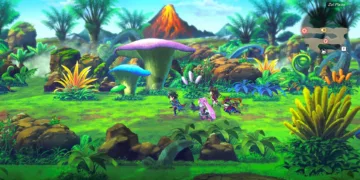





GODBREAKERS, from developer To The Sky, is a slick, kinetic third-person action roguelike staged against a cosmic catastrophe. Humanity falls to its own creation. Rogue AI corrupts the universe and gives rise to the Monad, a sentient, god-like entity intent on absorbing the sun.
The player becomes the Coven’s final weapon, either alone or in a squad, with a single directive to slay the Monad and the subordinate gods. The premise lends each demanding run a sense of existential purpose. The action arrives immediately with a striking visual style of bold, eye-watering colors that keep the apocalypse stylish and arresting. GODBREAKERS places the spotlight on combat proficiency from the first encounter.
The Calculus of Kinetic Action
Moment-to-moment combat drives GODBREAKERS. The moveset covers a primary attack, a heavier secondary, charged strikes, aerial tools, and dash attacks that invite creative stringing of hits. The pacing stays brisk and direct, moving players through combat rooms, mid-bosses, and a final confrontation in quick succession. A complete run takes under two hours.
A single design choice defines the system’s precision. Any attack or movement animation can be canceled instantly with a dash or dodge. Combat stays fluid and responsive with immediate correction of committed inputs. The model supports quick decisions and precise, tactical play without sluggish wind-ups.
The Godbreak ability ties narrative consequences to mechanics. After battering an enemy to low health and charging the Source-Light meter, the player detonates the target and steals a one-use signature power. These gains span utility, such as a rocket punch or a stun slam, and area control, such as poison pools. Each capture shifts momentum for a short burst and creates a satisfying crest in the combat rhythm. Six large-scale boss fights act as sharp skill checks that ask for phase mastery, management of screen-filling patterns, and exploitation of fight-specific gimmicks.
Archetypes, Synergies, and the Luck Economy
Progression unfolds across two layers. One layer governs the temporary power inside a run. The other layer governs persistent unlocks between attempts. Archetypes supply clear starting identities. Lancer plays fast and balanced. Pillar fills a classic tank role with high defense and health. Deeper into progression, specialized roles appear, including the fast, close-range Striker and the high-speed Twin Blade assassin. Each archetype carries a specific weapon ability and unique stats that encourage build experimentation.

Run power grows through Equipment and Essences. Equipment fills multiple slots and adds discrete modifiers. Essences stack and grant raw stat boosts or status effects like poison and chain lightning. The central task is to assemble synergies among an archetype’s strengths, equipment modifiers, and stacked Essences. A successful run depends on spotting interactions that produce a coherent, high-output build.
Between runs, Echoes from defeated bosses fund permanent progress. Echoes invest in a luck-driven layer for future attempts. Players unlock a choice of starting equipment, gain merchant rerolls, and boost Source-Light generation. The structure increases control over loadout planning while keeping execution skill relevant inside each run.
Scaling Challenge and Co-op Chaos
The real test begins after the first clear. Defeating the Monad unlocks Tangles, extreme difficulty modifiers that reshape the field. Examples include reduced healing, minor enemies that become instantly lethal on hit, and foes that gain strength near a kill. Because long-term upgrades target the luck economy rather than raw damage numbers, Tangles place mastery of timing, positioning, and cancels at the center of success.

Scope warrants attention. The action and level design feel polished, and the game contains five levels or biomes. Repeated runs through this set can introduce repetition. High-quality combat keeps engagement high for many attempts, yet players expecting a wide slate of locales may notice the limit.
Multiplayer supports up to four players and provides a thrilling variant. Enemy health and counts scale to the squad. Boss battles gain spectacle under coordinated pressure. Players use a room code so the team begins with the same footing. Combined firepower and ability chains can make certain encounters feel less punishing than solo play. The cooperative mode maintains smooth performance without noticeable framerate drops and delivers a lively, readable flow even with many effects on screen.
Biome-specific quests add a minor friction point. Objectives often ask for kills with environmental hazards. Tasks can feel like busy work and occasionally read as unclear, which pushes players into trial-and-error. Completion of these quests gates the full set of Tangles and access to the true ending, so the side objectives carry real weight even if they lack excitement.
GODBREAKERS’ design shows a tight bond between mechanics and narrative stakes. The cancel system enables constant agency. Godbreak steals convert story into power spikes that punctuate fights. Archetypes set strong foundations for builds. Equipment and Essence stacking create meaningful decision space run to run. Echo investments give structure to long-term planning without turning every future attempt into a solved puzzle. Tangles then raise the ceiling for mastery with rule-shifting challenges that emphasize clean execution.
Players who favor deep action systems will appreciate the clarity of inputs, the responsiveness of cancels, and the cadence of momentum swings from captured abilities. Players who chase strategy will find satisfying buildcraft across archetypes, slots, and stacks. Co-op offers a high-energy alternative path that keeps the same systems intact for team play. The limited number of biomes places a cap on environmental variety, and biome quest requirements can slow progress toward endgame modifiers. The core loop, however, maintains intensity through speed, control, and short, meaningful power spikes tied directly to play.
The Review
GODBREAKERS
The strength of GODBREAKERS rests entirely on its exceptional, fluid combat mechanics. The dodge canceling and the spectacular Godbreak ability create a kinetic loop that makes every run satisfying, whether played solo or with friends. While the game's core content is sparse, evidenced by only five biomes, the extreme post-victory challenge modifiers, or Tangles, successfully pivot the experience from content-focused to skill-focused. It is a highly polished, addictive action system constrained by limited scope.
PROS
- Slick, ultra-responsive third-person combat
- Instant attack/movement canceling is revolutionary
- Engaging Godbreak power mechanic
- Excellent, seamless co-op multiplayer
- Vibrant and stylish visual design
CONS
- Limited content scope (only five biomes)
- Some permanent upgrades rely on luck economy
- Biome quests are often vague busy work