
























![Kingdom Hearts Collection [I-III] Review](https://gazettely.com/wp-content/uploads/2026/10/Kingdom-Hearts-Collection-I-III-1-360x180.webp "Kingdom Hearts Collection [I-III] Review: KHII Holds Steady as Newer Entries Fluctuate 37")




Our Fault (Culpa Nuestra) arrives as the capstone to the Mercedes Ron Culpables romance trilogy in Spanish-language form. Its engine remains the volatile stepsibling-turned-lovers dynamic between Noah, played by Nicole Wallace, and Nick, played by Gabriel Guevara. Four years have elapsed since their break. Each appears settled into adult routines, at least on the surface.
The story sparks when circumstance, tidy rather than metaphysical, pulls them back into proximity. They reconverge in Ibiza as attendants for friends Jenna and Lion, a destination wedding that doubles as a showroom for sunlit water, gleaming terraces, and pristine wardrobes. The old attraction flares at once. Heat mixed with rancor. The film announces its project with a cascade of fashion and luxury. A moving catalogue of aspiration.
Pacing and the Problem of Narrative Acceleration
The script props the reunion on new alliances. Nick is engaged to Sofia, precise and unruffled. Noah works for Simon, who later becomes her boyfriend and remains sincerely considerate. These relationships take shape fast. The source of the earlier split also resolves fast. A secondary figure steps in as moral adjudicator. Contradictions vanish through plot fiat rather than earned repair.
The cadence wobbles. A long midsection lingers on corporate maneuvers and relationship maintenance, measured and beige. Then the throttle sticks open. The last half hour erupts into serial melodrama. A car chase. A shooting. A coma.
A pregnancy reveal arrives like a cue card. A final confrontation settles when the family dog, Thor, tips the scales. The compression reads like a writers’ room sweep of every soap device within reach. Little breath. Much noise.
The Philosophy of the Toxic Archetype
Performance carries thin text. Wallace and Guevara project allure with ease, which offsets the hollowing of the characters’ interior lives. Nick sketches a neo-noir anti-hero updated for boardrooms and inheritance. Control, business scheming, and sulking volatility define him. The last-minute reformation registers as a narrative decree rather than an epiphany.

He remains the billionaire failson figure the film keeps returning to. Noah’s arc considers choice but lands in repetition. She builds a steady life with Simon, who offers calm and care, then chooses high-risk magnetism with Nick whenever the plot requires ignition. Secondary figures serve thesis statements.
Simon embodies the Doomed Nice Guy, a genre constant that proves dependable for story mechanics and punishing for the character. Sofia, played by Gabriela Andrada, yields the single clear ethical pulse. Her moment of generosity and clarity toward Nick provides a brief sense of adult reasoning, a spark of moral lucidity in a drama that prefers speed.
Visual Storytelling and Aesthetic Excess
The movie operates as a luxury object. Cinematography coats scenes in mirror-finish polish. The Spanish coastline glows. Interiors gleam. Camera placement favors the commodity image. Clothes read as armor. Real estate reads as status text. Movement often pursues a music-video cadence, building sequences that value gloss and pose. Composition prioritizes surfaces and line.

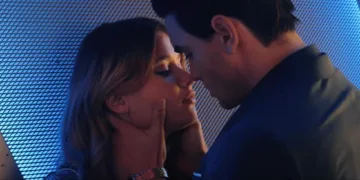
The frame turns characters into emblems against curated backdrops. Lighting smooths faces and heightens luster, a commercial sheen that stands in for sensual charge. The look aims for seduction and attains it in still images. Drama asks for friction. The glassy finish keeps wiping it away.
Sound takes the baton. Up-tempo EDM pop drives scene transitions and emotional cues, a steady pulse that fills pauses and manufactures urgency. Volume substitutes for feeling. Pacing and mix create audience psychology through pressure. The ear receives command signals: accelerate, desire, fret. A clever trick. A blunt one. Tension arrives by insistence rather than uncertainty.
The film’s lineage reaches back to high-stakes melodrama and forbidden-romance plotting, where sexual energy acts as fuse wire. Here the physical charge appears rarely and with restraint. The earlier spark the series relied upon sits mostly in memory. The production package remains sleek. The script remains thin. Dialogue clunks. Scenes resolve by convenience. Moral reckoning becomes a switch flipped offscreen.
Form and theme try to meet. The high-gloss image promises control; the story delivers chaos. That friction could open space for questions about freedom and self-making. Noah gestures in that direction, then the structure reasserts the gravity of Nick. The choice repeats. The film keeps picking spectacle over excavation. The audience feels managed. Framing positions viewers as voyeurs of wealth signals while sound hustles perception along a track. Suspense lives in propulsion more than consequence.
A noir shadow hovers at the edges through Nick’s type: the handsome operator who confuses power with intimacy. The movie nods to that tradition without committing to its moral chill. Expressionistic framing would have sharpened menace; the production prefers postcard brightness. The result removes the chiaroscuro of doubt and leaves billboard clarity. Pretty sells. Ambiguity wilts.
The closing barrage underlines the design. Sensation stacks on sensation. The car roars. The gun cracks. A hospital bed quiets what the edit just inflamed. Then a reveal. Then Thor settles the matter with disarming finality. The dog gets the last word. The audience gets release by accumulation, not by reckoning.
What remains is an artifact of polish, a carousel of images that promise feeling at a glance. The camera composes beauty. The cut races forward. The mix pumps the heartbeat. The writing waves from far behind, trying to keep up. The film trades inquiry for finish, guilt for gloss, and the hard work of change for a bow tied in haste.
Our Fault (Culpa Nuestra) is a Spanish romantic drama film that serves as the third and final installment in the film trilogy adapted from the bestselling Culpables novels by Mercedes Ron. The movie premiered on October 16, 2025, and is available to stream exclusively on Amazon Prime Video. It continues the turbulent, forbidden love story of step-siblings Noah Morán and Nick Leister, bringing their emotional saga to a dramatic conclusion after a four-year separation. The film was directed by Domingo González and was produced by Pokeepsie Films.
Credits
Director: Domingo González
Writers: Domingo González, Sofía Cuenca, Mercedes Ron (Novel)
Producers and Executive Producers: Álex de la Iglesia, Carolina Bang (Producers), Amazon MGM Studios, Pokeepsie Films (Production Companies)
Cast: Nicole Wallace, Gabriel Guevara, Gabriela Andrada, Marta Hazas, Iván Sánchez, Fran Morcillo, Goya Toledo, Eva Ruiz, Víctor Varona, Álex Béjar, Javier Morgade
The Review
Our Fault
This high-gloss spectacle suffers from extreme structural whiplash. Our Fault demonstrates impressive aesthetic polish and features the magnetic appeal of its lead actors, a formula designed for success. However, the screenplay accelerates into an unbelievable frenzy, lurching from slow relationship drama to a final act crammed with frantic, unearned melodrama. The film favors convenient twists and arbitrary plot devices over emotional substance. It is a visually appealing but ultimately empty conclusion to the trilogy.
PROS
- The production features visually stunning locales, high-end fashion, and slick cinematography.
- Nicole Wallace and Gabriel Guevara possess a magnetic screen presence that carries the material.
- Sofia's arc provides a brief, interesting flicker of moral complexity.
CONS
- The narrative suffers from severe inconsistency, moving from dull stretches to an overstuffed, chaotic climax.
- Plot resolutions and character transformations often feel abrupt and unearned, driven purely by convenience.
- The script relies on cliched, banal dialogue that undermines the high production value.
- The intense, signature sexual chemistry is noticeably tepid compared to the previous installments.







