
























![Kingdom Hearts Collection [I-III] Review](https://gazettely.com/wp-content/uploads/2026/10/Kingdom-Hearts-Collection-I-III-1-360x180.webp "Kingdom Hearts Collection [I-III] Review: KHII Holds Steady as Newer Entries Fluctuate 37")




Angela Gulner’s directorial debut, The Beldham (once subtitled The House at Hallow End), frames a domestic crucible inside the contours of a genre film. From its first minutes, the movie sets a folkloric register and cites the older definition of a beldham: a bird-like crone that feeds on infant souls. New mother Harper (Katie Parker) moves with her baby into the fixer-upper estate owned by her mother, Sadie (Patricia Heaton), under the strained pretense of aiding a renovation.
The atmosphere turns volatile. A caretaker, Bette (Emma Fitzpatrick), completes the uneasy triangle. Gulner’s script saturates the house with dread, pairing Harper’s visibly fragile state with mounting signs of an external menace, a shadowed figure with a beak-like face. The Gothic vocabulary becomes a vehicle for a study of maternal anxiety and of the historically thorny bond between mothers and daughters. The movie operates as psychological thriller and as bruising family drama. The true haunting reads as systemic.
The Perils of Internal Architecture
The narrative’s most provocative wager is a persistent ambiguity. Is the terror an expression of postpartum psychosis, a psychic wound made visible, or an actual supernatural entity? The Beldham treats space as subjectivity. It positions the audience inside Harper’s disorientation and turns the creaking house into a working “Grief-Chamber,” a place that confuses and isolates. This is the “tragi-horror” mode running at full power, oriented toward emotional devastation rather than easy jolts.
Structure reinforces the effect. The movie moves like a winding corridor, a deliberate blur between what can be trusted and what cannot, and that design builds deep unease. Pacing occasionally lingers, yet that patience prepares a single, concentrated revelation.
When it lands, the epistemic floor drops out. A familiar haunted-house tale gives way to a sadder account of loss on a personal scale. The reframe carries heavy force and recasts every strained glance and every odd sound that came before. Terror suddenly anchors itself in the cruelty of what is real.
These choices invite reflection on care, grief, and the architecture that holds them. Domestic space doubles as a moral laboratory here, a place where duty, fear, and love grind against each other. The house feels like a social archive, every hallway marked by a previous argument or a swallowed apology. Horror becomes a language for talking about how families carry wounds forward.
A Study in Feminine Tensions
The film’s weight rests on the trio of performances. Katie Parker gives Harper a tough, aching edge that earns sympathy even when her spirals test patience. She plays a mother pulled between internal fragility and external pressure, and the stress reads in small tics, unfinished gestures, and a stare that keeps trying to solve an unworkable problem.

Patricia Heaton’s Sadie arrives with practiced brusqueness. Her early chill and combativeness paint her as an antagonist in a fairy-tale key, the wicked stepmother template, yet the performance keeps hinting at a softer core. She reads as a woman at the end of her emotional bandwidth, still trying to hold a difficult line.
Emma Fitzpatrick’s Bette supplies the necessary counterweight. She projects warmth and clean, practical care, which gives credibility to her growing connection with Harper. Their rapport feels like a short reprieve from the family pressure cooker.
At the center of the film sits the Harper-Sadie relationship, an agonizing knot. The script reaches for the complexity of that bond, though certain exchanges land with a stilted quality. Some talk carries more weight than the sentences can hold, and the result can feel thin where history should feel thick. Even so, the cast’s commitment breaks through. The performances sketch the systemic pain of trying to protect someone from internal illness and from an encroaching threat. The idea of care as labor becomes visible, and that labor looks exhausting.
The Ornithological Soundtrack of Dread
Technique tightens the vise. Sound design does careful, unnerving work. The movie leans on ornithological elements, caws and unseen wing beats that turn a common noise into a night terror. Those sounds behave like whispered warnings from a secret that refuses to stay buried. The track makes the air feel crowded and unsafe.

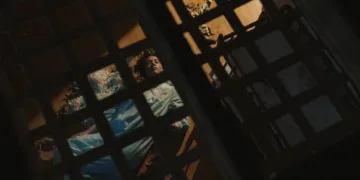
Cinematography partners with that design. The house sits in shadow, framed with a gritty, sometimes claustrophobic eye, and the images treat the building like an actor with motives. The rooms box Harper in and narrow her choices. Viewers share the enclosure and feel the squeeze. The architecture becomes an instrument of anxiety.
The Beldham functions with greater power as drama than as conventional horror. Its preoccupations are loss, sacrifice, and a parent-child contract that refuses to break. The finishing image carries emotional ambiguity, a mix of dread, sadness, and cautious hope collected in one frame. That last moment feels earned by the movie’s analytic patience and deepens the thematic design. It marks the work as a serious entry in contemporary stories of maternal fear and of the social systems that shape it.
The Beldham (also known as The House at Hallow End) is a 2024 American psychological horror film that marked the feature directorial debut of Angela Gulner, who also wrote the screenplay. The film premiered at the 57th Sitges International Fantastic Film Festival of Catalonia in October 2024 and later screened at the Austin Film Festival on October 25, 2024. The story centers on a new mother who returns to her family home and struggles with a fragile mental state while battling a generations-old presence threatening her child. As of the time of this writing, U.S. distribution details are pending, but the film was set for release in the United Kingdom, Ireland, and Latin America by Signature Entertainment in October 2025.
Credits
Director: Angela Gulner
Writers: Angela Gulner
Producers and Executive Producers: Angela Gulner, Talia Bella, Mark Meir, Randy Wayne, Ryan Francis (Executive)
Cast: Patricia Heaton, Katie Parker, Emma Fitzpatrick, Corbin Bernsen, Hannah Reese
Director of Photography (Cinematographer): Ksusha Genenfeld
Editors: Dashiell Reinhardt
Composer: Stephen Limbaugh
The Review
The Beldham
The Beldham succeeds powerfully as an intimate drama about loss and maternal despair, using horror iconography to heighten real-world emotional stakes. While the script occasionally struggles to ground the mother-daughter dialogue, the central performances—especially Katie Parker’s—are devastatingly effective. The film's technical atmosphere, driven by brilliant sound design, perfectly complements the meticulous pacing leading to its shocking, poignant final reveal. It offers a sophisticated, painful look at isolation and protective love.
PROS
- The film functions as an intense, heartbreaking drama about grief.
- The climactic reveal re-frames the entire story, providing devastating emotional weight.
- Katie Parker's lead performance is consistently compelling and sympathetic.
- Exceptional sound design, particularly the use of bird sounds, creates palpable dread.
- Claustrophobic and gritty visual style that enhances the feeling of entrapment.
CONS
- The mother-daughter relationship scenes occasionally feel stilted or unconvincing.
- The slow, surreal structure may test the patience of viewers expecting straightforward horror.
- Some foundational backstory elements feel misplaced or withheld too long, weakening early tension.







