
























![Kingdom Hearts Collection [I-III] Review](https://gazettely.com/wp-content/uploads/2026/10/Kingdom-Hearts-Collection-I-III-1-360x180.webp "Kingdom Hearts Collection [I-III] Review: KHII Holds Steady as Newer Entries Fluctuate 37")





Splinter Cell: Deathwatch arrives as the first animated series based on Ubisoft’s 25-year-old video game franchise, long tied to Tom Clancy’s name and a shelf of action novels. Netflix presents eight episodes and labels them canon, a choice that invites attention from viewers who track continuity. Writer and developer Derek Kolstad leads the project. His credits on John Wick and Nobody signal an effort to connect the games’ stealth action with contemporary, hard-edged screen style.
The premise places Sam Fisher (voiced by Liev Schreiber) years after Blacklist. He lives quietly on a farm in Suwalki, Poland until a nearby operation collapses for Fourth Echelon agent Zinnia McKenna (Kirby). The fallout drags Fisher back into special operations and into a fresh global conspiracy. The setup moves quickly and restores a legendary operative to active duty for a new cycle of espionage.
Story: Old Spies and New Threats
The structure begins with a familiar clean-up phase that uses early episodes to reintroduce spy craft and Fisher’s reluctant return. These chapters focus on Sam and Zinnia dodging mercenaries across Poland and the rhythm can feel procedural.
The tempo shifts once the mystery around Zinnia’s assignment and her link to Diana Shetland comes into view. Shetland, the CEO of Displace International, connects to a scheme involving revolutionary fuel energies and a shadowy presence that stays ahead of the heroes. From that point the plot picks up turns and new layers.
Kolstad has cited Old Man Logan and Clint Eastwood’s Unforgiven and the echoes show in Fisher’s post-spy farm life and his mentor role with Zinnia. The series draws on franchise history by hinting at ties between Fisher’s past, including his friend Douglas Shetland from 1991, and current trouble. One revision stands out. A major moment tied to Chaos Theory villain Doug Shetland receives a heavier, more striking treatment that sharpens the scene compared with the earlier version.
The campaign across borders still leans on a familiar frame. The conspiracy works as a spy engine yet often reads as generic. The story functions, the stakes rise, and the leads push forward. The distinct identity of the property thins at times, and the protagonist can feel replaceable inside the machinery.
Character Dynamics and Voice Performances
Sam Fisher returns as older, wiser, and worn by time. The animation frames him with a rough presence, close to a The Rock-era Sean Connery type, living a tough retirement that violence interrupts. Reentry into the field adds friction. He is not the silent hyper-stealth figure of earlier outings. He moves a touch slower and carries the added task of protecting others.

Liev Schreiber grounds the show with a gravelly command that fits an aging operative and still echoes the grain of Michael Ironside’s familiar performance from the games. Janet Varney appears as Anna “Grim” Grímsdòttir, who leads tech operations. Thunder (Joel Oulette), a hacker created for the series, rounds out the team.
Zinnia McKenna serves as Sam’s counterpart, yet her path runs on a firm desire for revenge and the writing keeps that motive near the surface. The relationship between Sam and Zinnia does not gain real depth across the run. The series also leaves the emotional weight of Sam’s retirement choice underexplored. The ensemble handles assignments cleanly but stays close to stock espionage roles. The global stakes rise while personal stakes remain modest.
Visual Style and Cinematic Action
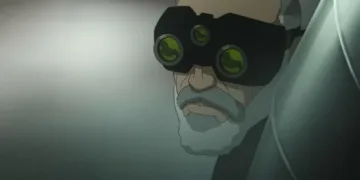
Sun Creature Studio, credited on Flee, animates a palette that leans into darkness and light and carries the black ops mood. The frame fills with night-vision goggles, green-lit control rooms, and low-voiced comms. The iconography signals the brand clearly and shapes an immediate viewing grammar. An early set piece staged in a winter squall stands out. The action staging lands with a cinematic punch and the choreography tracks cleanly through the snow.

The craft shows uneven results across different scene types. Fights and kinetic beats look strong, with body motion that feels less rigid than many animated action shows. Extended dialogue does not play as well. Mouth animation often reads stiff and simple exchanges can look flat.
The season opens with a streamlined stealth sequence that uses franchise signatures with confidence. Later chapters favor well-timed brawls and shootouts over pure tactical stealth. The tilt toward straight combat registers and shifts emphasis away from the core game mechanic.
Even with inconsistent character animation, the show maintains a watchable style. The familiar visual signals help viewers who do not know Splinter Cell lore find footing, and the action design supplies pace and clarity.
Splinter Cell: Deathwatch is an adult animated action television series based on the Tom Clancy’s Splinter Cell video game franchise. The series, which sees agent Sam Fisher drawn back into the field, premiered on October 14, 2025, and can be watched exclusively on the streaming platform Netflix. It was developed by Derek Kolstad, known for creating the John Wick film series, who also serves as the lead writer and executive producer.
Full Credits
The Review
Splinter Cell: Deathwatch
The series successfully transitions the venerable stealth franchise to animation, largely due to Kolstad’s strong structural instincts and Liev Schreiber’s gruff lead performance. While the action sequences are cinematic and the plot twists satisfying, the show is hampered by inconsistent animation quality, particularly in dialogue scenes. The emotional depth between Sam and Zinnia remains shallow, preventing the high-stakes narrative from fully resonating. It is a stylish, competent action thriller that serves the source material well enough for fans, yet stops short of achieving cinematic greatness.
PROS
- Liev Schreiber's authoritative voice performance.
- Action sequences are cinematic and intensely choreographed.
- Strong plot development with surprising twists after the initial setup.
- Successfully modernizes and retcons key franchise lore moments.
CONS
- Animation quality is inconsistent, especially during dialogue.
- Sam and Zinnia's emotional arcs remain surface-level.
- The story sometimes defaults to generic spy thriller tropes.
- Initial episodes can feel routine and slow to start.







