
























![Kingdom Hearts Collection [I-III] Review](https://gazettely.com/wp-content/uploads/2026/10/Kingdom-Hearts-Collection-I-III-1-360x180.webp "Kingdom Hearts Collection [I-III] Review: KHII Holds Steady as Newer Entries Fluctuate 37")





In a streaming environment crowded with content, platforms win by capturing narrowly defined audiences. The rise of polished niche programming is an important industry trend. Against that background, The Chosen Adventures arrives on Prime Video. It is an animated, family-minded spin-off of The Chosen, the historical drama that found an audience outside traditional studio pipelines. The series functions as a clear example of market segmentation in the streaming era, using the original show’s built-in viewers to stake out space in the market for wholesome children’s media.
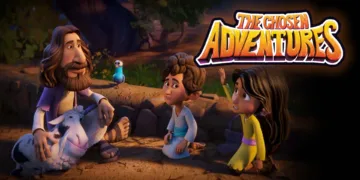
The episodes are short and intentionally compact, each lasting between 11 and 14 minutes. That runtime reflects contemporary viewing behavior. The series is overseen by writer and showrunner Ryan Swanson, and Jonathan Roumie returns to supply the central voice role. The action takes place in first-century Capernaum near the Sea of Galilee. The lead is Abby, a nine-year-old defined by relentless curiosity who tests the limits of her environment.
When her parents and the local religious teacher do not satisfy her questions, she seeks instruction from Jesus of Nazareth, presented here as a craftsman and a teacher who offers patient counsel. Abby explores the world with her timid friend Joshua and a comedic animal pair, Sheep voiced by Paul Walter Hauser and Pigeon voiced by Yvonne Orji. Their humor creates counterpoint to the historical setting.
Messaging, History, and Cultural Framing
The series is built around accessible, self-contained lessons. Unlike many contemporary animated shows that tuck moral meaning beneath rapid plot mechanics, this program places its educational aims up front. It emphasizes straightforward ethical themes—responsibility, compassion, familial respect—framed through the daily experience of growing up in a close-knit ancient community. That framing makes a deliberate contrast between the simplicity of the lessons and the complexity of modern life.
Showrunners work to weave Judaic practices and Biblical culture through both visual detail and narrative beats. Elements such as Shabbat observance, the synagogue’s role, and social norms of the period appear as parts of the story world and help create historical context. Jesus is depicted consistently as a teacher whose guidance is delivered through parables and quiet instruction rather than spectacle. Faith functions as an embedded part of daily life for the characters, shaping social and ethical choices rather than acting as an external motif.
The creative team introduces the era’s social tensions in ways aimed at a young audience. Roman authority and the presence of tax collectors are shown through children’s perspectives, producing a gentle commentary on power and economic pressure. Abby’s repeated attempts to access synagogue lessons call out restrictions on girls’ participation, and these scenes draw attention to representation and educational equity within the historical setting. The show acknowledges those cultural limits and stages them as a theme for its young protagonist to navigate.
More abstract questions, such as suffering or apparent misfortune, are treated with narrative economy. Episodes sometimes shift viewpoint—an example is action shown from the pigeon’s vantage point—to suggest how an apparent setback may have prevented a worse outcome, quietly gesturing at providential ideas. The series simplifies theological complexity to provide emotional reassurance. It prioritizes a consoling tone over extended doctrinal explanation, introducing serious subjects gently so children can engage with them without being overwhelmed.
The Power of Voice and Character Archetypes
A core asset of the series is the voice work, particularly for the animal sidekicks. Casting recognizable, high-caliber actors in secondary comedic parts signals a production-level commitment to performance quality.

Abby operates as the narrative catalyst. Her impulsive curiosity drives each episode. Joshua functions as the cautious foil, diligent and timid, and his gradual movement toward greater courage supplies a quietly satisfying arc. The performances by Romy Fay and Jude Zarzaur capture the raw, unpolished cadence of young speech in a convincing way.
Paul Walter Hauser’s Sheep and Yvonne Orji’s Pigeon provide a distinctive comic lift. Hauser’s Sheep is constructed from low-energy comic beats. Obsessed with food and naps, he delivers grouchy lines in a deadpan register. A flashback subplot gives the character an emotional backstory that deepens him beyond purely comic relief. Orji’s Pigeon plays a streetwise, quick-tongued survivor who often critiques events as they unfold.
Sheep and Pigeon act as a kind of modern chorus, offering commentary that connects the historical milieu to contemporary sensibilities. Their dialogue contains moments aimed at adult viewers, which rewards parental co-viewing. The comic pairing demonstrates how voice-over casting can define animated characters through precise delivery, and that casting choice raises the comedic caliber of the whole series.
Jonathan Roumie’s portrayal of Jesus provides a steady source of warmth and patience, maintaining the tone set by the live-action predecessor. The parental figures Abba and Eema, voiced by Zehra Fazal and Danny Nucci, ground Abby’s world in familial care and tradition. The inclusion of familiar supporting figures from the original series, such as Mary Magdalene and Matthew, nods to existing fans and helps situate new viewers in a larger narrative universe.
Aesthetic, Structure, and the Snacking Trend
Visually, The Chosen Adventures favors round shapes, saturated color, and textured surfaces. The animation purposefully avoids hyper-realism and the technical flourish of major studio tentpoles, while still achieving a polished and inviting look. The color choices and fluid character motion are put to work in service of maintaining a child’s attention. Within the expanding field of faith-oriented animation, the show stands as a competent, appealing example.
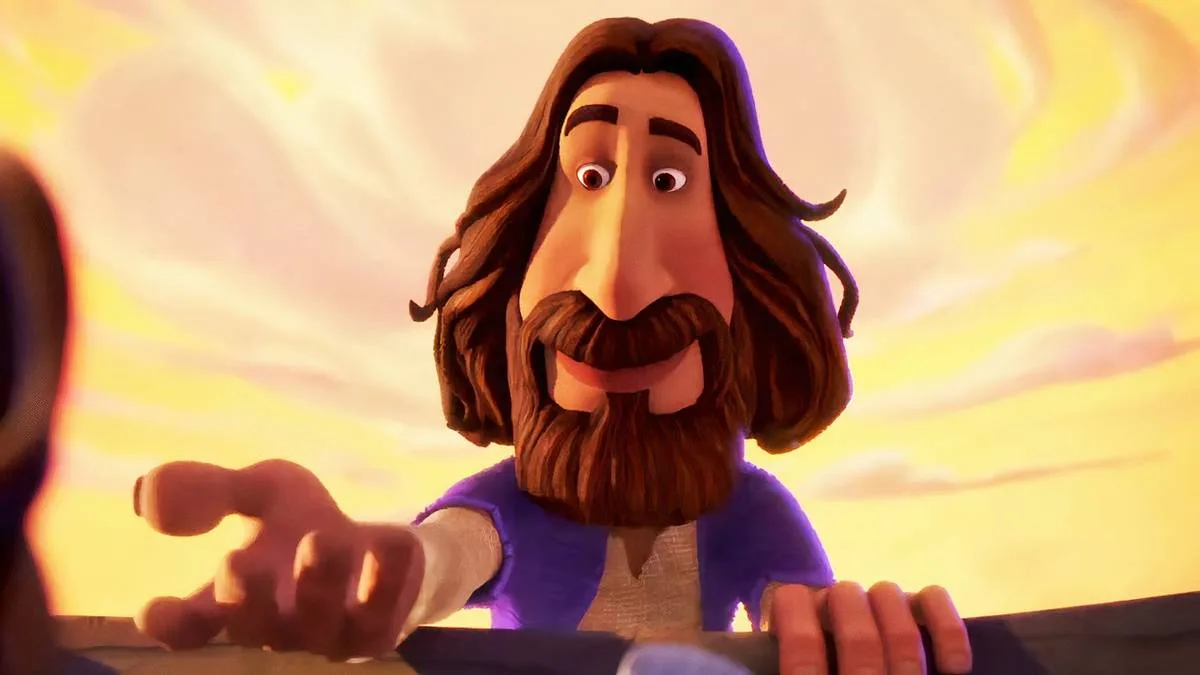
Tone is carefully balanced between the levity of animal antics and the moral seriousness of the lessons. The humor ranges from physical slapstick to measured deadpan and sly quips intended for adults. The presence of talking animals within an ancient setting functions as a device for translating spiritual ideas into digestible, entertaining moments.
The brief episode length, between 11 and 14 minutes, aligns the show with a broader streaming shift toward compact, easily consumed entries. That format yields a predictable structure: a child faces a relatable moral dilemma, hijinks follow, and a clear lesson is delivered. Such predictability can risk fatigue. The strength of the central characters, especially the comedic interplay of Sheep and Pigeon, offsets that risk and helps the formula remain engaging. A two-part cliff-hanger finale signals awareness of serial mechanics and encourages viewers to return.
Market Segmentation and Cultural Influence
The Chosen Adventures targets children aged 7 to 12 and their parents. It is tailored for religiously minded families who want media aligned with their values. The series exemplifies how streaming services are addressing specialist audiences with more sophisticated, high-quality offerings rather than generic content.

Broader appeal depends on narrative quality and character work. The show’s humor and dynamics can attract a wider audience. At the same time, the dense embedding of Judeo-Christian themes and the ties to the original series’ context mean that viewers without that background could feel culturally distant from the material. For its intended viewers, the series serves as a significant cultural artifact and raises expectations for Christian-oriented children’s programming.
For parents, the series offers practical value. Its short episodes and explicit lessons make it a useful prompt for discussions about behavior and moral choices. The show also signals a shift in faith-focused media away from low-budget, overtly proselytizing fare and toward well-crafted productions that reflect contemporary streaming norms.
The Chosen Adventures demonstrates that careful animation and sharp comedic writing can support an explicitly ideological project while meeting modern standards for production and performance. This example may influence future investment in similarly produced, niche animated content across diverse cultural communities.
The Chosen Adventures is an animated comedy and adventure series—a spin-off of the hit live-action show The Chosen—that premiered on October 17, 2025. The series focuses on the fictional children Abby (age nine) and her best friend Joshua, as they navigate life in Capernaum around 30 CE. The 14-episode first season, which also features a talking sheep and pigeon, explores spiritual and moral lessons through the eyes of the children who occasionally encounter Jesus of Nazareth (voiced by Jonathan Roumie). The entire first season is available to stream on Prime Video.
Full Credits
Title: The Chosen Adventures
Distributor: Prime Video (Amazon MGM Studios and 5&2 Studios)
Release Date: October 17, 2025 (All 14 episodes premiered simultaneously)
Rating: TV-PG
Running Time: Approximately 11–13 minutes per episode (14 episodes in Season 1)
Writers: Ryan Swanson (Showrunner/Executive Producer)
Producers and Executive Producers: Ryan Swanson, Dallas Jenkins, Chris Juen, Chad Gundersen, Keith Alcorn, Kellen Erskine, Derral Eves, Erin Elizabeth Gardner, Myesha Gosselin
Cast (Voice Actors): Romy Fay, Jude Zarzaur, Paul Walter Hauser, Yvonne Orji, Danny Nucci, Zehra Fazal, Jonathan Roumie, Jordin Sparks, Joey Vahedi, Yasmine Al-Bustami, Brandon Potter, George H. Xanthis
The Review
The Chosen Adventures
The Chosen Adventures is a savvy, highly polished case study in effective niche media strategy. It successfully translates an established live-action property into a short-form animated format ideal for modern streaming consumption. While the formulaic nature of its moral-driven episodes creates a predictable narrative framework, the production value—especially the exceptional, mature comedic timing delivered by Paul Walter Hauser and Yvonne Orji—provides unexpected depth and broad appeal. It sets a new, high standard for thoughtful, culturally specific children’s programming.
PROS
- Exceptional voice acting, particularly from Paul Walter Hauser and Yvonne Orji, which appeals equally to children and adults.
- Strategic, short-form episode format (11–14 minutes) perfectly adapted for contemporary viewing habits and young attention spans.
- High production quality featuring aesthetically appealing, round, and textured animation.
- Successful integration of historical details and Judaic life, grounding the moral lessons in a rich cultural framework.
- Strong character dynamics, particularly Abby's persistent curiosity and Joshua's subtle personal growth.
CONS
- The episodic structure is highly formulaic, risking predictability and potential audience fatigue over a long run.
- The deep and primary focus on Judeo-Christian tenets inherently limits its immediate appeal to a broader, non-religious demographic.
- The necessary simplification of complex theological concepts (e.g., the problem of suffering) prioritizes emotional comfort over philosophical nuance.
- The narrative favors pedagogical lessons and parables over the dramatic, spectacle-driven events associated with the source material.







