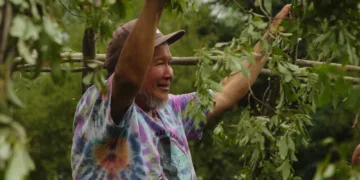



























Headlights skim a ribbon of road as a windshield catches the wide, unbroken sky. The image repeats like a refrain and frames the central tension of Wilfred Buck, Lisa Jackson’s feature-length documentary. The film introduces its namesake, a revered Cree elder, astronomer, and knowledge keeper from the Opaskwayak Cree Nation.
What follows is a contemplative and forceful account of a remarkable life and the endurance of a nation’s wisdom. Buck’s mission is cultural reclamation through the stars, an intellectual and spiritual meeting point between Indigenous cosmology and modern science.
As an educator, he shares Cree, Anishinaabe, and Lakota constellations, drawing clear lines from ancestral stories to present-day understanding. The portrait that emerges is one of steadfast resilience and of a person working for the survival of his people.
Echoes of Hardship
Buck’s personal history, adapted in part from his memoir I Have Lived Four Lives, records systemic injustice with unblinking clarity. His early years carried extraordinary harm. The ’60s Scoop tore his family apart, his siblings were taken, and his youth moved through cycles of addiction, poverty, and crime.
The film recalls a striking moment in which a change of course spared him from the Scoop, a near miss that shaped a will to endure. A later turn, marked by a committed return to ancestral roots and formal education, pulled him away from self-destruction.
Jackson presents this history with formal care. The past appears in stylized, evocative re-enactments on sumptuous 16mm, interwoven with archival materials. Buck’s own narration steers these sequences and gives the memories quiet lyricism and sorrow without resorting to dramatic pressure.
The Wisdom Written in the Stars
For Buck, the night sky holds immense power. It functions as record, spiritual presence, and steady guide. The film conveys a holistic Cree worldview, a philosophy that does not break reality into isolated fields. Jackson’s approach honors that vision by showing how storytelling, science, spirituality, land, and community are inseparable.

Ancestral narratives carry resistance and knowledge. Buck explains this through the sturgeon constellation, a cluster of thirteen stars that marks the Cree Nation’s temporal span, where past, present, and future stand in conversation.
Buck works tirelessly and remains on the move across Turtle Island, speaking at academic forums, leading workshops, and visiting communities. He makes specialized knowledge accessible and builds ties across generations. The documentary’s unconventional form, blending spoken-word poetry, constellation capture, and in-the-moment reportage, mirrors the Cree philosophy that rejects compartments. The film stands as quiet resistance to ongoing efforts to colonize Indigenous thought.
A Poetics of Reclamation
Lisa Jackson’s direction feels meticulous and deeply felt, a sophisticated hybrid documentary method. She blends direct cinema of Buck traveling and lecturing, archival photographs and video, and the dramatic 16mm re-enactments mentioned earlier.
The tone stays honest and careful. The film refuses manipulation and presents the unvarnished realities of racism, colonialism, and trauma, allowing the audience to receive the material with humility and genuine care.
Buck’s presence holds the frame. His jovial spirit, mischievous humor, and eloquent, welcoming manner make him a formidable subject and a natural speaker. The documentary treats generational trauma as a dormancy that can heal through reconnection with ancestral knowledge.
The narrative follows the unending work to restore purpose and integrity to the nation. Wilfred Buck reads as an elegy for what was taken and as an account of one man’s resolve to ensure that wisdom and culture continue. It leaves the viewer with the measure of his devotion and labor for his community, a foundation set where outside forces sought to press it down.
The film Wilfred Buck is a Canadian hybrid documentary that had its world premiere at the CPH:DOX festival on March 18, 2024. The film is a powerful portrait of Wilfred Buck, a Cree elder, star expert, and ceremonial leader who overcame a troubled past to become a celebrated keeper and teacher of traditional First Nations approaches to astronomy. The documentary is a co-production between Door Number 3 Productions and the National Film Board of Canada (NFB). In Canada, it became available for streaming on Crave starting December 2, 2024, and it is also available on platforms like SBS On Demand in Australia.
Credits
Director: Lisa Jackson
Writers: Lisa Jackson
Producers and Executive Producers: Lisa Jackson, Lauren Grant, Alicia Smith, Jennifer Baichwal, Nicholas de Pencier, David Christensen
Cast: Wilfred Buck, Raymond Chartrand, Brandon Alexis, Ed Azure, Ethan Neckoway, Caine Robinson, Moe McGillivary
Director of Photography (Cinematographer): Justin Black, aAron Munson, Nicholas de Pencier, John Price
Editors: David Schmidt, Eui Yong Zong, Matthew Lyon
The Review
Wilfred Buck
Wilfred Buck transcends the standard documentary format, offering a powerful, necessary meditation on history, cultural endurance, and cosmic connection. Director Lisa Jackson handles the subject's personal trauma and national history with remarkable honesty and care, positioning ancestral astronomy as a vital act of reclamation. The film is anchored by the deep wisdom and affable presence of Wilfred Buck, resulting in an inspirational, subtly layered cultural critique that honors a holistic worldview.
PROS
- Presents a compelling and inspirational portrait of resilience and cultural reclamation.
- Successfully illustrates the intersection of Indigenous cosmology, spirituality, and modern science.
- Lisa Jackson employs a careful, non-manipulative tone, allowing the subject's voice and the historical truth to carry the weight.
- Wilfred Buck is an eloquent, personable, and profoundly knowledgeable guide, anchoring the entire film.
- The documentary features beautifully stylized and evocative re-enactments, lending a poetic quality to the past.
CONS
- The use of fictional re-enactments, while visually striking, may feel structurally uneven or less potent than the direct cinema segments showing Buck's present-day work.