



























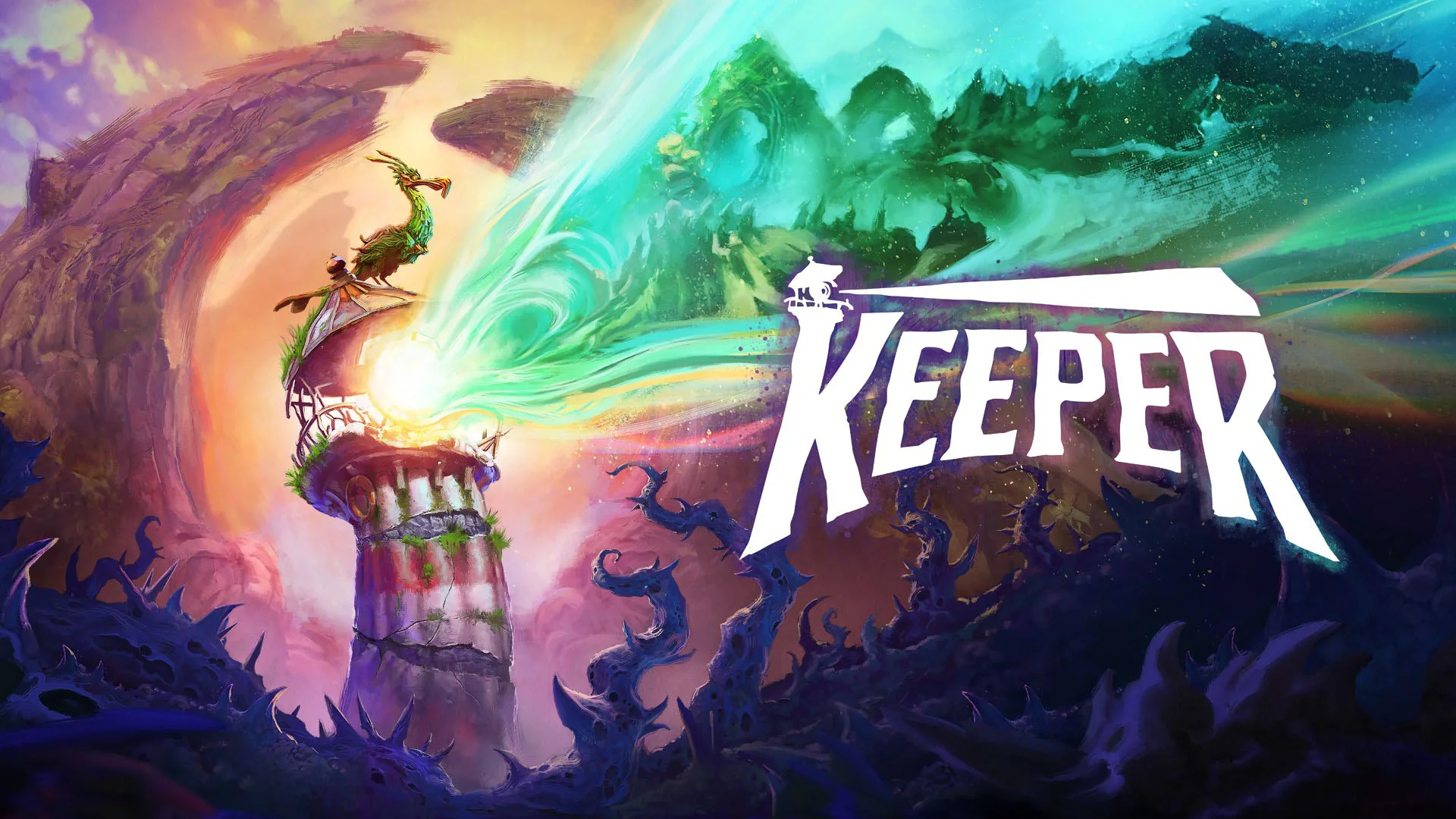

Playing as a sentient lighthouse sounds absurd until a few minutes into Keeper’s opening, when the improbable hero staggers on rope-and-stone legs while a small green bird named Twig rides the lantern. Double Fine treats that premise seriously, shaping a silent five-hour journey across a post-apocalyptic island where human traces have been overtaken by something at once beautiful and unsettling. The lighthouse awakens to push back a parasitic darkness and sets out toward the island’s distant peak, a trek that becomes a study of movement, companionship, and how an engineered object adapts to living terrain.
Keeper avoids tidy genre labels. It pairs contemplative exploration with direct puzzle design inside a surreal artistic framework that privileges mood over hard mechanical testing. Without spoken dialogue, the game communicates the evolving bond between lighthouse and bird through animation, sound, and environmental cues. The island teems with strange fauna and reclaimed ruins, and areas flow into one another through shifts in palette and orchestration rather than loading screens. The pace asks for patience, opting for sensory immersion over traditional difficulty spikes.
A World Painted in Brushstrokes
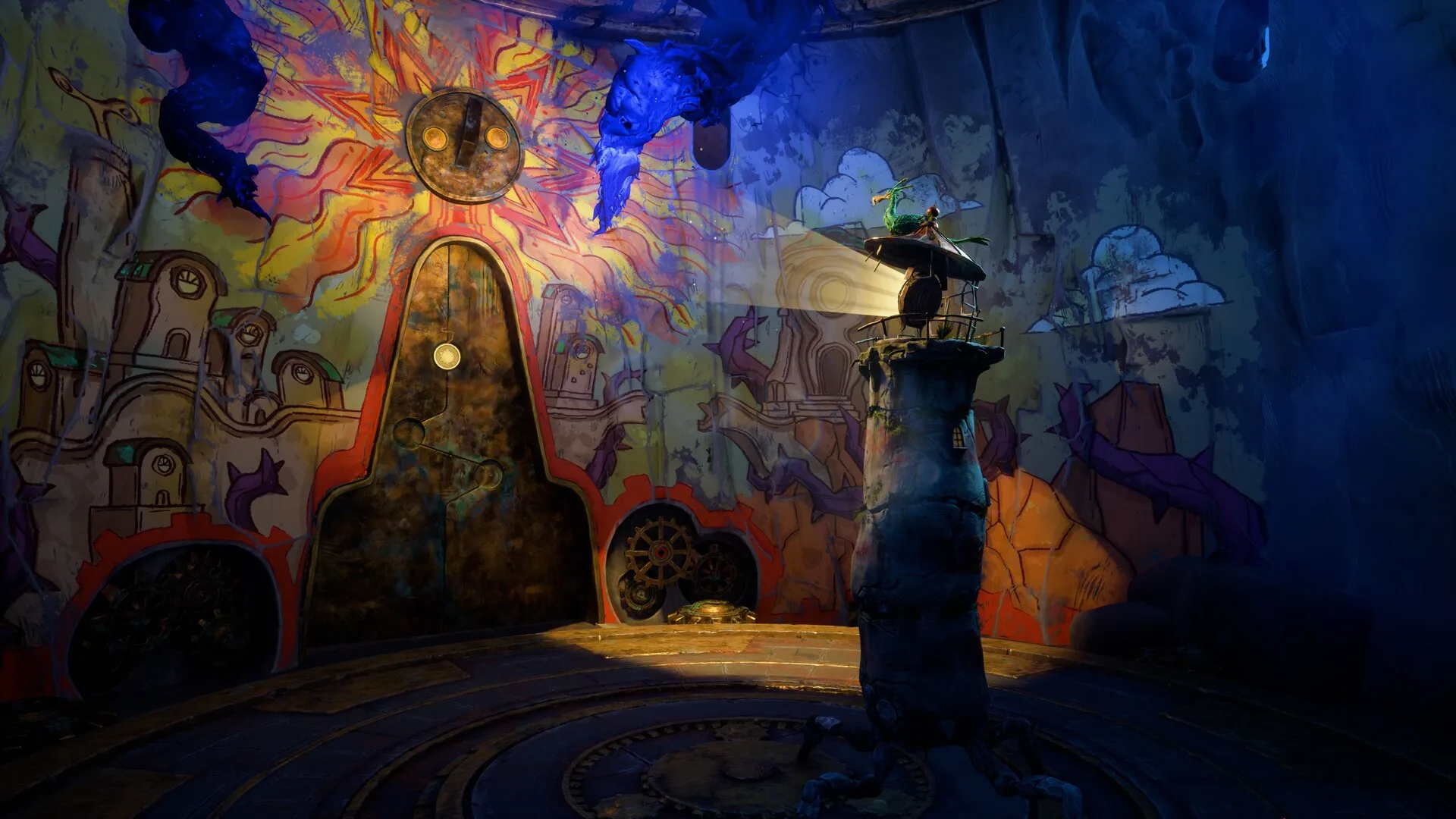
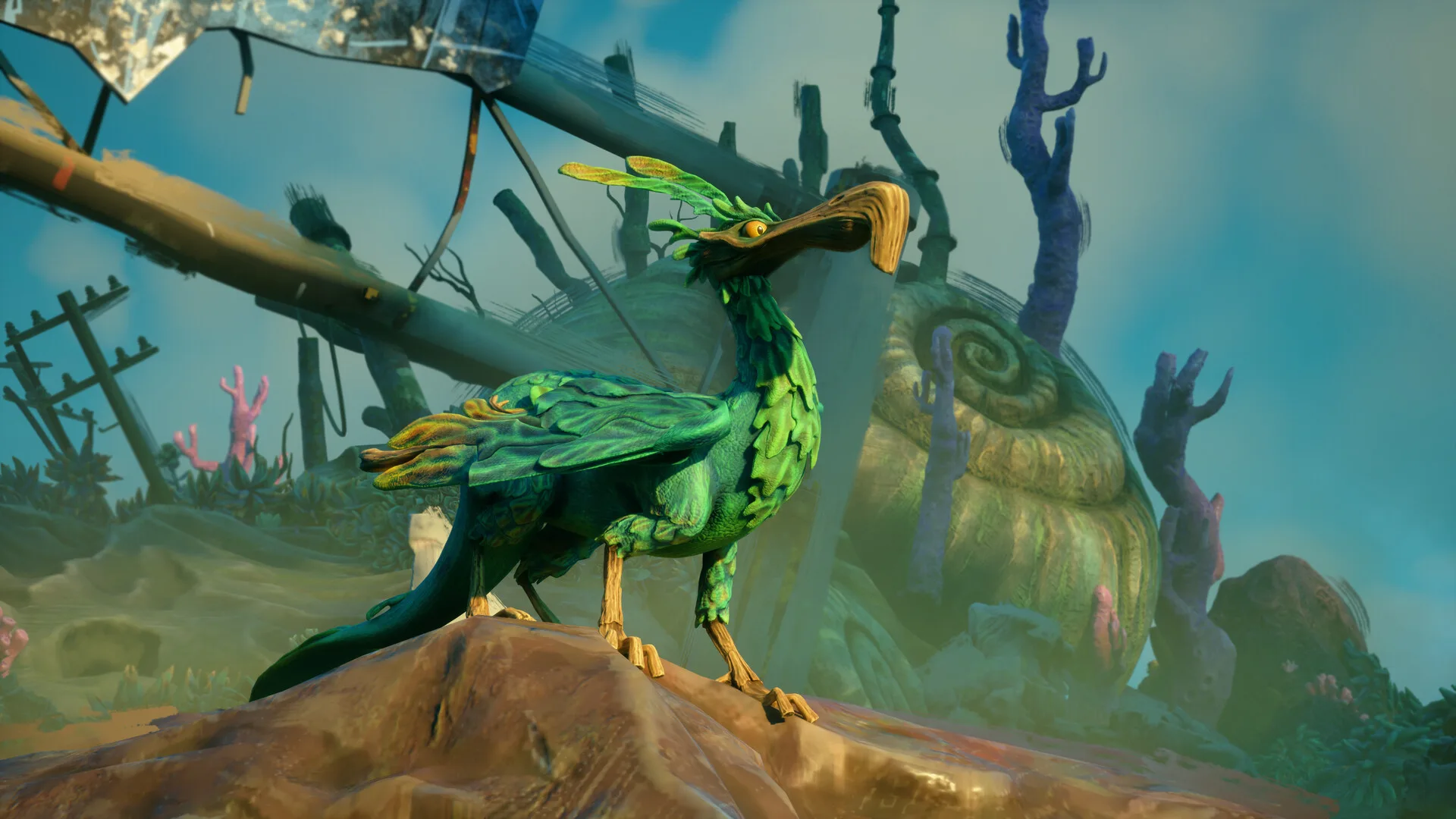
The visual presentation is the most striking achievement. Keeper uses a painterly surface treatment with thick brushstroke textures and an oil-paint overlay that gives environments a handcrafted feel. Character bodies read like clay figures enhanced by contemporary shading, which gives designs depth while keeping them whimsical and slightly alien. The lighthouse moves with expressive weight, its frame heaving and balancing on precarious legs. Twig communicates intent through precise gestures and head tilts, generating personality without words.
Environmental variety pushes the visual language across distinct biomes. The journey begins on a desolate coastline strewn with broken highways and abandoned houses, the camera pulling back to show waves against bleak shores beneath green-grey skies. From there the island transforms repeatedly. The Pollen Fields burst with cotton-candy vegetation and cliff faces that appear as if dragged by a thumb through wet paint.
Horologe presents a steampunk-tinged cityscape with Grecian echoes where machinery stands overgrown. Coral areas dissolve into fungal forests, twilight caverns open onto red rock clifftops with ocean vistas, and transitions occur without interruption. Color shifts mark new territories and guide progression through visual signals rather than interface prompts.
A fixed camera framework supports the cinematic aim. Shots are composed deliberately, often set to stress the island’s scale or the organic beauty of its ecosystems. Framing recalls classic fixed-camera design while maximizing spectacle, whether pulling back to silhouette the lighthouse against a pale sun or sweeping to reveal massive skittering creatures. The island’s layout can feel maze-like; the summit remains visible at the frame’s edge and teases proximity without becoming reachable.
Creature design reinforces an internally consistent ecology. Multi-eyed whales call through cloud-pierced peaks. Rocks push up stick-like legs and scuttle around bioluminescent pools. Cylindrical dragons wear coats like woven quilts. Fuzzy worm-birds dart through cerulean grass and take shelter in stone hollows. Tendriled life drifts on the breeze. Each creature responds to presence with small animations, making the world feel continuously reactive to light. These forms avoid simplistic cuteness while asserting their own biological logic.
Sound as a Silent Language
David Earl’s score forms the emotional backbone for Keeper’s wordless storytelling. His compositions balance twinkling, dream-like passages with undercurrents of unease, producing soundscapes that feel calming and slightly threatening at once. The music adapts as the player moves between regions, moving from jaunty percussion in some moments to swooning synth passages in others, building toward cacophonous bells or driving electronic rhythms as intensity rises. That evolution keeps the score present in every locale instead of letting it recede into the background.
Ambient effects and mechanical sounds fill the narrative space left by absent dialogue. Twig’s chirps punctuate discovery and alarm. The lighthouse groans and creaks, mechanical noises conveying mass and age. Environmental layers add texture: burbling pools, swaying grass, wind moving through strange foliage. These elements give the protagonists distinct personalities without words. Small audio cues repeated in context form a grammar that tracks the relationship between lighthouse and bird across play sessions.
The absence of HUD elements extends immersion through minimalism. No health meters, objective markers, or resource counters crowd the screen. Progression is taught through environmental and audio cues, training players to read the world rather than an interface. This design keeps attention on landscapes and inhabitant behavior and uses visual and auditory design to indicate objectives.
Mechanics That Prioritize Flow Over Challenge
Keeper’s systems begin simply and layer over time. Your primary tool is a lighthouse beam controlled by the right analog stick while movement remains separate. The beam can shine broadly to influence nearby nature or focus sharply to trigger interactions like restoring ancient machinery or detonating organic masses. Keeper lets you use physical momentum to charge through obstacles and lever the lighthouse’s weight to knock down barriers. When fine interaction is required, you send Twig to pull levers, turn cranks, or sit on pressure plates before summoning the bird back.
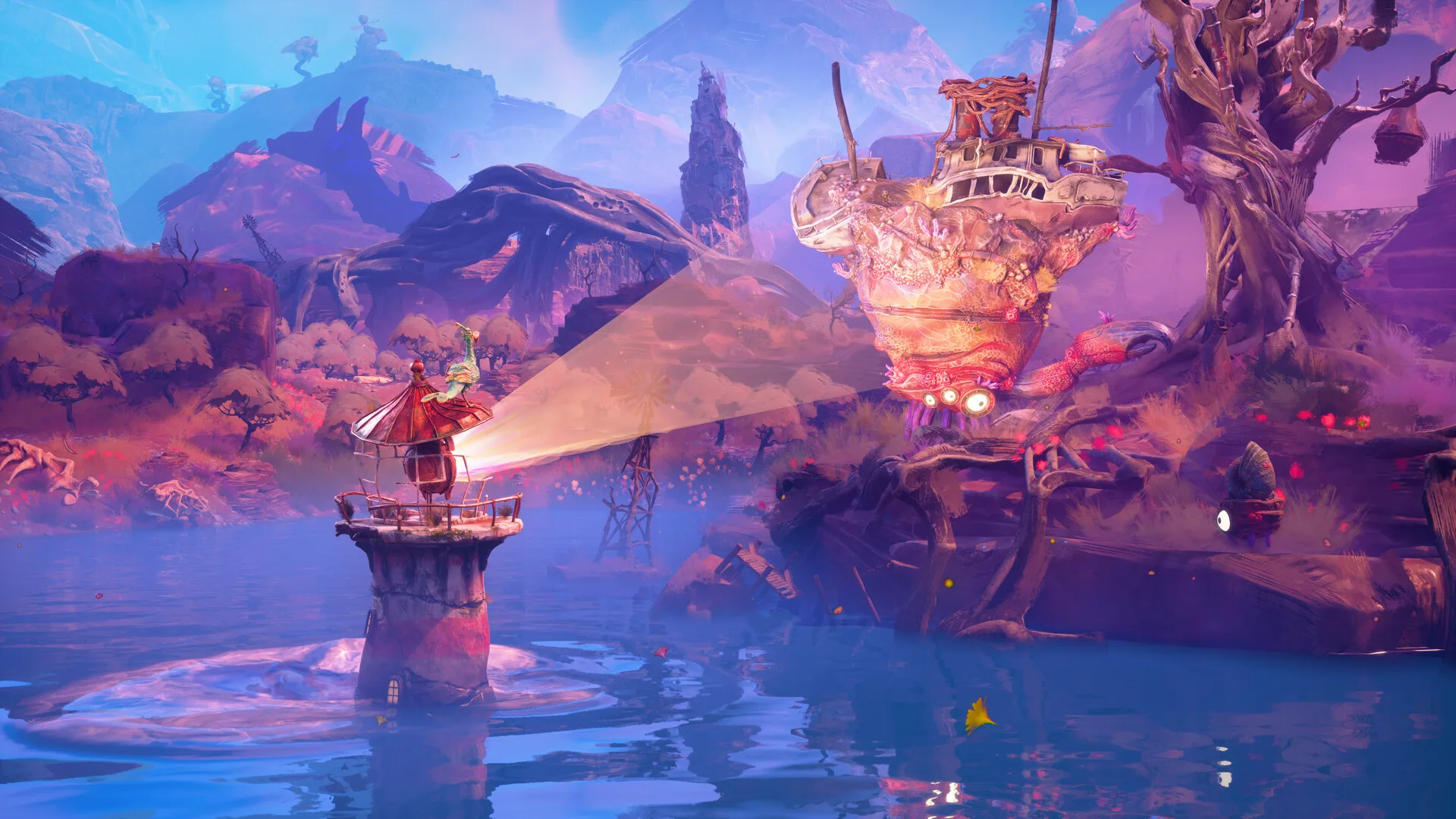
Early puzzle design is heavily signposted with straightforward solutions. Initial tasks often involve growing vine bridges by illuminating specific plants or scaring creatures into dropping items. The game makes solutions clear, frequently placing an obvious interactable in each space. Optional tutorial prompts can be toggled off and reinforce mechanics so that players rarely become stuck. This accessibility approach values forward momentum and reduces stoppages.
Complexity builds as additional mechanics layer onto the core. Time-manipulation totems let you rewind or fast-forward parts of the environment, briefly turning Twig into a ghost that phases through barriers or an egg that can weigh pressure plates. Levitation sections later retool Keeper into a lighter platforming mode where you drift past waterfalls and floating fauna. These abilities are introduced through environments that justify their use and feel woven into world-building.
The difficulty curve remains gentle. Most puzzles reduce to selecting the correct object to interact with, at times chaining a few steps together. A waterfall sequence might require tracking hidden levers, using the beam to detonate neural-like nodes, lowering platforms, and growing alien flora, but each step flows into the next without prolonged trial-and-error. Players who seek intricate, lateral puzzles will find the title light on that front.
Movement acts as a through-line for the systems. The opening hours emphasize awkward, tottering steps that demand careful balance and invite face-plants while learning the lighthouse’s weighted physics. Those early stumbles ease into surer strides, then faster dashes and expansive jumps. Later levitation introduces gentle glides. Final sequences change propulsion mechanics dramatically and alter how traversal feels at a mechanical level, preserving surprises that are best experienced directly. That evolution uses locomotion to echo themes of adaptation and belonging, making movement itself a narrative device.
Pacing issues interrupt the progression rhythm at times. Keeper divides into four acts with wildly differing lengths, and certain mechanics linger beyond their most interesting window before disappearing. Slow base movement makes backtracking tedious, especially in a middle section where the camera opens and navigation becomes less linear. Early routes stay narrow and directive, offering little space for exploration. When the game eventually opens, the sudden freedom can feel disorienting and leave players unsure where to probe next. The final roughly forty-five minutes provide kinetic set pieces and vivid spectacle that reward the patience required to reach them.
Stories Told Without Words
Narrative scaffolding is deliberately spare. The lighthouse awakens, rescues Twig from darkness, and the two set out to purge the island as they climb to a mysterious summit. The setup follows a restoration pattern familiar to many indie offerings where corrupted worlds regain light and life through player action. Keeper avoids surprise turns and plays its emotional beats in a predictable pattern for players versed in that storytelling template.
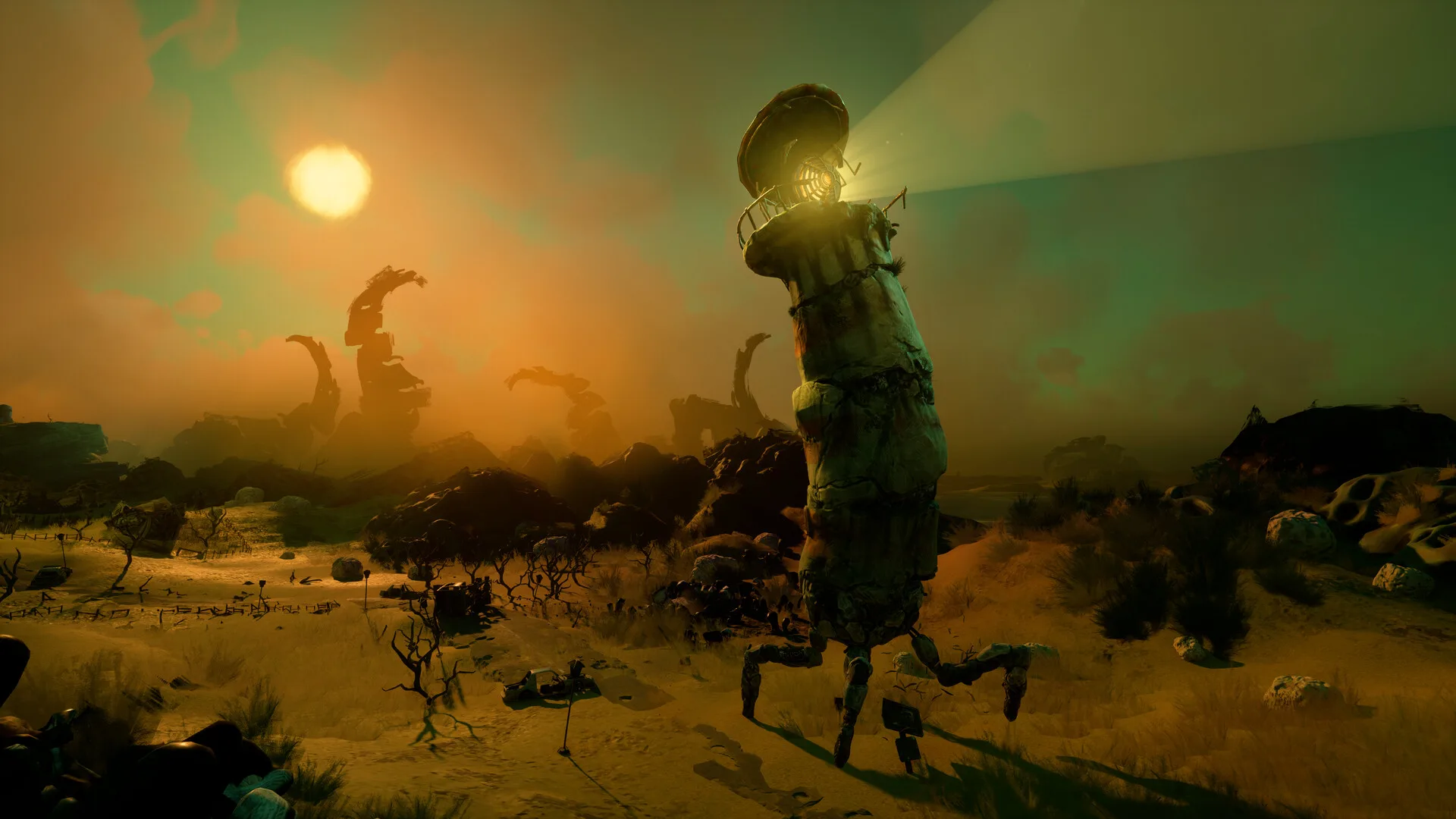
Visual storytelling carries narrative weight. Crumpled homes and rewilded urban spaces imply vanished civilizations. Environmental artifacts and scattered lore offer context, with achievement descriptions supplying extra detail for players who find hidden statues off the main route. Cutscenes use only animation and framing, trusting players to draw meaning from gesture. The absence of explicit explanation invites personal reading of events and imagery.
Thematic material focuses on tension between engineered structures and natural growth. The lighthouse functions as human engineering adapting to organic terrain, acquiring legs and learning to traverse spaces for which it was not designed. Twig embodies resilience, a small creature persisting where others were consumed. Their partnership examines mutual reliance and emergent symbiosis, two unlike entities finding shared purpose. Broader threads touch on isolation, connection, evolution, and the struggle to persist against encroaching darkness. The game leaves concrete answers unsupplied and invites projection onto ambiguous imagery.
Emotional impact depends on investment in the lighthouse-Twig rapport. With no dialogue, their bond grows through proximity and cooperative action, and small collaborative moments accumulate into something affecting by the closing hours. The lack of exposition means the game shows why the friendship matters rather than explaining it. For some players that approach creates a strong emotional pull. For others, the familiar story beats and thematic territory may feel safe and leave less of a lasting impression.
Control Schemes and Technical Execution
Movement controls model the character’s ungainly physicality, in ways that cut both ways. Locomotion feels weighted and clumsy; each step communicates actual mass and makes the character challenging to pilot in tight spaces. That intentional friction produces a productive tension between player intent and in-game capability, especially where the lighthouse’s bulk complicates traversal.
Acceptance of that friction depends on tolerance for deliberately cumbersome controls. With time the motions become more intuitive, although the fundamental heaviness persists.
The fixed camera sometimes interferes with gameplay. In open spaces the camera switches between angles, occasionally hiding key objects or complicating distance assessment for platforming. The right stick’s assignment to beam aiming removes manual camera control and obliges players to work within the game’s framing choices. This trade-off privileges cinematic presentation and accepts some functional compromise to preserve visual spectacle.
Technical performance is steady. Transitions between areas remain seamless and avoid loading interruptions. Visual fidelity holds consistently through the roughly five-hour run time, with effects and detail maintained at a high level.
What Keeper Offers and What It Withholds
Keeper targets players who prize artistry and atmosphere over dense mechanical systems. For those who treat games as sensory environments first and interactive mechanics second, the game provides a vivid tour through alien landscapes supported by an expressive score. Fans of experimental indie projects that emphasize visual ambition will recognize Double Fine’s confidence and distinct vision. The contemplative pacing and low-stress puzzles suit relaxed sessions where the goal is presence rather than challenge.
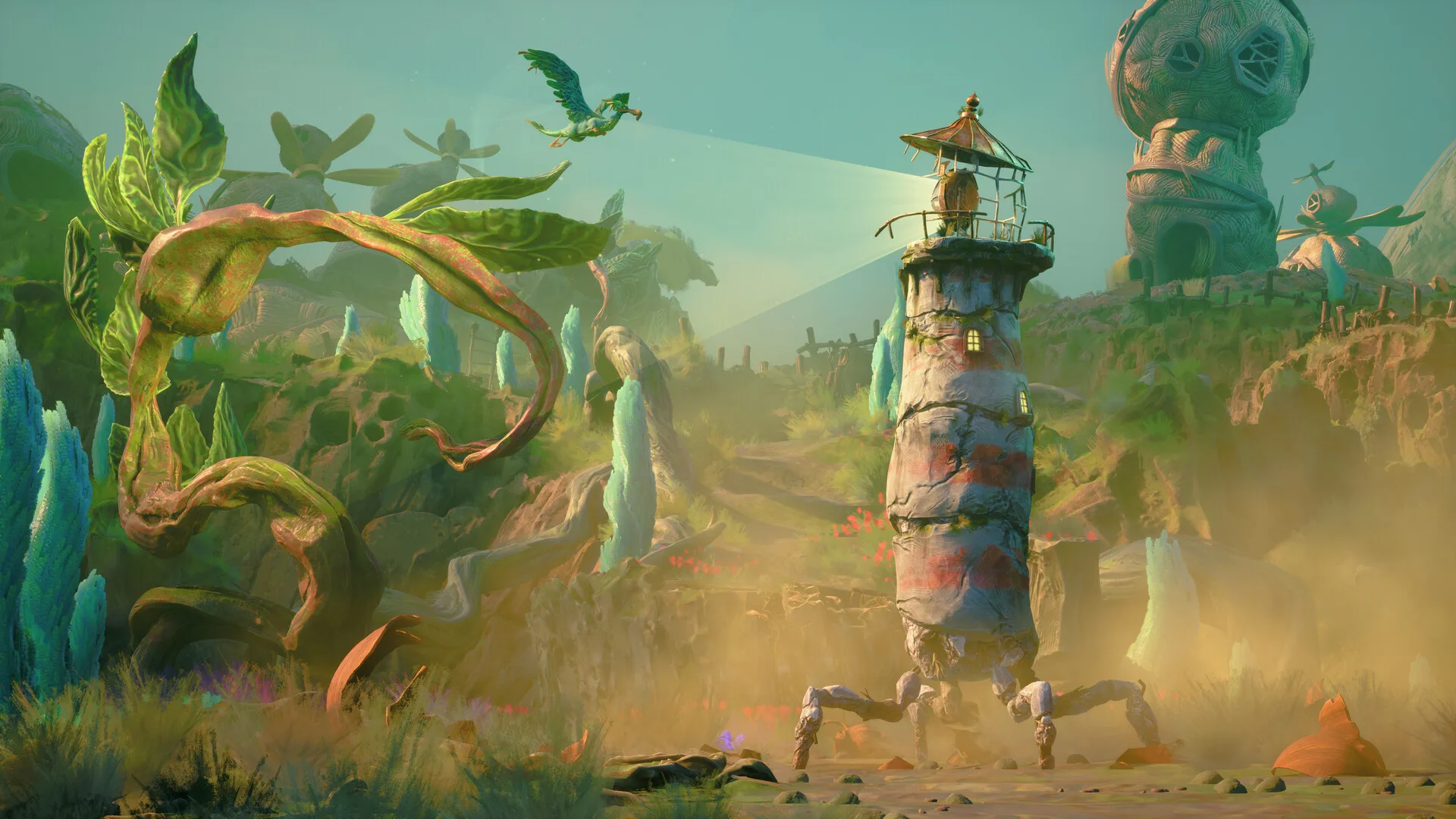
Players seeking demanding puzzles will find Keeper light. Clear solutions and heavy signposting simplify mental engagement and reduce puzzle-solving to locating obvious interactables. Those after deep mechanical complexity or tight, gameplay-first design will likely prefer other options. Slow movement and uneven pacing test patience, particularly during early restrictive hours before the game settles into a more fluid rhythm. Players who want explicit narrative closure will find the game keeps its meanings open.
Double Fine’s creative certainty shows in Keeper’s adherence to its own parameters. The studio commits to an artistic vision that frames the experience as an interactive tone poem wrapped inside a puzzle platformer shell. The approach polarizes by intent. Keeper asks you to accept slow movement and simple puzzles in exchange for striking visuals and subtle emotional accumulation. The closing sequences deliver kinetic payoff and psychedelic spectacle that validate the patience required to arrive there.
As a sensory work, Keeper performs impressively. The visuals alone will compel players who view game spaces as art. The lighthouse and bird relationship, conveyed through motion and sound, reaches genuine affect despite its simplicity. Whether those strengths outweigh mechanical limits depends on what each player prizes in interactive media.
Keeper knows its shape: a beautiful, strange, patient examination of movement and companionship framed in surreal imagery. It refuses to apologize for centering wonder over difficulty and atmosphere over dense systems. For the audience aligned with that intent, the outcome is exceptional. For others, Keeper will remain a gorgeous experience best appreciated while relinquishing control of the stick.
Keeper is a surreal, atmospheric puzzle adventure game developed by Double Fine Productions and published by Xbox Game Studios. The game is a unique, wordless story following a long-forgotten lighthouse that awakens and becomes ambulatory, embarking on an unexpected journey with a spirited seabird companion named Twig. Set on a post-human island, the game features third-person exploration and environmental puzzle-solving, with a focus on discovery and a visually striking, painterly world inspired by surrealist artists like Salvador Dalí. It is characterized by its quiet, emotional narrative about companionship and metamorphosis. Keeper was released on October 17, 2025, and is available to play on PC (Steam and Microsoft Store) and Xbox Series X|S.
Full Credits
Director (Creative/Game Director): Lee Petty
Writers (Lead Writer/Narrative Designer): Lee Petty (Creative Lead for a story told without words)
Producers/Studio Leadership (Producers, Executive Producers, and Key Studio Heads): Tim Schafer, Caroline Esmurdoc, Greg Rice
Art Director/Lead Artist: Lee Petty (Creative Lead and artistic visionary)
Developer, Publisher: Double Fine Productions, Xbox Game Studios
Release Date: October 17, 2025
The Review
Keeper
Keeper is a visual masterpiece that sacrifices mechanical depth for atmospheric immersion. Double Fine crafts a stunning, surreal world where every frame deserves admiration, supported by an evocative score and wordless storytelling that trusts players to find their own meaning. The simple puzzles and deliberate pacing will frustrate those seeking challenge, but players who value artistry and contemplative exploration will discover something special. It's a game that knows exactly what it wants to be, succeeding brilliantly as sensory experience while accepting its limitations as interactive entertainment.
PROS
- Breathtaking visual design with painterly, brushstroke aesthetic
- Exceptional soundtrack that enhances atmosphere perfectly
- Expressive animation brings personality to silent protagonists
- Seamless environmental transitions without loading screens
- Strong final sequences deliver kinetic spectacle
CONS
- Overly simple puzzle design lacks challenge
- Clunky movement controls can frustrate
- Uneven pacing with restrictive early hours
- Fixed camera occasionally obstructs gameplay