







Rhayne Vermette’s second feature, Levers, treats cinema as an instrument for sensing rather than storytelling, a dense and mesmerizing study in deliberate opacity. The film unfolds in the snow-blind dark of Ste. Anne, Manitoba, after an apocalyptic blast removes the sun for twenty-four hours. Day collapses into a brooding night with a faint scriptural charge.
The French title, Levers, meaning Sunrises, states a guiding idea with stark simplicity: a search for light and a chance to begin again within an abyss. Vermette invites the viewer into a cryptic atmosphere where exposition dissolves, and the screen becomes a site for inquiry. The result feels like a memory summoned by many minds at once, a ceremony for looking and listening rather than a chain of plot points.
Tactility and the Language of Damage
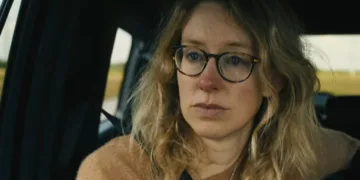
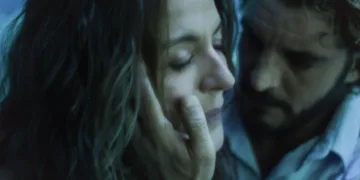
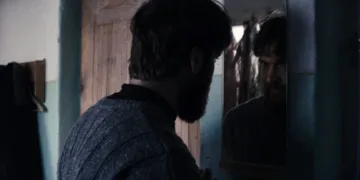
Form and texture define the experience. Vermette builds the film with older formats and broken Bolex cameras, embracing wounded tools that stamp each image with abrasion. The footage arrives with grain and roughness, a palpable surface of deep gloom interrupted by scant illumination.

The low-resolution image rejects sterile polish and pulls the frame closer to the hand. Structure follows the same impulse. Levers arranges itself as out-of-order vignettes, each cued by hand-drawn tarot cards. The cards whisper of design and fate without yielding a key.
The rhythm feels like a waking dream, or like memory scattering across ice. Sound holds this strangeness in place. Echoing bangs, cannon or gunshot, open cavities in the track and suggest histories that have not ended. The acoustics behave like a second image and invite the body to listen for the wound rather than the answer.
The Philosophy of Enigma
Levers commits to ambiguity as an ethical stance. The film refuses the comfort of a solved riddle and studies the impulse to demand clarity. A civil servant pores over security footage. A grieving sculptor searches for bearings. Their work mirrors the audience’s own effort to understand. Knowledge is pursued and recedes in the same breath, a cycle that becomes the film’s philosophical weight.
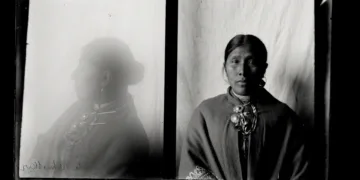
Vermette places this inquiry within her Métis worldview and a haunted prairie geography. Images carry an ancestral charge. The infinity symbol of the Métis Nation moves through a procession. Nuns gather the tears of an Indigenous woman. Such emblems do not decode the plot.
They speak of colonial history and cultural erasure, and they braid the vanished sun to an older, inherited injury. The film asks for attention to motifs of moon, stone, and river and invites meaning without a promise of finality. Opacity becomes method and ethic, a way to think and to feel at the same time.
The Auteur’s Demand
A vision this exact calls for patience from the viewer. The pacing lingers. The structure spins and returns. Instant payoff never arrives. The film asks for surrender to disorientation and rewards that surrender with an eerie spell that persists after the lights return. Vermette works as an unapologetic auteur with a steadfast devotion to non-traditional form.
What some call stiffness reads here as rigor, a fixed alignment between means and aim. Levers faces an unknown future and tries to steady the present by stepping outside the habits of narrative expectation. The images hold, then echo. They mark the mind with a cold shine and leave behind a work of conceptual precision that honors ambiguity and treats cinematic enchantment as a serious philosophical act.
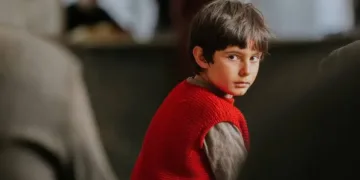
Levers is an experimental drama film from Canadian Métis filmmaker Rhayne Vermette. The film had its World Premiere at the Toronto International Film Festival (TIFF) on September 5, 2025. It centers on a small town in Manitoba whose residents are confronted by mysterious events after a loud bang causes the sun to disappear for a day, just as a community sculpture is about to be unveiled. Shot on grainy 16mm film using broken Bolex cameras, the narrative is told episodically in 22 chapters inspired by the major arcana of a tarot deck. The film screened at the New York Film Festival (NYFF) and Vancouver International Film Festival (VIFF) in Fall 2025. As of October 2025, it is available for viewing at select film festivals and art house cinemas, such as the ICA in the UK.
Credits
Director: Rhayne Vermette
Writers: Rhayne Vermette
Producers and Executive Producers: Rhayne Vermette, Oliver King, Charlene Moore
Cast: Val Vint, Andrina Turenne, Will George, Annie Beach, Daina Leitold, Darryl Nepinak, Robert Pellerin, Ryan Steel
Director of Photography (Cinematographer): Rhayne Vermette, Ryan Steel, Heidi Phillips, Kristiane Church
Composer: Bret Parenteau
The Review
Levers
Levers is a formidable confrontation with cinematic convention. Rhayne Vermette's tactile darkness explores cultural trauma and existential ambiguity. The film demands patience, but it rewards the viewer with mesmerizing, unforgettable imagery. This is a profound, anti-narrative work committed to the unknown, offering challenging art rather than easy comfort. Its refusal of easy legibility forces a rewarding philosophical engagement.
PROS
- A fully realized and distinct experimental style.
- Effective use of broken analog formats to create textured, moody visuals.
- Explores existential despair and Métis cultural resilience.
- A complex soundscape that punctuates and deepens the darkness.
- Forces profound philosophical reflection on meaning and trauma.
CONS
- Actively resists conventional narrative structure.
- Slow pace and fragmented scenes require deep viewer patience.
- Emotional connection is often sacrificed for atmosphere.
- Will not appeal to viewers seeking traditional plot resolution.
- Prioritizes sensory immersion over logical coherence.