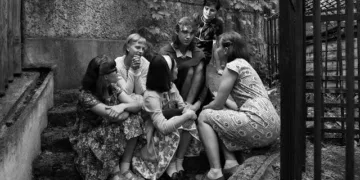
















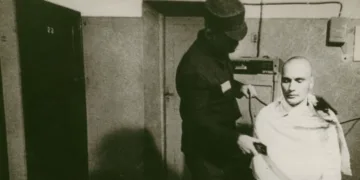









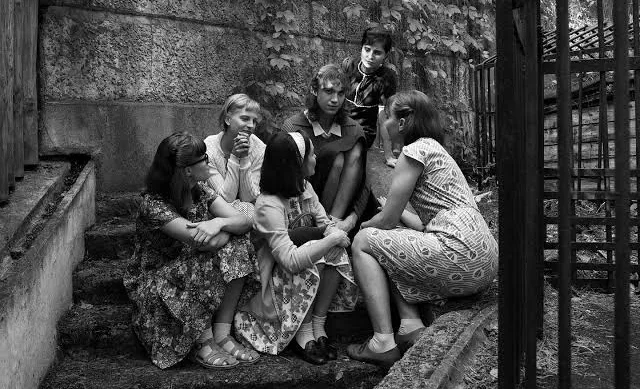

Ulya looks at a legend before history has finished shaping her into one. Viesturs Kairišs’ black-and-white biographical drama follows Ulyana Semjonova in her early years, long before the medals and records could harden into myth. The film finds her in rural eastern Latvia, living among an Old Believer family, working the farm, and carrying a body that everyone else seems to notice before she does.
Her height becomes a public fact, almost a village possession. Strangers stare. Family members worry. Coaches from Riga see possibility, perhaps even destiny. Ulya herself seems less certain. Basketball enters her life as an opportunity built from discomfort, a door opened by the same trait that has made ordinary existence feel like a trial.
Kairišs resists the bright grammar of the sports film. This is no clean march toward glory. Ulya is colder, stranger, and sadder, fascinated by the violence of being observed. Its finest moments understand that alienation can become a climate. Its weaker ones mistake silence for depth.
The Shape of Exile
The story follows a clear path: Ulya leaves the farm, joins an elite women’s basketball team in Riga, struggles with the sport, faces suspicion and mockery, retreats toward home, then begins to understand that home cannot protect her from being reduced to her body. The arc is familiar, yet the film treats it with an austere spiritual gravity, as if athletic training were a form of reluctant self-possession.
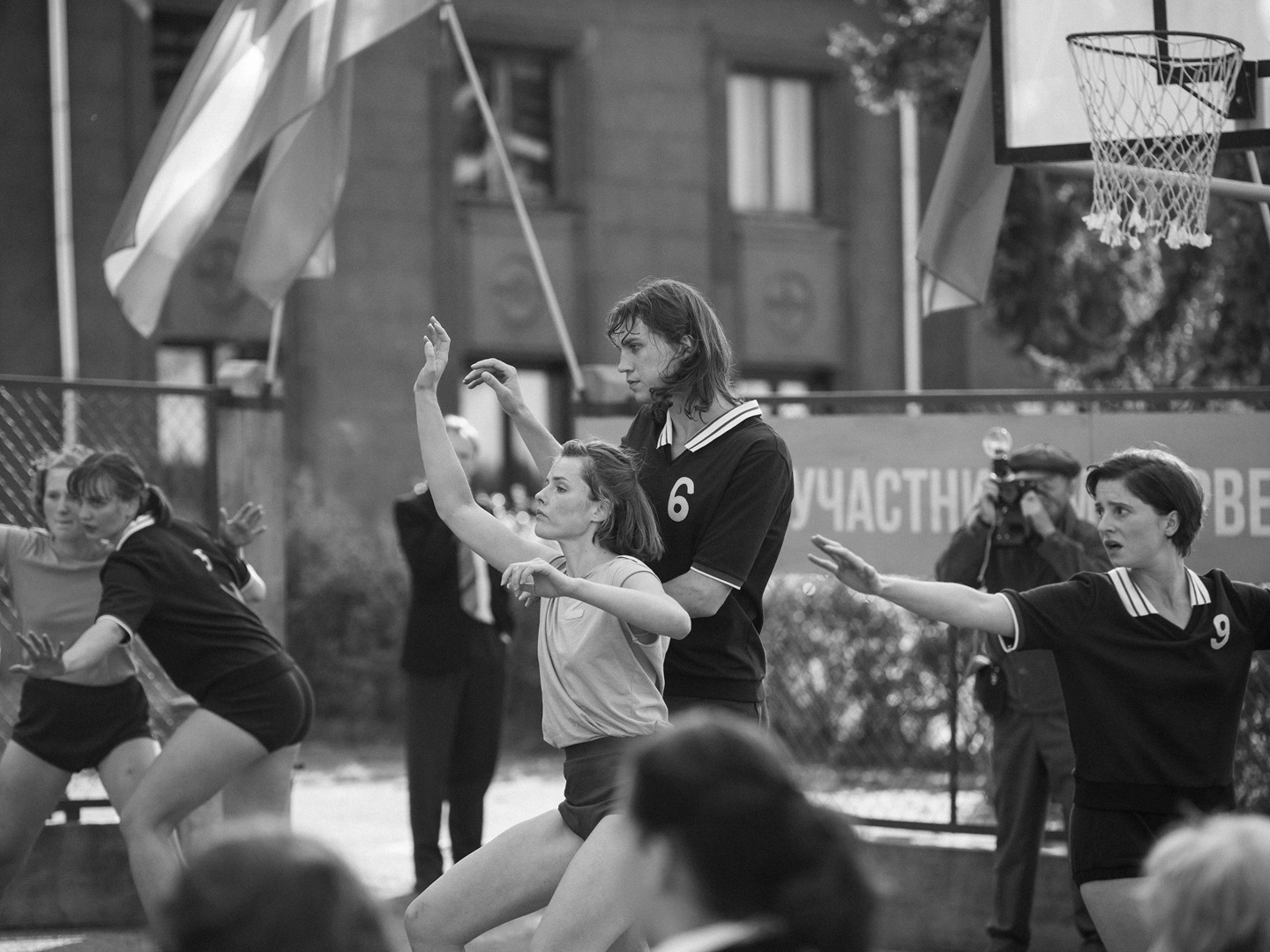
Ulya’s tragedy is not height alone. It is the fact that her height belongs to everyone before it belongs to her. Coaches imagine victories. Teammates see favoritism. Authorities see a body to inspect. Her family sees uncertainty, perhaps shame, perhaps fear. She is passed from one gaze to another, and the film keeps returning to that existential wound: what remains of the self when the world keeps naming you from the outside?
The screenplay is less persuasive when it asks Ulya to remain nearly mute through too much of this process. Her quietness has purpose, and shyness can be cinematic. Still, the film sometimes leaves her interior life sealed behind its own solemnity. She feels pain, confusion, and longing, yet specificity arrives only in fragments.
Her return home is one of the sharper narrative turns. The village no longer feels like refuge. Riga may be cruel, but the countryside has its own cages. Basketball then becomes a paradox: a system that objectifies her and a discipline through which she might finally claim motion.
Black-and-White as Burden
The film’s most powerful language is visual. Wojciech Staroń’s cinematography gives Ulya a rough, damp beauty, the kind that seems carved from soil, fog, and old wood. The rural passages feel close to folklore. Ulya is framed as a figure belonging to nature and yet estranged from it, too visible to disappear, too inward to become spectacle willingly.
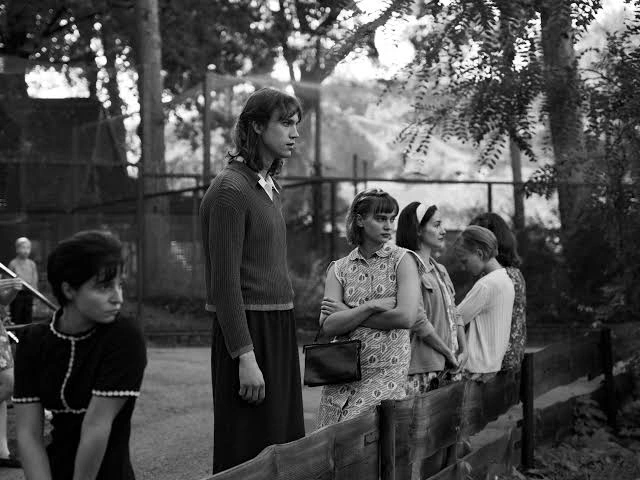
The black-and-white images carry a harsh tenderness. Faces appear worn by weather. Interiors feel airless. Fields and barns possess a ritual quality, hinting at a world where bodies are measured by labor, usefulness, and endurance. In that setting, Ulya’s body becomes another site of expectation, another animal strength to be claimed by others.
Riga changes the texture. The city does not free her. It sharpens the loneliness. Blurred images and fractured framing turn urban life into a place of dislocation, where Ulya seems constantly out of focus within her own experience. The mournful soundscape presses heavily on the film, sometimes beautifully, sometimes with a severity that drains oxygen from scenes that might have benefited from brief warmth.
The giraffe image is direct, maybe too direct, yet it works as a bleak visual rhyme. Captivity recognizes captivity. The basketball court, meanwhile, becomes the film’s central symbolic chamber: a place where Ulya is reduced to size, then slowly learns how size might become movement, rhythm, will.
Performance, Sport, and the Limits of Sorrow
Kārlis Arnolds Avots’ performance is central to the film’s risk and its unease. He approaches Ulya with evident seriousness, shaping her through stooped posture, guarded glances, and a body that seems to apologize for occupying space. There is real feeling in the performance, especially in moments where humiliation passes across the face before language can protect her.
Yet the portrayal often remains external. The physical work is precise, sometimes painfully so, but Ulya’s inner weather does not always gather force. The film wants to argue that society fails to see the person beneath the body, then risks repeating that failure by making the body the dominant text. Avots conveys anguish, but the character’s private thoughts remain faint.
The supporting figures deepen this issue. Parents, coaches, and teammates often behave less like lived-in people than dramatic pressures arranged around Ulya. They push, doubt, ridicule, soften, or instruct. Few seem to possess a life outside their function in her story.
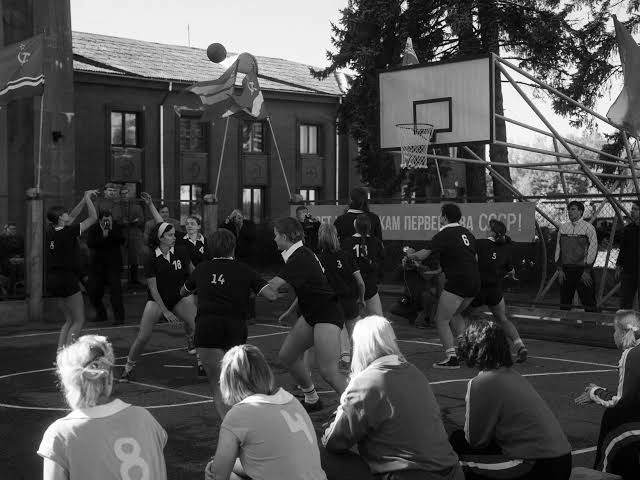
The basketball scenes are also uneven. Kairišs avoids the usual rush of sports editing, keeping attention on Ulya’s perception rather than the scoreboard. That choice has integrity. Yet the games lack rhythm and physical conviction, which weakens the very arena where Ulya’s transformation should become visible. The film’s images linger. Its sorrow stains. Its drama, however, does not always rise to meet the force of its gaze.
Ulya is a visually striking historical character drama that celebrated its world premiere at the 79th Cannes Film Festival on May 21, 2026, where it screened in the prestigious Un Certain Regard competition. Shot in a poetic, textured black-and-white grain, the narrative is inspired by the formative years of legendary Latvian athlete Ulyana Semyonova, one of the most celebrated figures in women’s basketball history. Set in late 1960s Soviet Latvia, the story follows a towering teenager from a remote rural family whose unusual height marks her as an extreme outsider until basketball talent opens a path to the city of Riga. Audiences can follow its run through premier international festivals ahead of its upcoming theatrical rollouts across Europe later this autumn.
Full Credits
Title: Ulya
Distributor: Destiny Films, Ego Media
Release date: May 21, 2026
Running time: 102 minutes
Director: Viesturs Kairišs
Writers: Kārlis Arnolds Avots, Līvija Ulmane, Andris Feldmanis, Viesturs Kairišs
Producers and Executive Producers: Guntis Trekteris, Pille Rünk, Małgorzata Staroń, Ieva Norvilienė
Cast: Kārlis Arnolds Avots, Chulpan Khamatova, Aleksas Kazanavičius, Artūrs Krūzkops, Alise Dzene, Dārta Cīrule, Madara Viļčuka, Varvara Čekhs
Director of Photography (Cinematographer): Wojtek Staroń
Editors: Armands Začs
Composer: Siim Skylas
The Review
Ulya
Ulya is a visually arresting biopic shaped by sorrow, silence, and the burden of being seen too narrowly. Its black-and-white imagery gives Ulyana Semjonova’s early life a haunting force, and its study of alienation carries real philosophical weight. Yet the writing often keeps her inner self at a distance, while the basketball scenes lack the energy needed to make her transformation fully land.
PROS
- Striking black-and-white cinematography
- Strong sense of alienation and existential unease
- Thoughtful focus on the body as social burden
- Sincere lead performance with moments of pain and restraint
CONS
- Ulya’s inner life feels underdeveloped
- Supporting characters are thinly written
- Basketball scenes lack rhythm and credibility
- Heavy tone sometimes smothers emotional variation







