










![Kingdom Hearts Collection [I-III] Review](https://gazettely.com/wp-content/uploads/2026/10/Kingdom-Hearts-Collection-I-III-1-360x180.webp "Kingdom Hearts Collection [I-III] Review: KHII Holds Steady as Newer Entries Fluctuate 33")






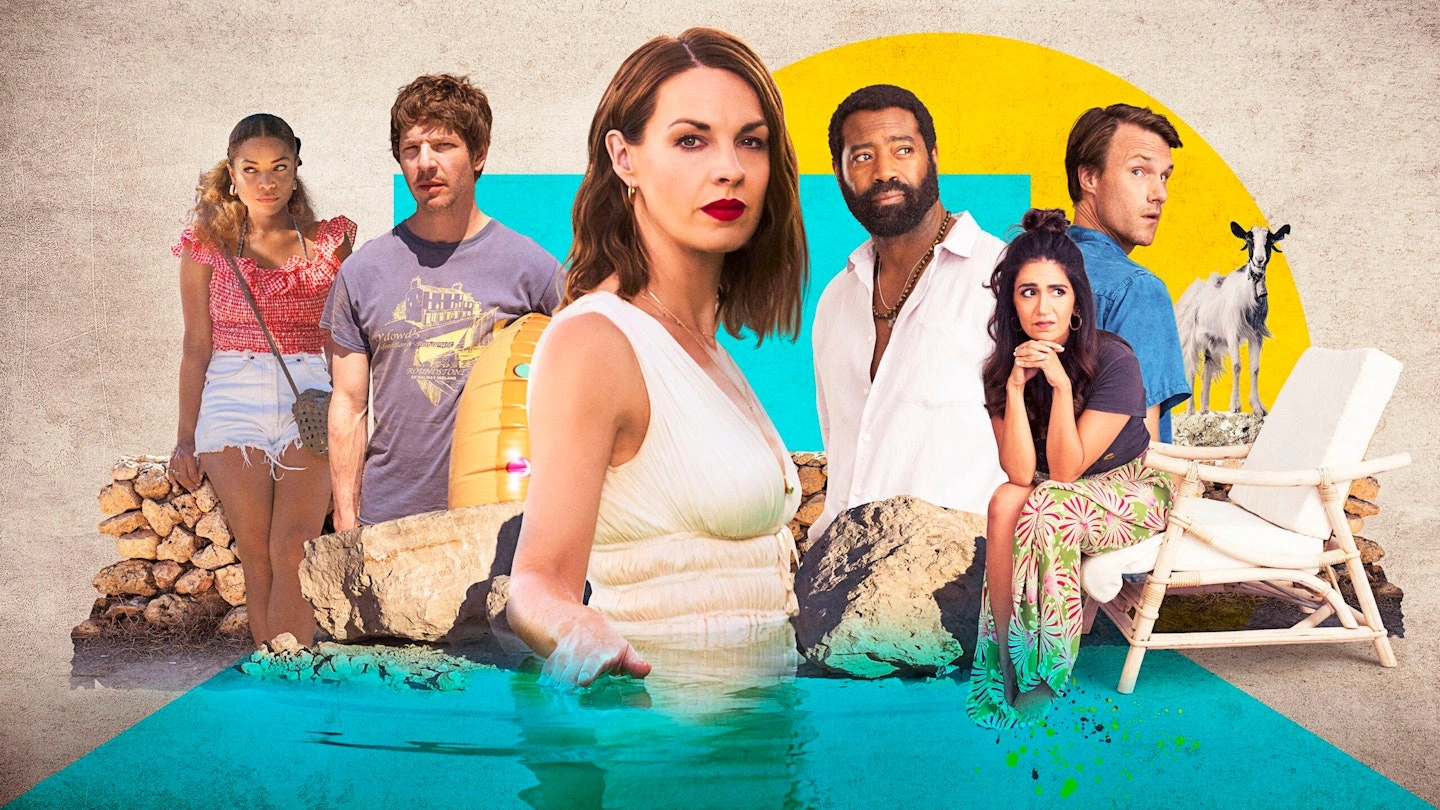

The eight-part BBC comedy-drama Two Weeks in August, available in full on BBC iPlayer, takes a familiar streaming premise and drains away the fantasy of sunlit escape. Written by Catherine Shepherd and directed through the collaborative work of Tom George and Matthew Moore, each tight 45-minute episode cuts into the brittle self-image of the modern professional class. Four old university friends arrive at a breathtaking villa on a remote Greek island with partners, children, and a hired nanny for a fortnight’s summer holiday.
The setting promises ease, then turns into a social pressure chamber where distance from home offers no emotional clarity. The group meets awkwardness, money panic, rivalry, and old resentment in place of relaxation. Shepherd rejects grand mystery machinery and finds dread in domestic expectation, long friendship, and the quiet debts people keep asking others to pay.
Performative Progressivism and Villa Politics
Zoe, played with careful restraint by Jessica Raine, carries much of the series’ moral and emotional weight. Her husband Dan, played by Damien Molony, brings severe, unspoken depression into every shared room, his sour irritability flattening the holiday mood before it has any chance to breathe.
Zoe is a burnt-out comprehensive schoolteacher and lifelong appeaser, trained by habit to absorb everyone else’s needs. Their strained finances sharpen the social texture of the villa. They can barely afford the flights and their portion of the rental, and that quiet pressure exposes the class divide the group would prefer to leave unnamed.
The other guests deepen the friction through their own forms of contemporary self-interest. Solomon, an underemployed actor chasing a role in a mythological drama, treats the trip as proof that his career still has movement.
Jess, his glamorous younger second wife, claims the best bedroom and avoids both expense and effort by leaning on Zoe’s reflexive helpfulness. Solomon’s teenage daughter from a previous relationship shares the house with Léa, played by Florence Banks, a French nanny whose open laziness and refusal to do basic work turn paid care into another small social farce.
Nat, a commitment-phobic HR professional, and Jacob, desperate to preserve a fading youth, add further instability. Jacob’s uninvited dating-app hook-up, Will, arrives with a younger energy that exposes the older characters’ anxieties with almost comic efficiency. Shepherd’s satire lands hardest in the gap between language and conduct. These people speak fluently about wealth inequality and the global refugee crisis.
Their actions reveal privilege, self-absorption, and casual disregard for the working-class people sustaining their holiday. The show turns the villa into a miniature study of performative progressivism, where social justice vocabulary circulates freely while responsibility remains strangely underbooked.
The Rapid Decay of Social Civility
The tension breaks on the first night after an unexpected illicit boundary is crossed, and the group’s polite surface collapses with impressive speed. From there, the narrative moves through escalating incidents that push everyone toward emotional collapse. Infidelities and recreational narcotics sit beside practical emergencies, proving how fast comfort loses its polish once basic systems fail.
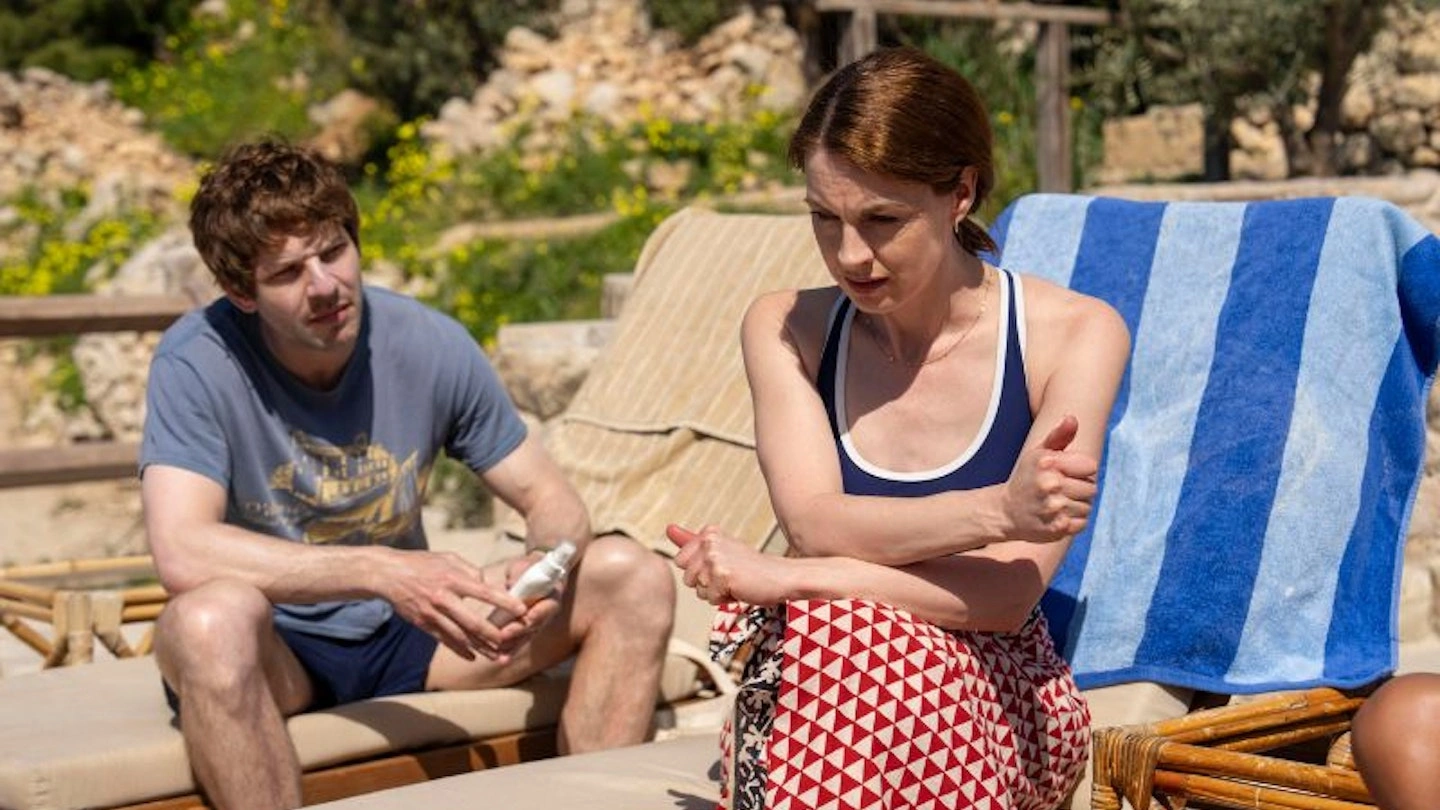
A child eats a nut, triggering a medical panic that exposes parental incompetence. A local migrant is knocked from his bike in a harrowing collision, and the guests process the event mainly as a disruption to their schedule. A rental car and a boat break down, sealing the group inside their beautiful prison.
A major mid-series set piece unfolds at a chaotic party hosted by Flick and James, unbearable expat toffs who claim they moved to the island to absorb its creative energy. The party accelerates the show’s tonal shift in its second half. Petty grievances and cringe comedy begin giving way to emotional survival, and the social satire takes on a harsher charge.
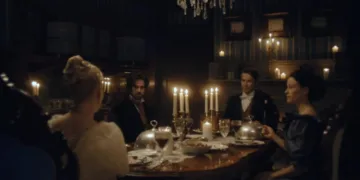
That turn reaches its clearest point during a dinner-table confrontation, where the real duration and severity of Dan’s long-term struggles come into view. The group is forced to face the damage hidden beneath its curated ease, and the series briefly finds the painful clarity its characters have spent so much energy avoiding.
Mythic Overload and Tonal Fractures
Jessica Raine anchors the series with a performance built on containment. Zoe’s move from subdued wallflower to someone who finally breaks under the strain gives the drama its strongest emotional line. Her collapse has a cathartic force because it reflects the cost of constant accommodation, especially for a woman expected to cushion every mood in the room. The series makes her refusal to keep carrying other people’s psychological baggage feel socially pointed, a small rebellion against the invisible labor that polite groups often assign to the most reliable person present.
The production stumbles with its use of Greek mythology. Zoe’s psychological unraveling is accompanied by hallucinations of three silent, ominous Fates, a device meant to give the story a timeless quality. The effect often overloads the narrative and distracts from the grounded human distress already present in the villa.
Shepherd’s script also wavers tonally between sharp ridicule of entitled navel-gazing and sincere investment in the characters’ pain. That uncertainty makes emotional commitment difficult, since the show shifts between social satire and character study without fully settling into either register.
The 45-minute structure keeps the episodes moving, and the Aegean scenery gives the series an alluring surface. The larger design can feel like a messy chain of incidents, lacking the organic force of a fully consequential story. Still, Two Weeks in August reflects a growing streaming-era pattern: prestigious international settings used to stage domestic anxiety, class discomfort, and liberal self-examination. Its uneven construction leaves viewers suspended between empathy and cynicism, which may be the most honest place for a show about people fluent in the language of justice and far less skilled at practicing it.
Two Weeks in August premiered as an eight-part psychological mystery drama on Saturday night, May 23, 2026. The series is currently available to watch in full on BBC One and the streaming platform BBC iPlayer. Shot beautifully across the coastlines of Malta and Gozo to represent a remote Greek island, the story chronicles a high-density summer holiday that devolves into a nightmare of social transgressions and moral compromise.
Full Credits
Title: Two Weeks in August
Distributor: BBC One, BBC iPlayer
Release date: May 23, 2026
Rating: TV-MA, Unrated
Running time: 45 minutes per episode
Director: Tom George, Matthew Moore
Writers: Catherine Shepherd
Producers and Executive Producers: Roberto Troni, Kat Reynolds, Catherine Shepherd, Jo McLellan
Cast: Jessica Raine, Damien Molony, Nicholas Pinnock, Antonia Thomas, Leila Farzad, Hugh Skinner, Dylan Brady, Florence Banks, Dolly Wells, Tom Goodman-Hill
Director of Photography (Cinematographer): Darrin Zammit Lupi
Editors: Jon Henson
The Review
Two Weeks in August
Two Weeks in August succeeds as an uncomfortable, razor-sharp dissection of middle-class entitlement, anchored by a phenomenal, layered performance from Jessica Raine. However, its brilliant social satire is frequently undermined by a jarring shift into melodrama and an overengineered mythological framing device that clutters the narrative. By trying to balance cynical caricature with sincere tragedy, the series loses its structural footing in the second half. It remains a compelling, highly atmospheric critique of modern relational exhaustion, even if it occasionally collapses under the weight of its own existential ambitions.
PROS
- Jessica Raine delivers a masterclass in controlled, slow-burning emotional exhaustion.
- The sharp, cringe-inducing dialogue perfectly skewers performative progressivism.
- Beautifully shot Aegean landscapes create a stark, effective contrast with the internal ugliness of the characters.
- A concise 45-minute runtime prevents early episodes from dragging.
CONS
- The inclusion of hallucinatory Greek Fates feels heavy-handed and overstuffed.
- The script suffers from tonal inconsistency, wavering between biting satire and unearned melodrama.
- A messy narrative structure treats escalating crises as a checklist rather than organic consequences.
- Most supporting characters are written as shallow, unsympathetic archetypes, making emotional investment difficult.




It wasn’t filmed in the Aegean. It was filmed in Malta. It says so at the end – it doesn’t look a bit like Greece, anyway. It’s a boring ripoff of The White Lotus with pretensions to insight.
You’re completely right on the filming location! We made sure to note the Malta and Gozo shoot in the breakdown at the end, but our review text definitely fell into calling it Aegean scenery since that’s what the production team was aiming to recreate.
Thanks for reading and sharing your take on the series!
As well as this one, a few other reviews have mentioned that the inclusion of the hallucinations of Greek figures makes it feel heavy-handed, and a few mention that it takes-on too many themes. We binge-watched the entire series last night from 11pm until the early-hours, completely transfixed. Yes there are a lot of threads; casual racism, small boats, global warming, the dark side of tourism, greek mythology woven through the piece, the idea that even in a post-me-too world women have the burden of expectation upon them (I loved the sharp throwaway line at the party where she’s asked “is he babysitting them” and she responds “I think it’s just called parenting”). But the drama doesn’t purport to resolve these themes, nor in some cases to even deal with them at all. They are just there in the backdrop. And why shouldn’t they be? They’re all-pervasive in our lives, so why write them out? It’s silly to suggest that a drama must fully address a theme if it brings it up at all. For me this was a masterpiece, I’m biased towards Catherine Shepherd as personally I find her work to be beautiful, witty, and full of depth – and so I don’t expect everyone to love it – but for me: stunning photography, witty, at times un-watchably good, deeply sad, unresolved. Unpretentious, and without cliche. Character development was super, at no point did I lose faith in the character of Zoe. I wondered if I might at some point, given how off-the-rails things became, but her character pulled through. Jessica Raine was incredible, her performance was raw and moving. The whole cast were superb and although some of their characters were a little annoying, they developed some likeable facets and some reminded me of my own friends (annoying/loveable) so it worked for me. μπράβο to the cast and the writing.
This is an incredibly thoughtful breakdown! We love seeing this level of discussion in our community. Thanks for reading Gazettely!