

















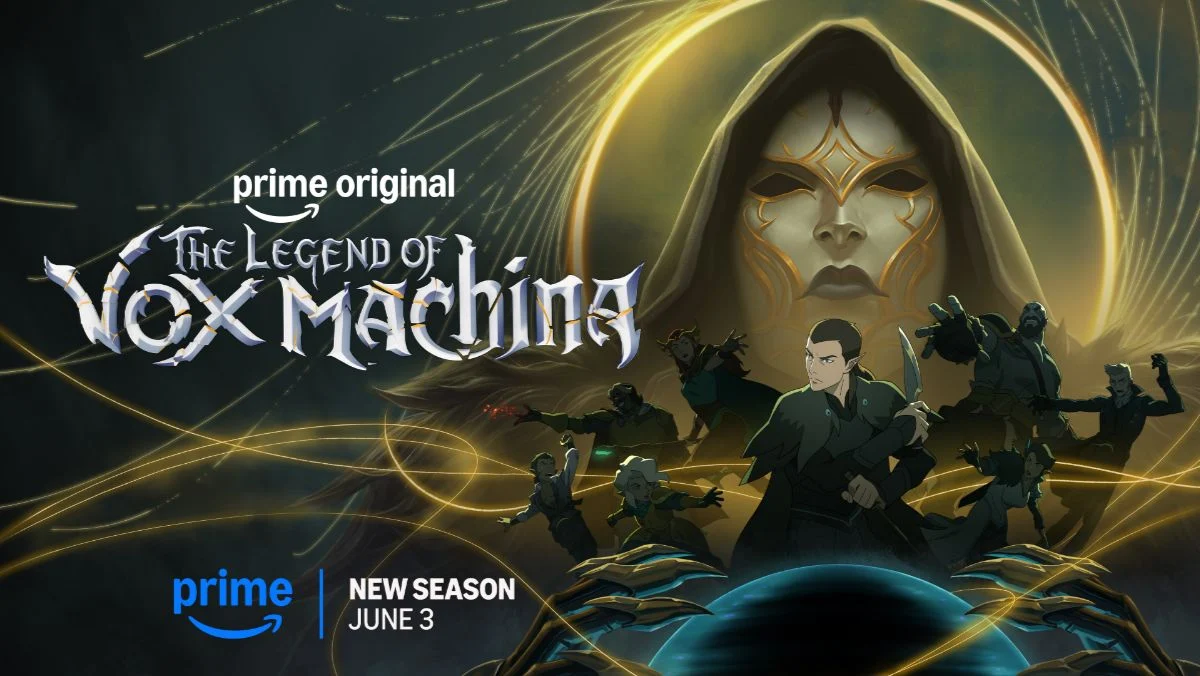

The Legend of Vox Machina is an adult animated fantasy series adapted from Critical Role’s debut Dungeons & Dragons campaign, produced by Titmouse, Inc. for Prime Video. Three seasons in, it has established itself as something genuinely rare: an adaptation that treats its source material as a set of characters to honor rather than a set of events to reproduce.
Season 4 opens one year after Vox Machina’s defeat of the Chroma Conclave, the sprawling dragon-fueled catastrophe that consumed much of the preceding two seasons. The team, now celebrities across Tal’Dorei (a condition nobody appears to have wanted), has scattered to various personal pursuits. Percy and Vex are settling into aristocratic life in Whitestone. Keyleth is completing her leadership trial. Grog and Pike are drinking. Scanlan is with his daughter. Beneath Whitestone Castle, meanwhile, something dark is fermenting in the ziggurat below.
This is the penultimate season. Season 5 will close the show entirely. That knowledge gives Season 4 a particular gravity: the quiet moments carry the specific weight of things that are ending, and the looming presence of the Whispered One’s cult suggests that the ending, whenever it arrives, will be earned.
The Villain Vacuum: Freedom in the Absence of a Clear Enemy
For the first time in the series, Season 4 begins without a primary antagonist in the room. The Chroma Conclave is defeated; the Whispered One exists only in whispers and ominous portents. Fantasy storytelling, which tends to organize itself around escalating threats the way a pyramid organizes itself around its apex, does not usually know what to do with a moment like this. The Legend of Vox Machina does.
The writers use the vacancy deliberately. Rather than manufacturing tension through a placeholder threat, the early episodes allow Vox Machina to disperse and simply exist. The show catches up with each member individually before the gravity of something new pulls them back together. The reunion carries genuine emotional weight precisely because the separation was given room to mean something. Television pacing is a discipline many prestigious series have conspicuously failed, and Season 4 handles it with unusual confidence.
What follows is the show’s most tonally diverse run to date. Episode 5 is a full-scale heist, Ocean’s Eleven by way of high fantasy, complete with its own bespoke opening credits sequence. It is chaotic, precise, and very funny. Episode 7 is something else entirely: a haunted house mystery in which each character is isolated in a room constructed around their specific psychological vulnerabilities. It is genuinely chilling and rewards rewatching for the precision of its construction.
The arrival of the Whispered One’s cult pushes deeper still, into sacrificial ritual and body horror, territory that sits at the grimmer end of fantasy’s spectrum. Here is the season’s defining quality, what might be called its “tonal elasticity”: the ability to shift between comedy, horror, heist, and high fantasy within a single season without the seams showing. The humor does not puncture the dread; the horror does not swallow the warmth. The show has accumulated enough craft and viewer trust across four seasons to pull this off cleanly.
Twelve episodes, none of them wasted. The season front-loads character work, experiments through its middle section, and converges on a finale that positions Season 5 as a genuine reckoning. Significant departures from the source tabletop campaign are scattered throughout, and will unsettle dedicated Critical Role fans expecting a faithful adaptation while delighting everyone else. The cliffhanger ending is daring to the point of cruelty. That is a compliment.
Who Are You When No One Needs Saving?
Splitting an ensemble for a significant portion of a season is either a narrative risk or the show’s most sophisticated structural decision, depending on your perspective. In Season 4’s case, it is almost certainly both, and the tension between those readings gives the season much of its texture.
By separating its cast, the show trades ensemble chemistry for individual interiority. These characters are seen as they are when they are not performing heroism for each other, or for the adoring public of Tal’Dorei. The results are, without exception, illuminating.
Keyleth and Vax carry the season’s primary emotional burden. Keyleth’s arc builds toward her Aramenté leadership trial, including an underwater sequence of genuine visual inventiveness, but the real drama is quieter. Vax, bound to the Raven Queen by a covenant that increasingly resembles a countdown, is diminishing. Marisha Ray and Liam O’Brien carry the full weight of anticipatory grief, which is its own distinct and particularly terrible category of mourning, separate from the grief that arrives after loss. You have not lost the person yet. You have lost the certainty of keeping them. Season 4 understands this distinction, and it is a devastating one.
Pike and Grog deserve their own paragraph.
Their storyline is the season’s emotional anchor. Pike, the group’s healer and moral compass in better times, is spiritually adrift: her connection to the Everlight has eroded under the accumulated weight of resentment and exhaustion. Ashley Johnson delivers what may be the finest work she has done in the series. Travis Willingham’s Grog, meanwhile, pulls off something quietly extraordinary. In a season populated by complicated people making complicated decisions for complicated reasons, this large, not especially cerebral barbarian becomes the clearest moral voice in the ensemble. His instinct for right and wrong, unclouded by self-interest or philosophical second-guessing, starts to read less like simplicity and more like a form of wisdom his companions have educated themselves out of. There is a long tradition of this figure in literature (the holy fool, the court jester who speaks plainest truth), and Grog inhabits it without any apparent awareness that he is doing so.
Vex and Percy provide the season’s more sardonic thread. Wearing both celebrity and aristocracy with equal discomfort, they map onto a recognizable modern predicament: the achievement turns out not to look like what it promised from the outside. Taliesin Jaffe’s Percy remains one of the series’ most layered figures, a man of considerable intellectual sophistication who is constitutionally ill-suited to contentment.
Scanlan is largely absent, and the gap is real. Sam Riegel’s bard is with his daughter Kaylie, a narratively coherent decision that leaves a hole in the group’s chemistry the other characters work around without quite filling.
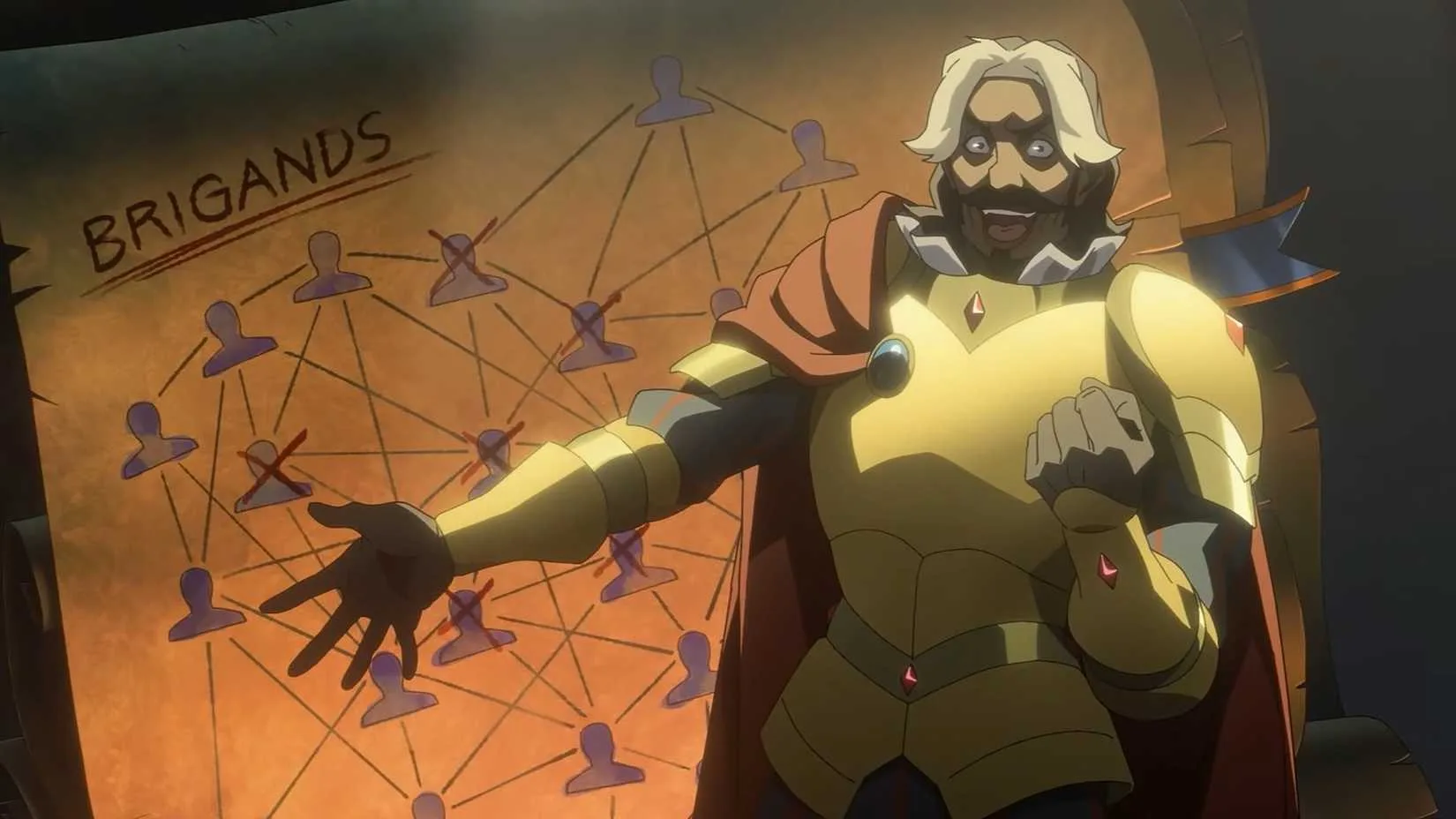
Wayne Brady voices Taryon Darrington, an amateur adventurer, aspiring author, and self-appointed Vox Machina team member, accompanied by Doty, a mechanical scribe who documents his exploits with conspicuous creative liberty. Taryon is pompous, vulnerable, periodically insufferable, and entirely necessary. Brady differentiates the character sharply from Scanlan, giving Taryon his own comedic and emotional register rather than simply occupying a vacancy. His function is structural as much as comic: he arrives carrying an idealized image of Vox Machina that collides productively with who they actually are, and that collision drives some of the season’s best material. The dynamic between Taryon and Percy is a consistent pleasure.
Andy Serkis joins the voice cast in a role best left unnamed here. He brings considerable gravity, and his character’s full significance will be felt most keenly in Season 5.
The Weight of the Legend: Heroism, Celebrity, and the Grief That Walks Ahead of Loss
Season 4 is, among other things, a sustained examination of grief in its more complex forms. There is grief for those already lost; there is grief for those not yet gone; there is the particular, seldom-discussed grief of becoming a version of yourself you did not choose and are not sure you recognize. This is not light viewing. It is also consistently excellent.
Keyleth’s storyline channels anticipatory loss with the precision of something closely observed. The knowledge that Vax is being drawn away by forces beyond anyone’s control haunts every scene they share, lending even lighter moments a specific heaviness. This is grief as chronic condition: present, periodically managed, and periodically unmanageable.
Pike’s arc operates from similar roots. A healer who has spent years giving without reserve is finally confronting the cost. Her estrangement from the Everlight reads simultaneously as theological crisis and psychological exhaustion, the two registers indistinguishable from each other.
The larger question the season holds open is pointed: what does it mean to be a hero when the heroism is over? There is something recognizably contemporary in Vox Machina’s discomfort with their own celebrity, a condition that cuts across human history in patterns the show handles with quiet honesty. The gladiator between fights, the soldier returned from a war nobody discusses anymore, the athlete whose body no longer cooperates with the legend they are expected to embody: the gap between the public figure and the private person is ancient territory, and Season 4 charts it with unusual care.
Taryon’s arrival crystallizes the question. His uncritical idealization of Vox Machina is a mirror held up to people who have stopped looking at themselves clearly. The collision of expectation and reality is funny at first, and then it becomes something thornier and more interesting.
The season does not close this question. The show is saving the answer for Season 5, and the restraint keeps the tension appropriately alive.
The Art of Making It Look Easy
Titmouse, Inc. continues to produce animation of genuine quality and invention. The underwater sequences accompanying Keyleth’s Aramenté trial are a particular standout: fluid, complex, and attentive to the behavior of light in ways that animated television rarely bothers to be.
The horror episodes deploy a more austere visual language. Shadows are used architecturally. Creature designs lean into the uncanny rather than the spectacular, which is the harder choice and the more effective one. The action sequences are kinetic without becoming incoherent, a balance that consistently looks easier than it is.
The original voice cast, Laura Bailey, Travis Willingham, Taliesin Jaffe, Ashley Johnson, Sam Riegel, Marisha Ray, and Liam O’Brien, remain fully committed. The emotionally demanding arcs this season draw correspondingly stronger performances, particularly from Johnson and Willingham. Wayne Brady moves between broad comedy and genuine vulnerability without making the transition visible. Matt Mercer’s work as narrator and as various characters grounds the world with an authority earned through deep familiarity with the material.
The musical numbers earn their place. Grog’s recap song is hilarious and precisely calibrated. Taryon’s contribution is an earworm of real tenacity. Both pieces serve characterization above spectacle.
The Legend of Vox Machina is a critically acclaimed adult animated fantasy-adventure series produced by Amazon MGM Studios, Critical Role Productions, and Titmouse. Based on the first Dungeons and Dragons tabletop roleplaying campaign by Critical Role, the series follows a chaotic yet lovable band of misfits who evolve into heroes tasked with saving the realm of Exandria from dark, magical forces. The highly anticipated fourth season is scheduled to premiere on June 3, 2026, and will be available to stream exclusively on Prime Video with a three-episode weekly rollout.
Where to Watch The Legend Of Vox Machina season 4 Online




Full Credits
Title: The Legend of Vox Machina Season 4
Distributor: Amazon MGM Studios, Prime Video
Release date: June 3, 2026
Rating: TV-MA
Running time: ~27 minutes per episode
Director: Sung Jin Ahn
Writers: Brandon Auman, Sam Riegel, Travis Willingham, Liam O’Brien, Marisha Ray, Meredith Kecskemety, Eugene Son, Kevin Burke, Mae Catt, Chris Wyatt, Jennifer Muro, Suzanne Keilly, Marc Bernardin, Ashly Burch, Todd Casey, May Chan, Colleen Evanson, Marque Franklin-Williams
Producers and Executive Producers: Chris Prynoski, Shannon Prynoski, Ben Kalina, Brandon Auman, Laura Bailey, Taliesin Jaffe, Ashley Johnson, Matthew Mercer, Liam O’Brien, Marisha Ray, Sam Riegel, Travis Willingham
Cast: Laura Bailey, Taliesin Jaffe, Ashley Johnson, Matthew Mercer, Liam O’Brien, Marisha Ray, Sam Riegel, Travis Willingham, Wayne Brady, Kevin Michael Richardson, Debra Wilson, Tom Cardy
Editors: Todd Raleigh, Felipe Salazar, Tim Collins
Composer: Neal Acree, Sam Riegel, Peter Habib
The Review
The Legend of Vox Machina Season 4
Season 4 does what penultimate seasons rarely manage: it uses its transitional position as an asset rather than an excuse. By abandoning the formula of an immediate central villain, it creates space for character work that pays off with surprising emotional force. Taryon Darrington earns his place. Pike and Grog break your heart cleanly. The tonal range is ambitious and controlled. Some rough edges remain, primarily Scanlan's absence, but they are minor grievances against a confident, inventive season that arrives ready to set the table for what should be a superb finale.
PROS
- Exceptional character-focused storytelling across nearly every arc
- Bold genre experimentation within a single season
- Wayne Brady's Taryon Darrington is a genuinely inspired addition
- Ashley Johnson and Travis Willingham deliver career-best performances
- Visually inventive animation, particularly the underwater sequences
- Confident, unhurried pacing that trusts its audience
CONS
- Scanlan's reduced presence leaves a noticeable gap in ensemble chemistry
- The Whispered One remains more suggestion than presence for much of the season
- Shorter episode runtimes occasionally feel limiting for the material