































Deconstruction Simulator opens with a tutorial that doubles as your character’s origin story. After being sent to the wrong address by a negligent boss, you demolish an innocent person’s home and take the fall for the mistake. Fired and humiliated, you decide to start your own demolition company from scratch. The narrative disappears after this setup, which feels appropriate for the genre.
What remains is a satisfying loop of accepting contracts, reducing structures to rubble or carefully dismantling them piece by piece, and managing the financial logistics of your growing business. Two modes accommodate different play styles: Standard mode adds deadlines and budget constraints, while Relaxed mode lets you focus purely on destruction. The physics-driven demolition feels genuinely cathartic, and the business management layer gives your actions tangible consequences.
How Destruction Becomes Routine (and Why That’s Half the Point)
Every morning begins at your computer, where three demolition contracts await selection. A fourth, higher-tier job appears locked behind permit requirements. Each contract outlines specific tasks: level an entire structure, remove particular walls, relocate furniture between rooms, or salvage designated items into the client’s rental van.
Job descriptions provide brief flavor text that adds personality to what could feel like pure busywork. Contracts span one to five in-game days, and your workday ends at 6 PM when darkness falls and your inadequate flashlight makes further progress nearly impossible.
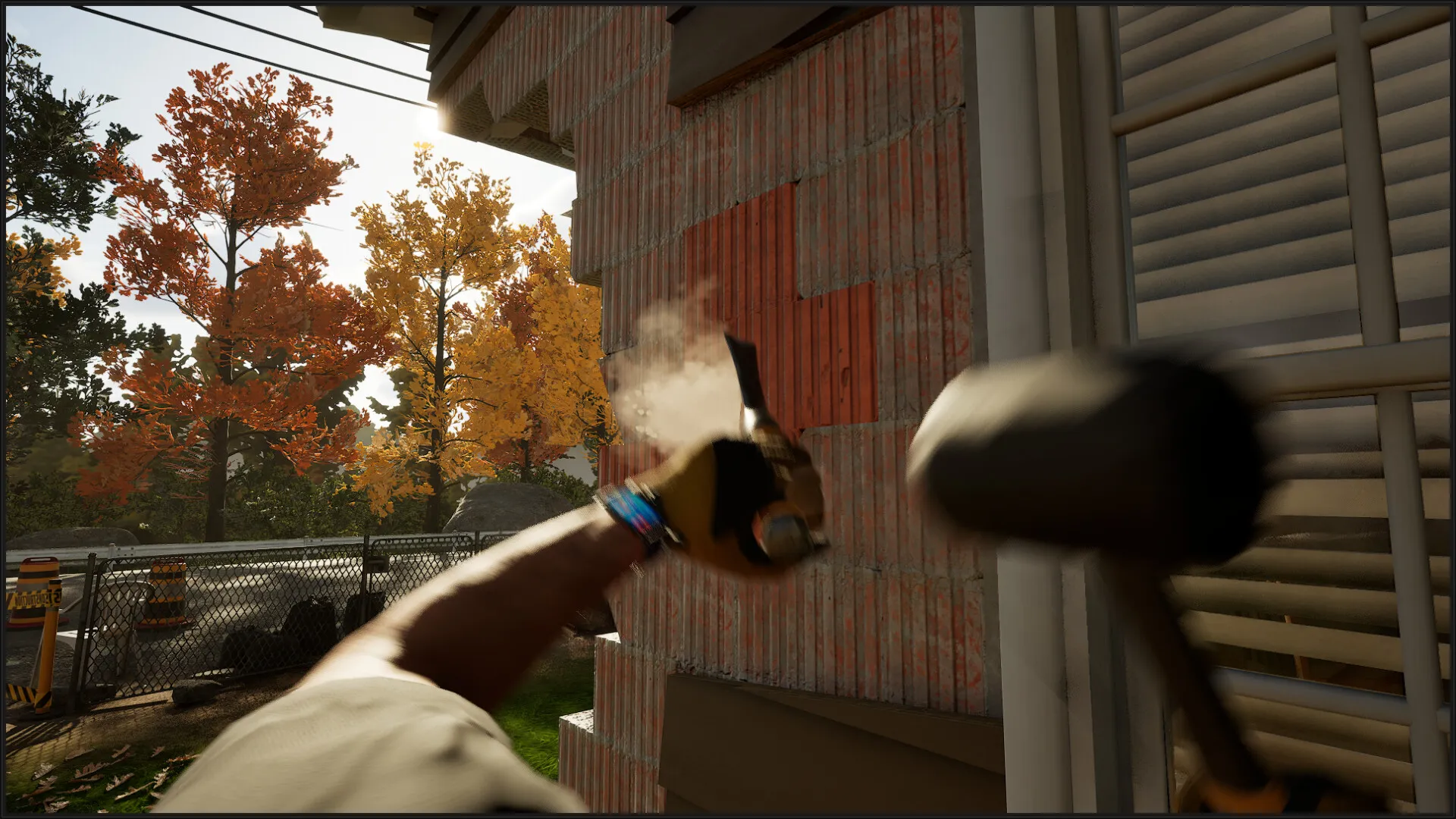
The sledgehammer serves as your primary tool, requiring multiple swings to break through walls and fixtures. Each impact produces satisfying dust clouds and reveals the structural framework beneath plaster surfaces. The feedback feels solid, though the lack of upgrade options for this essential tool becomes frustrating over dozens of hours of repetitive clicking.
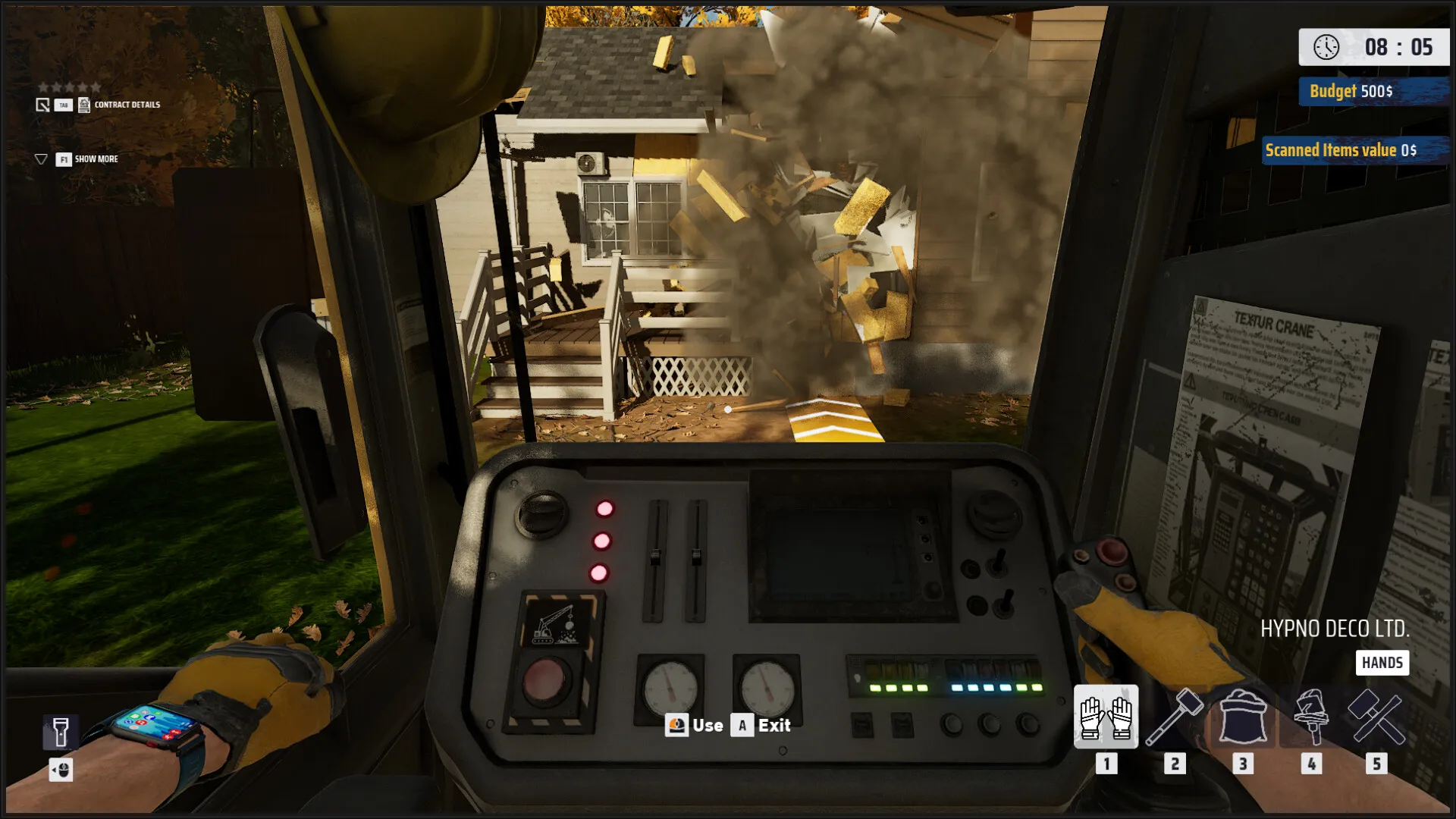
The wrecking ball crane offers a dramatically different approach. Renting this equipment for $600 transforms demolition into spectacle, letting you level entire houses in under a minute. The cost creates meaningful tension: many contracts pay $600 or less, meaning crane rental consumes your entire profit margin. The ball also destroys everything indiscriminately, obliterating valuable salvage you could have collected manually.
Manual dismantling represents the third path. Unscrewing hinges and brackets, carefully removing doors and windows, boxing up kitchen fixtures one piece at a time. This methodical approach preserves item condition for later resale. The game establishes compelling friction between these three philosophies: raw efficiency, dramatic spectacle, or careful resource extraction.
Everything can be salvaged: furniture, appliances, wooden beams, bricks, entire plaster wall sections, windows, doors. You’ll load these items into your van for transport back to the warehouse. The vehicle’s limited capacity turns loading into an exasperating puzzle. Items cannot rotate on all three axes, preventing obvious solutions like laying drywall slabs flat. The physics system sometimes treats furniture like bouncing rubber balls, causing carefully arranged cargo to explode across your van interior.
The recycling system introduces a perverse incentive. Smashed debris can be bagged and transported home for automatic collection at day’s end. Recycling consistently generates better income than carefully preserving items for eventual resale. This completely undermines the intended decision between destruction and preservation. Why spend twenty minutes delicately dismantling a kitchen when smashing everything pays better and finishes faster?
Running a Business Where Nothing Adds Up
Managing your demolition company reveals economic systems that range from clever to completely broken. Operating costs include fuel, daily warehouse expenses, tool purchases, and equipment rentals. The price relationships feel arbitrary: a crowbar costs $1,000 while a complete house demolition contract pays $600. These disparities create situations where accepting certain jobs means guaranteed financial loss.
The three daily contracts vary wildly in compensation. One might offer $100 while another promises $1,100 for similar work. You can skip unprofitable days entirely by absorbing the warehouse cost. This flexibility helps mitigate the worst economic imbalances.
Your warehouse serves as central hub and storage facility. You can purchase additional shelving to organize salvaged materials, though you must first expand the warehouse footprint. Larger vehicles become available, allowing bigger hauls and reducing tedious trips.
The sales system feels unnecessarily restrictive. You cannot directly sell your stockpiled inventory. Instead, specific orders appear on your computer, requesting exact items and quantities. If you happen to have these items, you can fulfill the order. More often, the requested items don’t match your current inventory. Toilets and copper pipes sit unused while buyers desperately seek chairs you haven’t encountered in six contracts. The game would benefit enormously from letting players set prices and list items directly rather than waiting for the algorithm to randomly generate matching orders.
Tool upgrades affect only operational speed and efficiency. The permit system gates access to larger properties, requiring you to complete a certain number of assignments before unlocking the next tier. Reputation requirements exist on paper but rarely matter in practice.
When Technology Actively Works Against You
The performance problems represent Deconstruction Simulator’s most damaging flaw. Testing on high-end hardware (RTX 5080, Ryzen 7 9800X3D) should guarantee smooth frame rates. Instead, intense destruction sequences cause frame rates to plummet to 20-30 FPS. DLSS support provides minimal relief, adding perhaps 10-20 frames without frame generation technology. These optimization failures become particularly frustrating when directly comparable games deliver superior visuals, more complex physics, and dramatically better performance.

The physics system creates most of the game’s satisfying moments. Watching structures collapse realistically, seeing walls crumble and studs revealed beneath. These elements work well. The problems emerge in how debris behaves after destruction. Broken pieces scatter explosively in random directions, forcing you to traverse entire maps collecting scattered debris. Structural elements sometimes remain suspended in mid-air after you’ve demolished everything supporting them.
Van loading physics compound transport frustrations. Items bounce unpredictably, treating solid furniture like weightless styrofoam. Carefully arranged cargo can explode into chaos from minor collisions.
Unreal Engine provides a competent visual foundation appropriate for the simulation genre. Environmental pop-in frequently occurs as landscapes load. The variety of building designs impresses, though seeing identical buildings appear in consecutive contracts breaks immersion.
Audio design represents a significant missed opportunity. No background music plays during demolition work. Hours of gameplay pass in near-total quiet, which becomes genuinely maddening during long sessions. The opening tutorial features voice acting so stiff it’s almost impressive, though this disappears quickly.
The bug list reads like a quality assurance nightmare. Items vanish completely from job sites after you leave and return. The game crashes frequently, particularly when adjusting settings or alt-tabbing. Settings reset unpredictably. Objectives sometimes fail to register as complete. The inventory system occasionally claims you lack items demonstrably sitting in your warehouse. These aren’t minor inconveniences but progress-destroying failures.
The Strange Pleasure of Digital Demolition
The core destruction feels phenomenal when it works. Swinging your sledgehammer through plaster walls provides genuine catharsis. The spectacle of wrecking ball demolitions delivers moments of pure visual satisfaction. Even the quieter moments of methodical dismantling offer meditative pleasure in reducing a structure to component parts through patient labor.
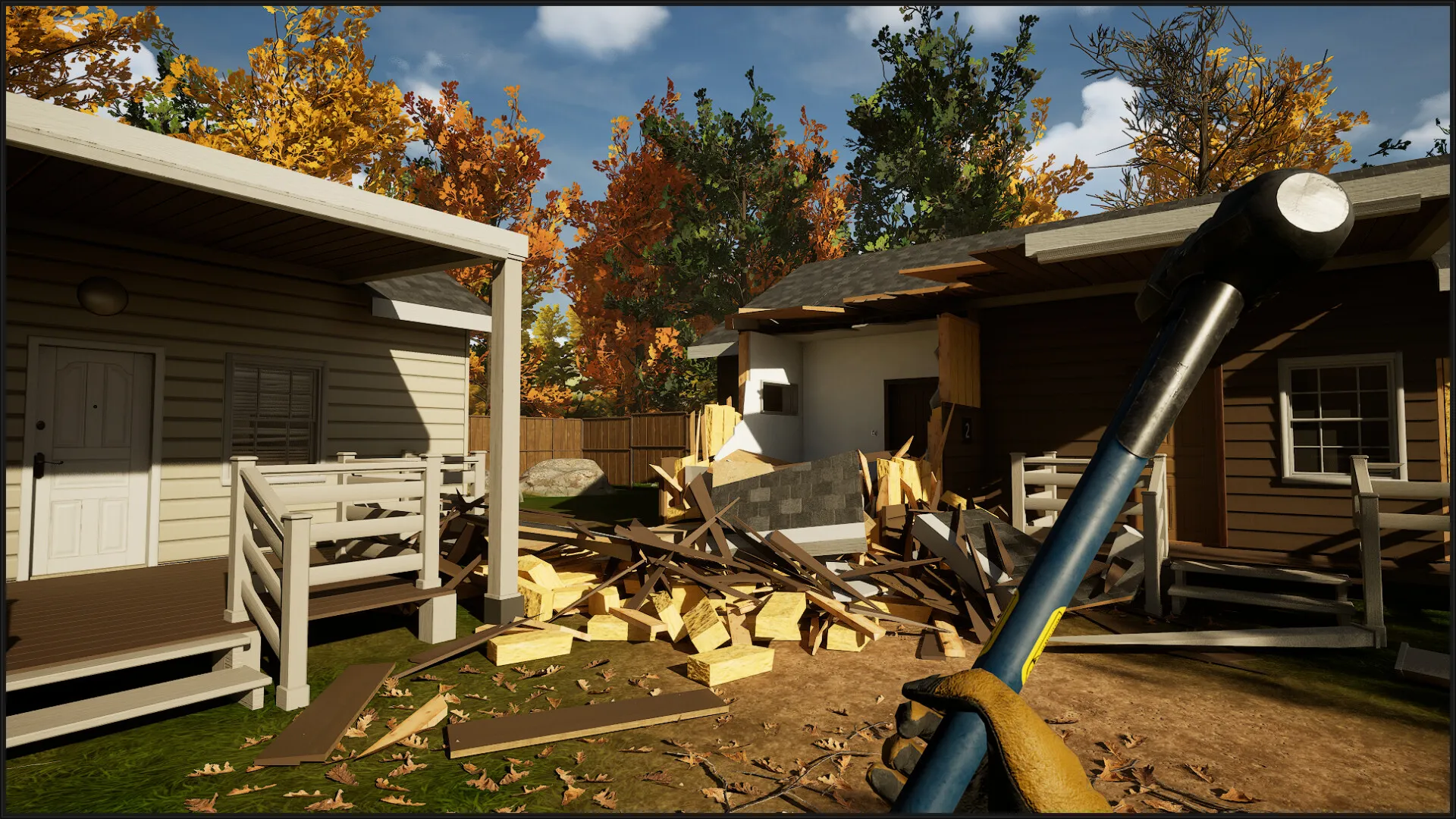
The frustrations accumulate just as consistently. Your character moves sluggishly, especially when carrying large objects. The same actions repeat across every contract: swing hammer, collect debris, load van, drive home. After 6 PM, poor lighting makes continued work impractical, arbitrarily ending your day. The van loading puzzle becomes genuinely infuriating when physics glitches scatter your carefully arranged cargo. Chasing debris across entire maps after explosive physics failures tests your patience repeatedly.
Pacing feels strange. Individual jobs can consume over an hour, yet stopping mid-task often isn’t practical. The gameplay works best in moderate doses: complete one contract, step away for days, return refreshed. Marathon sessions amplify monotony as you perform identical actions across multiple properties.
The engagement holds for a surprisingly long time despite these issues. The initial hours feel genuinely addictive. Even after 20+ hours, the core loop retains enough appeal to keep you playing. Eventually, though, repetition wins. The limited variety means you’re doing the same things in hour twenty that you did in hour two, just with more expensive equipment.
Who This Game Is Actually For
At approximately $20, Deconstruction Simulator prices itself fairly for the content offered. The question isn’t whether the price is reasonable, but whether you’ll tolerate the experience long enough to extract that value.
Simulator enthusiasts represent the core audience. The game demands patience for janky systems, acceptance of significant technical flaws, and tolerance for repetitive gameplay loops. Players seeking meaningful stories should look elsewhere.
The developers show genuine community engagement and passion for their work. This matters because the game desperately needs continued support. The core concept is solid. Underneath the performance problems, physics glitches, broken economy, and quality of life issues sits an 8/10 experience waiting to be excavated.
The current state creates a love-hate relationship with the material. The destruction feels genuinely satisfying when physics cooperate and performance holds steady. The core loop hooks you effectively enough to overcome serious technical obstacles. At the same time, every session brings crashes, vanishing items, frustrating economic decisions, and performance problems that shouldn’t exist.
This is a game to wishlist and monitor. For patient simulator fans willing to embrace jank as part of the experience, there’s fun to be found here right now. For everyone else, waiting makes sense. Let the developers address the optimization disasters, fix the progress-destroying bugs, and rebalance the economy. Your tolerance for broken systems will determine whether the time investment feels worthwhile.
The Review
Deconstruction Simulator
Deconstruction Simulator offers genuinely satisfying demolition mechanics wrapped in catastrophic technical failures. The core loop of smashing buildings and managing your business proves addictive despite broken economics, severe optimization problems, and progress-destroying bugs. Physics-driven destruction delivers real catharsis, while strategic choices between methods create engaging friction. However, crashes, vanishing items, and frame rate collapses undermine everything. Simulator enthusiasts with infinite patience might overlook these flaws, but most players should wait for substantial patches. There's a great game buried here, but it needs serious renovation work before recommendation.
PROS
- Satisfying physics-driven destruction with realistic building collapses
- Meaningful strategic choice between sledgehammer, wrecking ball, and manual dismantling
- Addictive core gameplay loop that hooks for 20+ hours
- Fair pricing at approximately $20
- Warehouse expansion provides tangible sense of business growth
- Impressive variety of building designs
CONS
- Catastrophic performance issues (20-30 FPS on high-end hardware)
- Progress-destroying bugs including vanishing items and frequent crashes
- Broken economy with arbitrary pricing and unprofitable contracts
- Debris scatters explosively, requiring tedious map-wide collection
- No background music creates maddening silence
- Restrictive sales system limits player agency
- Repetitive gameplay with no meaningful mechanical evolution
- Van loading puzzle frustrating due to rotation limitations