











AMC’s decision to rename its prestige vampire drama signals something deliberate and irreversible. The Vampire Lestat, the rebranded third season of what began as Interview with the Vampire, arrives as an adaptation of the second novel in Anne Rice’s Vampire Chronicles, and the title change is its most honest marketing move. The story’s gravitational pull has shifted from the brooding, self-lacerating Louis de Pointe du Lac (Jacob Anderson) to the mercurial, impossible-to-ignore Lestat de Lioncourt (Sam Reid).
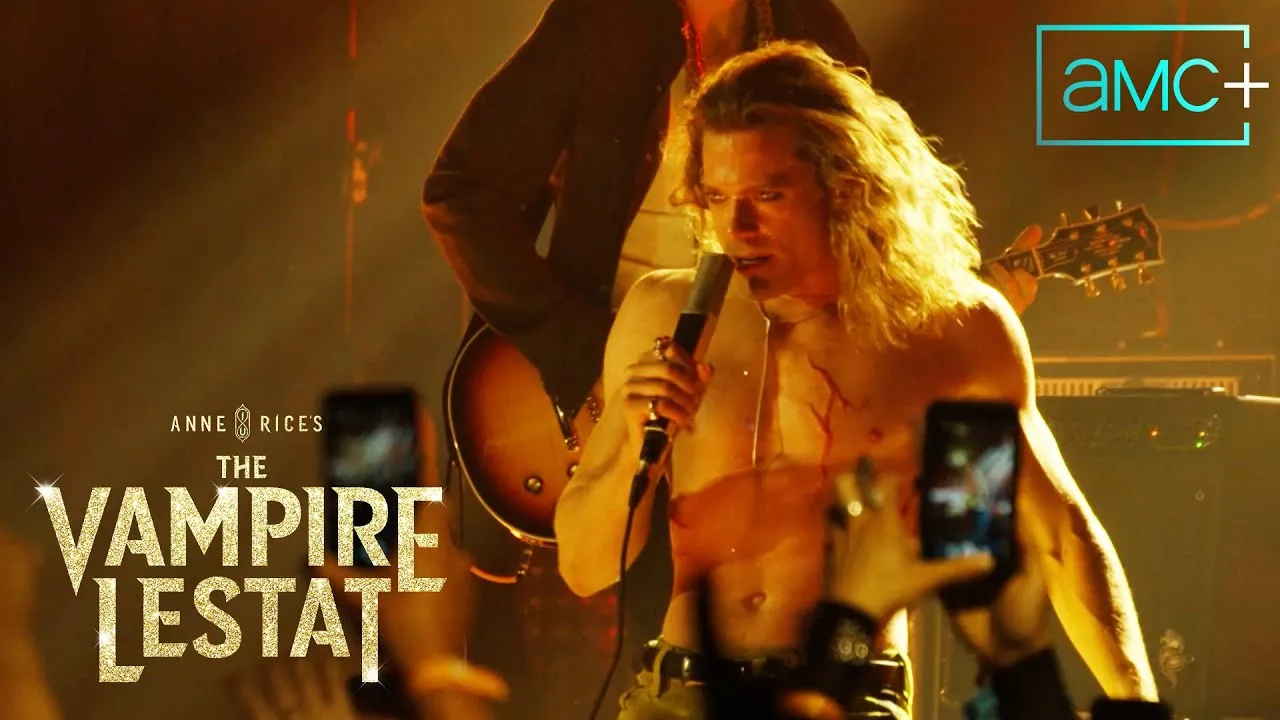
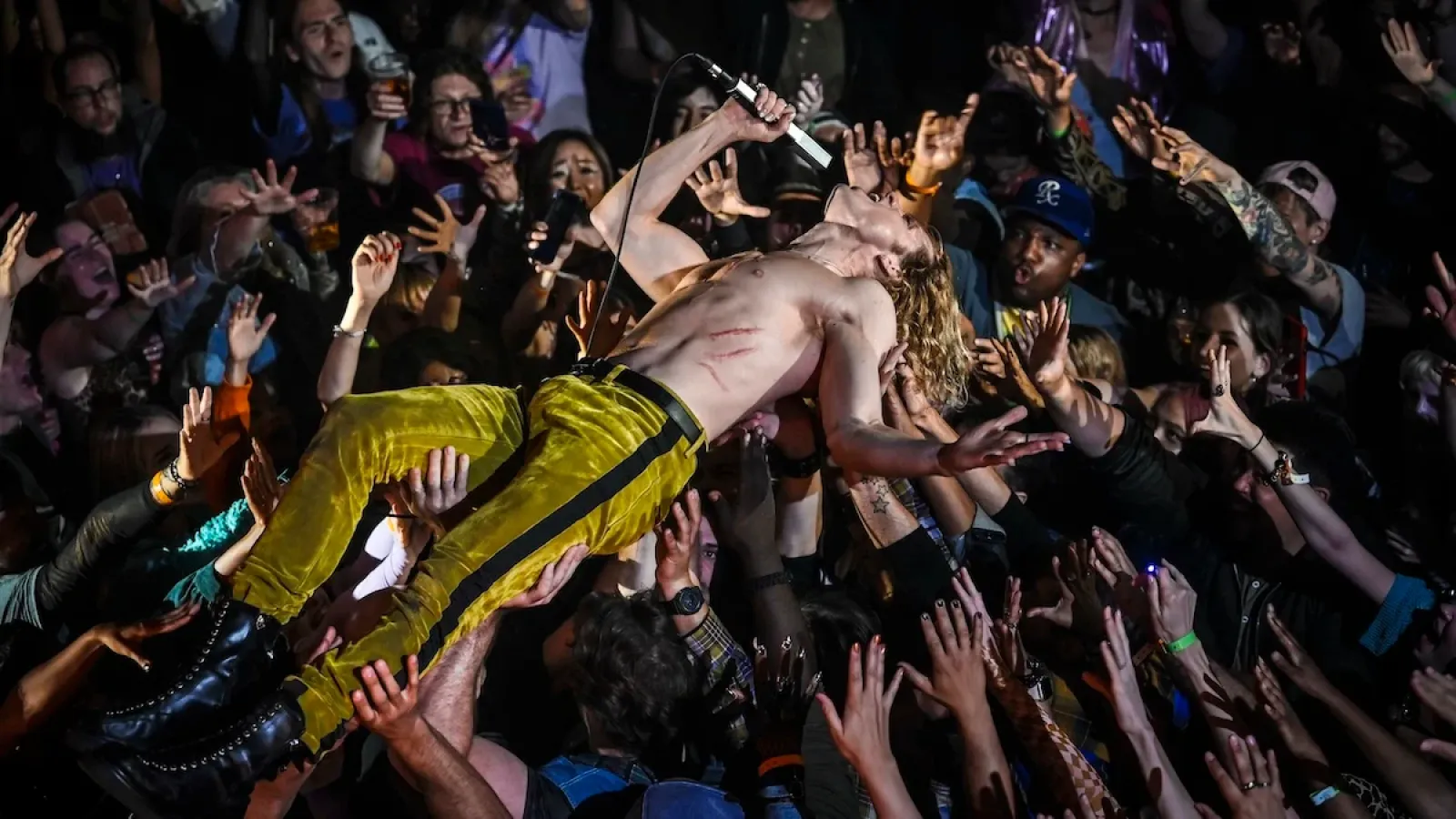
The inciting premise is deceptively simple: journalist-turned-vampire Daniel Molloy’s (Eric Bogosian) published account of Louis’s life enrages Lestat, who responds by muscling his way into a struggling rock band, renaming it after himself, and taking it on a North American tour. Where the first two seasons were formally structured, architecturally lush, and retrospective in their grief, this season is chaotic, campy, and driven by the sound of feedback and performance.
This is emphatically not an entry point for newcomers. The show assumes fluency in the world it has already built, and it has no intention of slowing down to accommodate anyone who hasn’t done the prerequisite viewing.
The Unreliable Vinyl
The season’s storytelling apparatus is its most formally adventurous quality, setting this chapter apart from anything the series has previously attempted. Lestat’s account arrives primarily through a collection of preserved vinyl recordings he has titled his “Failings,” intimate and crackling dispatches that function as a corrective autobiography. Where Louis’s formal interview carried the procedural weight of testimony, the “Failings” feel rawer and more combustible, a confessional that Lestat simultaneously controls and cannot fully contain. The precise origin of these recordings is left deliberately mysterious, generating an unsettling undercurrent throughout.
Running alongside the “Failings” is Daniel’s rock documentary, a sardonic second frame that captures Lestat in performance mode, the version of himself he has chosen to present to the world. The gap between what the recordings reveal and what Lestat performs for Daniel’s cameras is a constant source of dramatic irony, and the show mines it with precision.
The structural approach is radically non-linear. Episodes move without signposting between 18th-century France, the more recent horrors of the Théâtre des Vampires era, and the present-day tour circuit. Lestat is a slippery narrator: evasive, self-serving, prone to baroque tangents, and occasionally too chemically altered to maintain a coherent timeline. The show uses the ghosts that haunt him to surface truths he strategically omits, turning omission itself into a form of revelation. Certain scenes from prior seasons reappear from Lestat’s perspective, and the effect is quietly devastating. Memory does not lie exactly; it simply reframes, and the truth settles somewhere between exaggeration and ache.
The pacing mirrors its subject’s psychology. The early episodes are deliberately overwhelming, an assault of imagery and sensation that replicates the disorienting experience of being on tour. That intensity eases in the back half of the season, which may feel like a gear shift for those consuming episodes in one sitting; weekly viewers are likely to experience those quieter moments as breathing room rather than stall.
This is television that refuses second-screen consumption. There is no exposition designed to be absorbed while scrolling, no redundant recapping of what just happened. The show treats its audience as capable of active engagement, which in a streaming landscape engineered for distraction, reads as a genuine creative statement.
The Stage Is the Wound
Sam Reid’s performance this season is the kind that tends to go unrewarded by awards bodies, which have historically treated genre television as a lesser category. That institutional bias deserves naming, because what Reid does across seven episodes is extraordinary by any measure. He plays Lestat across multiple centuries and emotional registers simultaneously: strutting rock frontman, grieving ex-lover, damaged son, manipulative interviewee, and a child who never fully recovered from the violence of his earliest years. He sings all the songs himself, which matters enormously given how tightly the music is threaded into character psychology. The moments where Lestat’s carefully constructed persona fractures under the accumulated weight of his trauma are the season’s most affecting, and Reid handles those collapses with a precision that makes them feel inevitable rather than engineered.
The band provides necessary human texture. Lead guitarist Larry (Noah Reid), rhythm guitarist Alex (Seamus Patterson), bassist Salamander (Ryan Kattner), and drummer TC (Sarah Swire) are mortals on a tour they cannot fully comprehend, and their presence keeps the supernatural excess grounded in something recognizable. The tour world itself is rendered in full sensory extravagance: the bus, the green rooms, the afterparties. Lestat’s lawyer Christine (Jeanine Serralles) occupies an entertainingly contradictory position, equally likely to join the chaos as to be found professionally managing its aftermath.
Composer Daniel Hart’s contribution to the season cannot be overstated. His work transforms the show into something approaching a visual album, in which each song functions as a targeted excavation of a specific wound from Lestat’s past. Songs reference his violent turning at the hands of Magnus (Damien Atkins), his formative and doomed relationship with Nicolas de Lenfent (Joseph Potter), his unresolved grief over Claudia’s death, and his endlessly complicated dynamic with Louis. The music is better than any reasonable expectation would predict: catchy and emotionally precise, with tracks already available to stream.
The show makes meaningful distinctions between the songs Lestat writes to provoke, those that function as tributes or elegant deflections, and the rarer, more devastating compositions that escape him before he can shape them into something manageable. The latter category is where the season truly lives.
Everyone Is Haunted
Louis de Pointe du Lac arrives in Season 3 in a more self-possessed state than in prior outings, which makes what happens to him all the more effective. His original arc pulls him into psychological territory that is both chilling and genuinely heartbreaking, and Jacob Anderson handles it with the quiet, controlled intensity the role has always demanded. Anderson and Reid’s scenes together in the back half of the season are among the finest the show has produced, built around shared grief over Claudia and the ways her death permanently altered the architecture of their relationship. These are two actors who have spent three seasons learning to occupy the same space, and it shows.
Eric Bogosian’s Daniel Molloy has been transformed by vampirism into something even more acidic than before. His baby-vampire status adds new layers of comedy and dramatic friction: a character who has always been defined by his refusal to be impressed now confronting an existence that should, by all logic, impress him enormously. Armand’s (Assad Zaman) return to warn Daniel about the professional and existential risks of aligning himself with Lestat arrives loaded with unresolved accountability, and the question of how much trust a 500-year-old vampire earns through a history of manipulation is one the show declines to answer neatly. Zaman generates chemistry with essentially every cast member he encounters, which remains one of the show’s most reliable pleasures.
Gabriella (Jennifer Ehle) is the season’s most formally challenging presence. Lestat’s mother, his fledgling, his sometime-lover: the show does not soften the incestuous dimension of their relationship, choosing to treat it as tragic and deeply disturbing rather than provocative window dressing. Ehle toggles between glacial fury and theatrical excess with genuine skill, holding her own against Reid at his most unhinged. The season’s most significant limitation is structural: because everything is filtered through Lestat’s perspective, Gabriella’s interior life remains largely opaque, which is both a deliberate formal choice and a missed opportunity.
Delainey Hayles’s return as Claudia takes a shape too good to spoil, and Sheila Atim’s Akasha is a performance that quietly dismantles whatever expectations viewers may have carried in with them.
The Monster Remembers Itself
The tonal range of The Vampire Lestat is one of its most striking and deliberate qualities. The season functions simultaneously as a rock documentary parody, a supernatural thriller, a dark comedy, and an emotionally devastating character study, holding all of these registers without collapsing under the weight of any one of them.
Cultural references arrive at a dizzying pace: Reddit, Joey Chestnut, Taylor Swift, Florence Welch, algorithmic culture, and the particular exhaustion of living inside contemporary American information chaos all earn their place in Lestat’s commentary. Placing a vampire rock star inside a MAGA-era media landscape and treating the absurdity as both satirical and entirely logical is precisely the kind of cultural move that distinguishes prestige horror from mere genre spectacle.
The thematic architecture beneath the excess is built on memory’s treachery, the franchise’s central preoccupation from its beginning. What the show adds this season is a sustained examination of loneliness as a structural condition of immortality: no quantity of adoring fans fills the void Lestat carries. His arc is about the unsustainability of deflection as a coping mechanism, the accumulated weight of traumas that have never been processed, only performed around. The tension between the self one constructs for public consumption and the self that refuses to stay buried drives every significant scene.
Showrunner Rolin Jones draws from multiple novels in Rice’s Vampire Chronicles, incorporating material from Queen of the Damned and Merrick alongside the titular novel, and the blending is handled with enough confidence that the seams are rarely visible. Timelines shift, character details change, pivotal moments are reimagined, and the emotional and philosophical spirit of Rice’s world is preserved throughout. A Season 4 tease suggests an expansion into broader supernatural territory, a signal that the show intends to keep reinventing itself as aggressively as its lead character insists on doing.
Interview with the Vampire Season 3, officially subtitled The Vampire Lestat, is a gothic horror and musical drama series developed by Rolin Jones based on Anne Rice’s bestselling novel. The highly anticipated rock-and-roll-centric season is set to premiere on June 7, 2026. Resentful of his portrayal in Daniel Molloy’s trashy bestseller, the vampire Lestat de Lioncourt decides to set the record straight the only way he knows how—by starting a rock band, dropping original tracks like “Long Face,” and going on a multi-city tour that triggers a massive, unnatural surge in the global vampire population. The series will be available to stream exclusively on AMC and AMC+.
Where to Watch The Vampire Lestat Online










Full Credits
Title: Interview with the Vampire Season 3: The Vampire Lestat
Distributor: AMC, AMC+
Release date: June 7, 2026
Rating: TV-MA
Running time: 1 hour
Director: Craig Zisk, Levan Akin
Writers: Rolin Jones, Hannah Moscovitch, Jonathan Ceniceroz, Kevin Hanna, Anusree Roy, Ryan Kattner, Anne Rice
Producers and Executive Producers: Rolin Jones, Mark Johnson, Alan Taylor, Anne Rice, Christopher Rice, Mark Taylor, Jessica Held, Adam O’Byrne, Tom Williams
Cast: Sam Reid, Jacob Anderson, Eric Bogosian, Assad Zaman, Delainey Hayles, Jennifer Ehle, Christopher Heyerdahl, Sheila Atim, Joseph Potter, Noah Reid, Ryan Kattner, Seamus Patterson, Sarah Swire, Damien Atkins, Ella Ballentine, Jeanine Serralles
Director of Photography (Cinematographer): David Tattersall, Jesse M. Feldman, Stuart Howell, Earle Dresner
Editors: Adam Penn, Christopher Nelson, Leo Trombetta, Tyler L. Cook
Composer: Daniel Hart
The Review
The Vampire Lestat
The Vampire Lestat is television that earns its ambition. Sam Reid's performance alone would justify the season's existence, but the show surrounds it with formal invention, genuine musical artistry, and an ensemble firing on every cylinder. It is chaotic by design, demanding by preference, and occasionally uneven in its pacing. For viewers willing to meet it on its own terms, it delivers something rare: a prestige drama that keeps genuinely surprising you.
PROS
- Sam Reid's career-best, multi-layered performance
- Daniel Hart's music functions as genuine character storytelling
- Bold, formally inventive narrative structure
- A strong ensemble with no weak links
- Tonal range that spans comedy, horror, and tragedy without losing coherence
- Culturally sharp, satirically aware writing
CONS
- Inaccessible to newcomers without prior season knowledge
- Gabriella's interior life remains underdeveloped
- Early episode pacing may overwhelm some viewers
- The short season run leaves certain storylines feeling compressed